
Disclaimer: Vox Populi, IIT Kanpur, is the exclusive owner of the information on this website. No part of this content may be duplicated, paraphrased, or interpreted in any other way without written consent from Vox Populi. If you want to reproduce any of the content on this page, please contact our chief editors directly or reach out to us by email at voxpopuli@iitk.ac.in.
As part of the Campus History series, this installment documents the significant protests and agitations that occurred at IIT Kanpur from its inception to the year 1984. Beginning with the first student strike in 1969, the institute witnessed a succession of events that shaped its administrative, social, and cultural fabric. Together, these episodes offer a historical perspective on the evolving dynamics of campus life during IIT Kanpur’s formative years.
1969: The First Student Strike at IITK
The first student strike in IIT Kanpur’s history occurred in 1969, lasting a day or two. It was led by Anil Agarwal, then President of the Student Gymkhana, who later became a prominent environmentalist. The strike stemmed from multiple grievances, including perceived preferential treatment of American faculty members’ children and growing anti-U.S. sentiment due to the Vietnam War. Additionally, some postgraduate students with Naxalite sympathies fueled discontent by writing slogans like “Chairman Mao is our chairman” on campus roads. When these students were made to scrub the slogans off, it further aggravated tensions.
The immediate trigger, however, was an altercation between a student named Kapoor and the accounts department. Kapoor, facing expulsion due to poor academic performance, claimed he was mistreated by the administration, dramatically displaying a torn shirt with shoe marks. Seizing the moment, Anil Agarwal delivered a fiery speech, rallying students and leading the strike. Classes were boycotted for two days, marking the beginning of organized student activism at IIT Kanpur.
A second wave of student unrest followed in the summer of 1969 when students demanded the postponement of their mathematics exam after the death of India’s President, Dr. Zakir Hussain, as the government had declared a seven-day mourning period. The administration allowed students to choose between taking the exam immediately or after the summer break. Some students who took the exam as scheduled benefited from lenient grading, while those who postponed it faced a tougher test.
1970: The Keating Protest – An Alarm Clock for the US Ambassador
In 1970, as tensions between India and Pakistan rose in anticipation of the Bangladesh Liberation War, Indo-U.S. relations also became strained. Nixon (then President of the U.S.) and Kissinger (then National Security Advisor) firmly backed Pakistan. Meanwhile, at IITK, Kanpur Indo-American Program (KIAP) was coming to an end, further complicating the campus’ view of the US.
It was against this backdrop that Kenneth Keating, the US Ambassador to India, announced a visit to IIT Kanpur. His timing was unfortunate. Just days before, Indira Gandhi had traveled to the US to meet Nixon. By diplomatic protocol, Ambassador Keating was expected to be at Palam Airport to see her off. However, he was absent—this was seen as an affront that made front-page news. Keating claimed it was a misunderstanding and that his alarm clock had failed to ring, and he had overslept.
This incident became the centerpiece of student protests when Keating arrived at IITK. As a symbolic gesture, some students planned to present the Ambassador with an alarm clock—a sharp jab at his diplomatic misstep. It remains unclear whether the protesters managed to hand him the clock, but there were national news stories on the protest at IITK and the clock.
Ironically, Keating was later revealed to be a big supporter of India. During the 1971 Indo-Pak war, he sent secret cables to Washington criticizing the Nixon administration’s pro-Pakistan stance, arguing that it harmed U.S. credibility. For his defiance, Nixon branded him a traitor and removed him from his post.
Reflecting on the incident, some IITK students later wondered whether they had been too harsh on Keating.
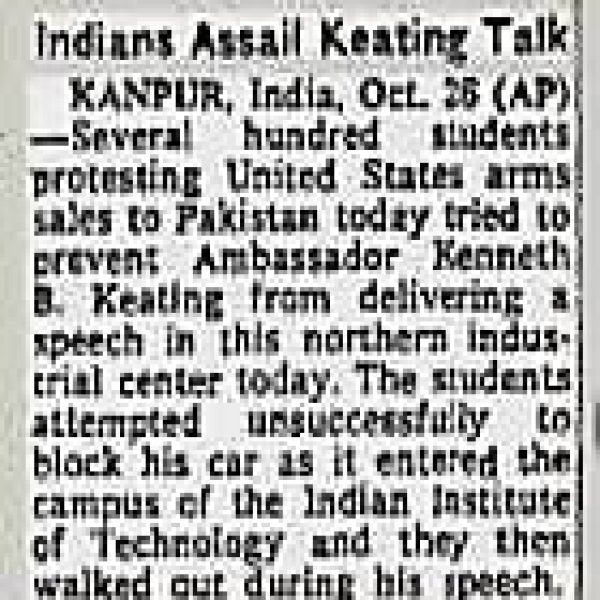
From The New York Times archives, Oct 27, 1970
1971: The First Karamchari Strike
In October 1971, IIT Kanpur witnessed its first-ever karamchari (worker) strike. At that time, nearly 700 workers remained on daily wage contracts despite meeting the criteria for permanent employment. Also, the permanent workers had no fixed norms for regularizations, promotions, or any incentives. After repeated failed negotiations with the administration, the IIT Kanpur Karamchari Sangathan launched the strike, effectively bringing campus operations to a standstill. For three days, 25-27 Oct,1971, there was a complete blackout on campus as electricity and water were shut off. This disruption forced the students and the faculty to take notice, drawing them into the ongoing struggle. The agitation persisted for two years before the matter was finally resolved.
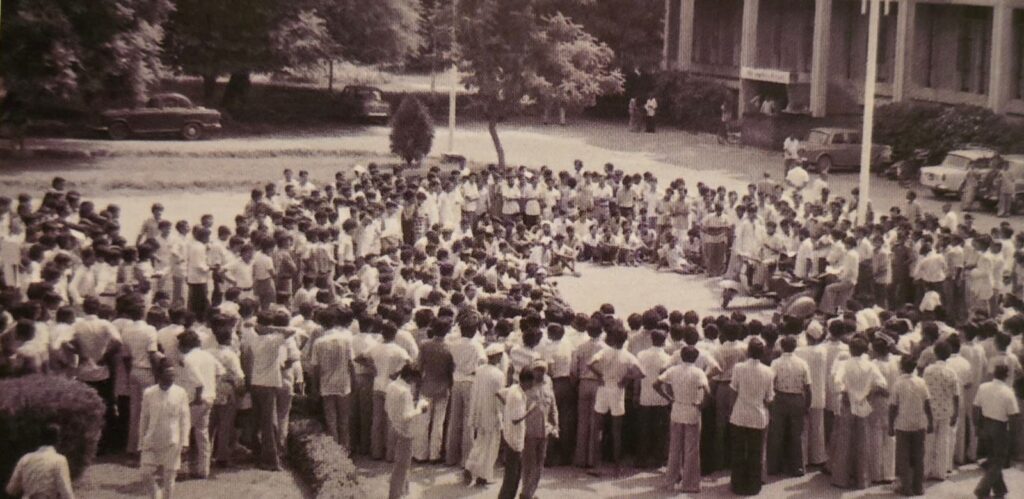
A view of Karamchari Dharna at Vijay Chowk
Winter 1974: Student Protest Over Medical Negligence
On October 30, 1974, V.N.R. Sharma, a postgraduate student, passed away due to delayed medical attention at the Health Centre. The on-duty doctor was absent, and the Health Centre’s telephones were out of order, forcing him to be carried around for nearly an hour in search of medical help.
Outraged students boycotted classes the next day and launched a relay hunger strike. Protests were organized, silent processions were held, and the press was informed. Students demanded the resignations of both the Chairman of the Board of Governors (BoG) and the Director, holding their internal conflicts responsible for institutional inefficiencies.
The Teachers’ Forum eventually backed the students with a silent procession led by the Convener of the Academic Senate, marking their support. Under mounting pressure and central government intervention, Dr. Zaheer (Chairman of the BoG) resigned on November 8, 1974, when a student delegation, along with a faculty representative, met him in Hyderabad. Director Dr. Muthana had already agreed to step down if the Chairman did.
What set this IITK’s strike apart was its highly organized, non-violent approach and justified demands, at a time when student protests across the country were often marked by violence.
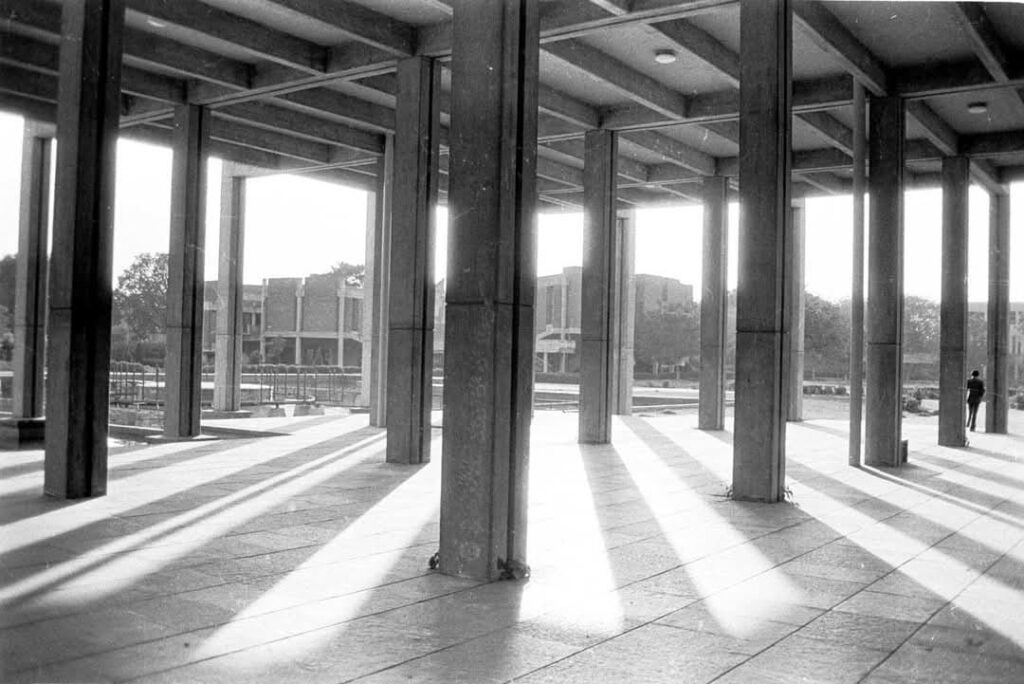
Entrance to the central library (now P.K. Kelkar Library) where relay hunger strike took place
September 1978: Protest Against Appointment of DOAA
In September 1978, IITK students staged a two-day protest against the appointment of the Dean of Academic Affairs (DOAA) without any student consultation. This move was seen as part of a larger effort to sideline student participation in institutional decisions, disregarding the strong track record of student responsibility.
Led by Student Gymkhana President Suresh Lodha (now a Professor of Computer Science at UCSC) and Student Senate Convener Sanjeev Bhargava (formerly a Professor at IIT Kanpur), the Gymkhana organized a silent procession and a two-day class boycott. The protest opposed both the creation of the DOAA post and the appointment of Dr. M.M. Oberoi as the first DOAA.
Though the appointment was not reversed, the protest was a significant assertion of student rights, reinforcing the demand for student consultation in key administrative decisions.

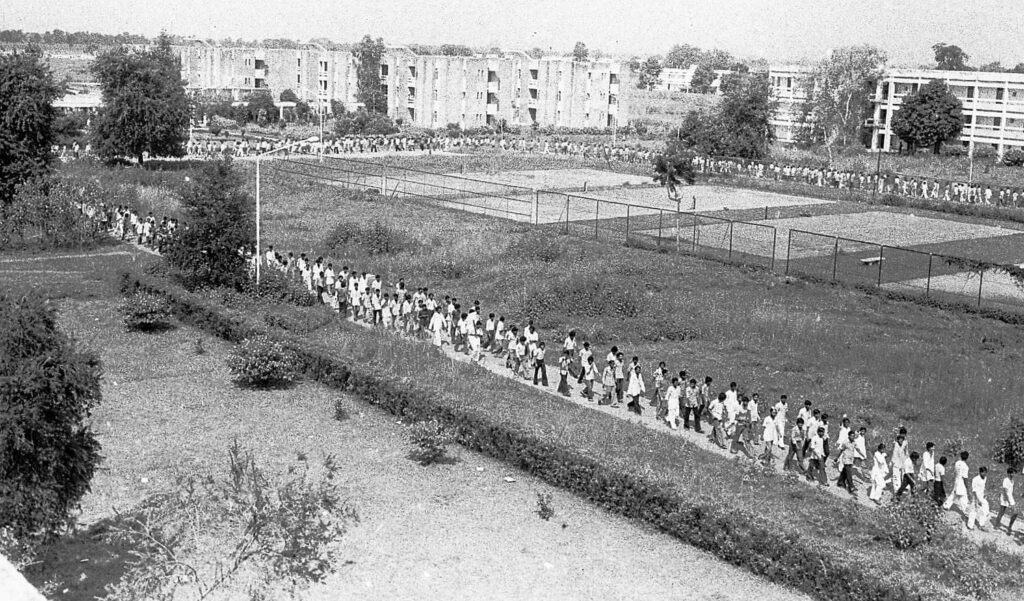
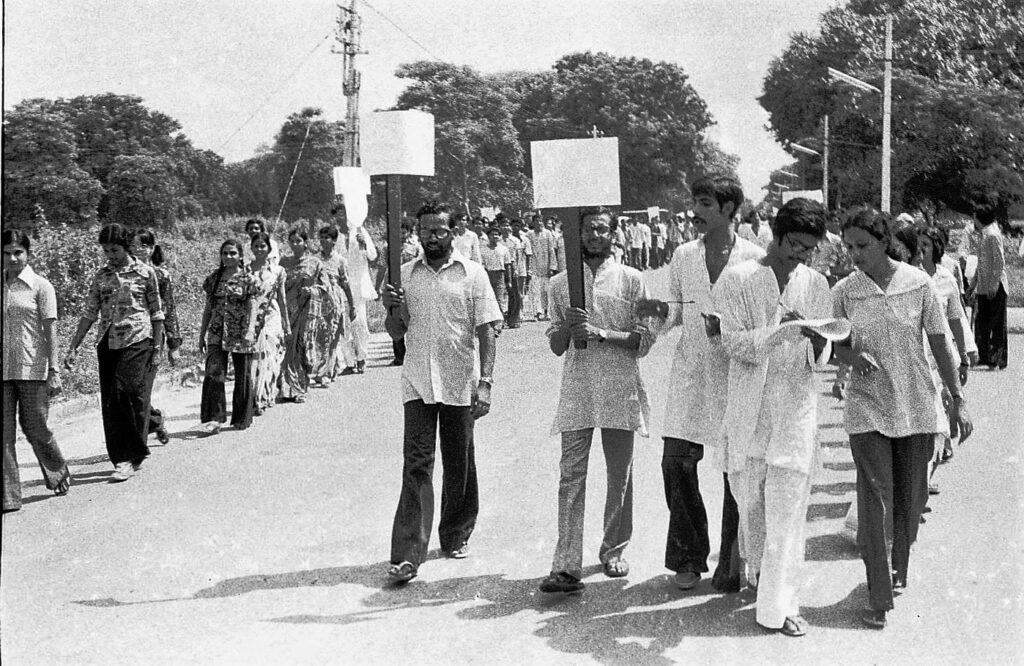
Leading the procession are (L to R): Sanjeev Bhargava, Suresh Lodha, Vijay Saraswat, Piyush Gupta, Anjali Joshi
1979-80: Administrative Turmoil and Student Protest
In 1979, Director Dr. A. Bhattacharya suspended Registrar Mr. Giriraj Kishore and Campus School Principal Mr. J.N. Matto. However, when Mr. Matto was reinstated by the Visitor (the President of India) without consulting the Institute authorities, Director Bhattacharya and Chairman of the Board of Governors, Mr. L.M. Thapar resigned in protest in January/February 1980. Following their resignations, all Deans, Deputy Director Dr. N.C. Nigam, and several BoG members also stepped down. Subsequently, Dr. P. Venkateswarlu was appointed as Acting Director and Chairman BoG.
In the same year, student protests erupted due to misconduct by some Hall V mess workers. This led to the establishment of the R.N. Biswas Committee on mess management in March/April 1980.
Summer 1980: Campus Violence and Security Reforms
On the night of June 19-20, 1980, a violent confrontation occurred in front of the library when a group, including Karamcharis and outsiders armed with security personnel’s ‘lathis’, assaulted students. Later that night, students heading to the GH to post notices condemning this attack were beaten by Karamcharis near the Director’s Residence. A couple of students who managed to escape this scuffle, helped in spreading news of this assault across the hostels, prompting a group of students armed with hockey sticks and curtain rods to intervene and save the few students who were still caught up. This escalated into a violent clash involving brick-batting, resulting in injuries on both sides. Police and PAC(Public Account Committee) were deployed to control the situation, and summer residents of Halls II and III were temporarily relocated to Hall V under police protection.
In response, students organized a relay hunger strike, but the Director struggled to mediate between the two sides. The conflict was eventually resolved with the suspension of one person from each group to maintain ‘balance’. A court case filed by the State Government on the basis of FIRs was later dismissed in April 1982 due to expiration of the time limit.
This incident ultimately led to the establishment of the Institute’s security section and the addition of a proper gate to control entry from G.T. road to prevent similar occurrences in the future.
1980-81: The Hall III Mess Crisis and Karamchari Strike
In September 1980, a misappropriation of over ₹52,000 from the Hall III Mess funds pushed it to the brink of closure, with only two days’ worth of food left by the 16th of September. Despite repeated requests from the Hall Executive Committee (HEC), no oversight had been maintained on the accounts. The situation worsened when Satish, the de facto Comptroller General, tragically passed away in a swimming pool accident in May 1980, with the missing funds unaccounted for. The mess managed to survive through loans and an institute grant.
In October 1980, Mr. R.N. Dogra took over as Chairman of the Board of Governors. Soon after when he visited the campus, Karamcharis (including mess workers) began an agitation, which escalated into a strike in January 1981.
In a remarkable display of resilience, students, with support from NCC, faculty and their spouses, took charge of hostel affairs (including managing the mess) and ensured that academic activities continued uninterrupted for almost a month. By rotation, students who had free slots in their timetable worked in the mess (shopping for food supplies, preparing food, serving) while others attended their classes.
The administration decided to merge the first mid-semester exams with the second, acknowledging the extra responsibilities students had taken on. Despite the challenges, the Institute continued to function, breaking the momentum of the strike.
1982-83: Protests Against the Drawing Hall Construction
In 1982-83, administration’s plan to build a Drawing Hall (for course TA101: Engineering Drawing) between the FB and the LH-Complex was shelved after strong protests from students and faculty. So, the walkway (behind L7), which would have been otherwise extended across the lawn meeting near the T-junction linking the WL, FB and Library, still remains unfinished and with a dead-end.

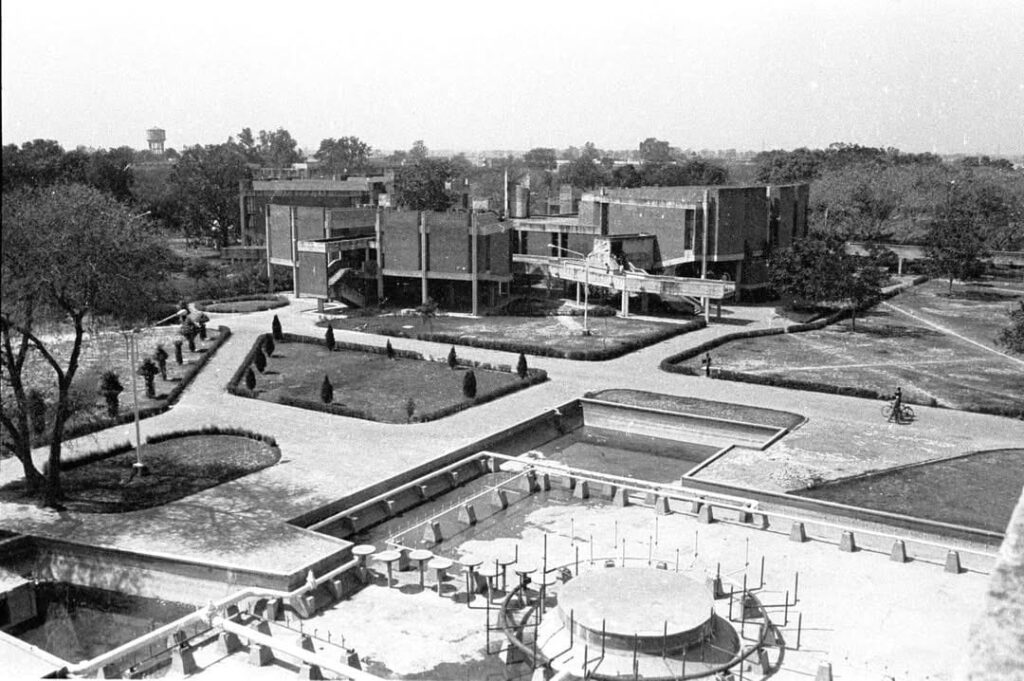
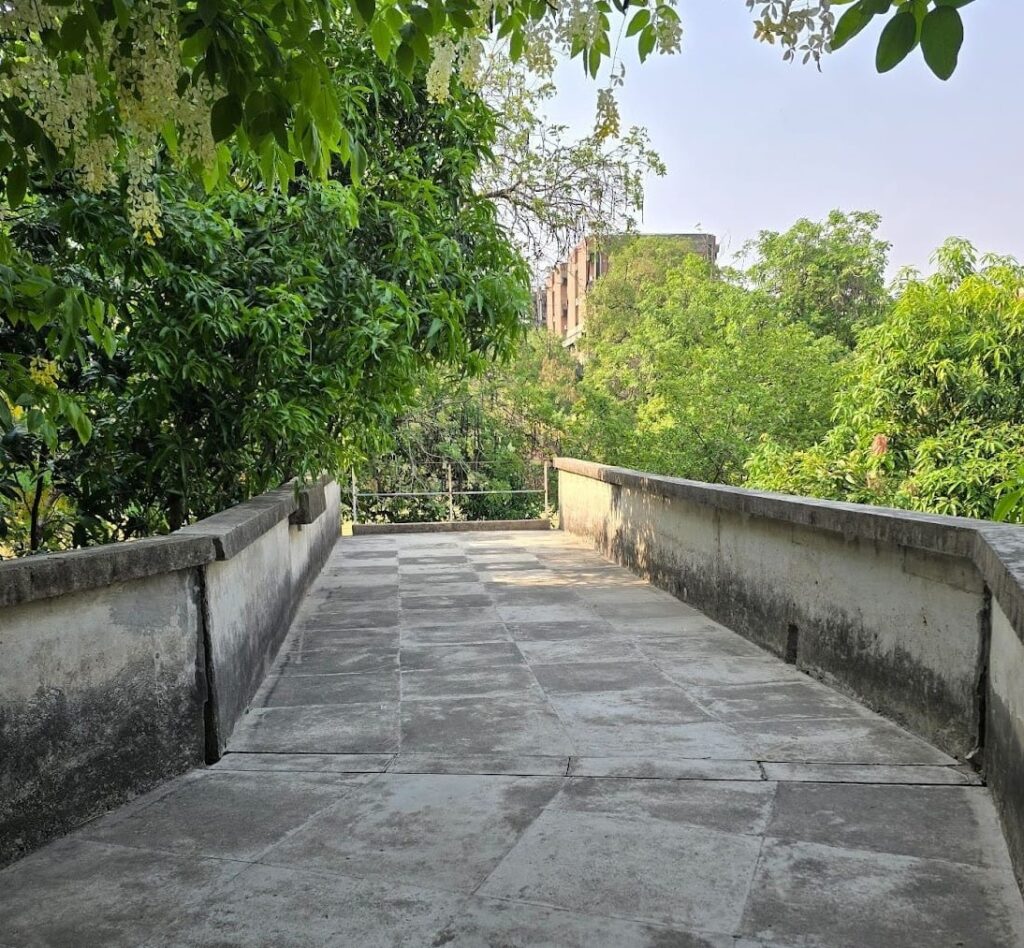
Images of ‘The Walkway to Nowhere’ (L to R): LHC from the top of FB – Sept 1967; 1977; Walkway behind L7 2025
1984: Anti-Sikh Violence Reaches IITK
Following the assassination of Prime Minister Indira Gandhi by her Sikh bodyguards in 1984, riots erupted across the country, and IIT Kanpur was not spared from the turmoil.
One day, trucks carrying local rioters arrived at the IITK main gate, demanding entry. The security guards, led by an elderly Nepali sentry, initially refused to let them in, citing the absence of official orders. However, the mob eventually forced its way inside on foot, as the guards refused to raise the boom for the trucks. The rioters, young men dressed in pyjamas, kurtas, and gamchas, armed with lathis, quickly spread out across the campus. Their targets were Sikh families and the Gurudwara.
Reports from students later revealed a particularly harrowing incident: a Sikh professor, who was caught off guard in his own home, armed himself with a sword in a desperate attempt to protect his family. The mob, incited by shouts of “maaro saale ko”, prepared to attack. However, the gang leader intervened, pulling out a katta (a country-made pistol), and ordered his men to move on to the Gurudwara, which was broken into, vandalized, and set on fire.
This violent episode was a stark reminder that even an academic institution like IIT Kanpur was not immune to the larger socio-political chaos engulfing the nation.
References:
‘A History of IIT Kanpur’ document
‘This bit of that IITK’ Facebook page
‘Sharing a Dream’ documentary by IIT Kanpur
‘The Fourth IIT: History of IIT Kanpur’ book
The Spark August 2023 (Issue 7)
The Spark May 2024 (Issue 9)
The Spark January 2025 (Issue 11)
‘Student activities’ (We extend our sincere gratitude to Prof. K. Muralidhar for sharing this document with us)
Edited By : Vedanshi Aggarwal
Written By: Riddhi Shingte, Disha Singh
Designed by: Bhavit Meena
Video Edited by: Siddharth Mahar, Dhruv Kejriwal