

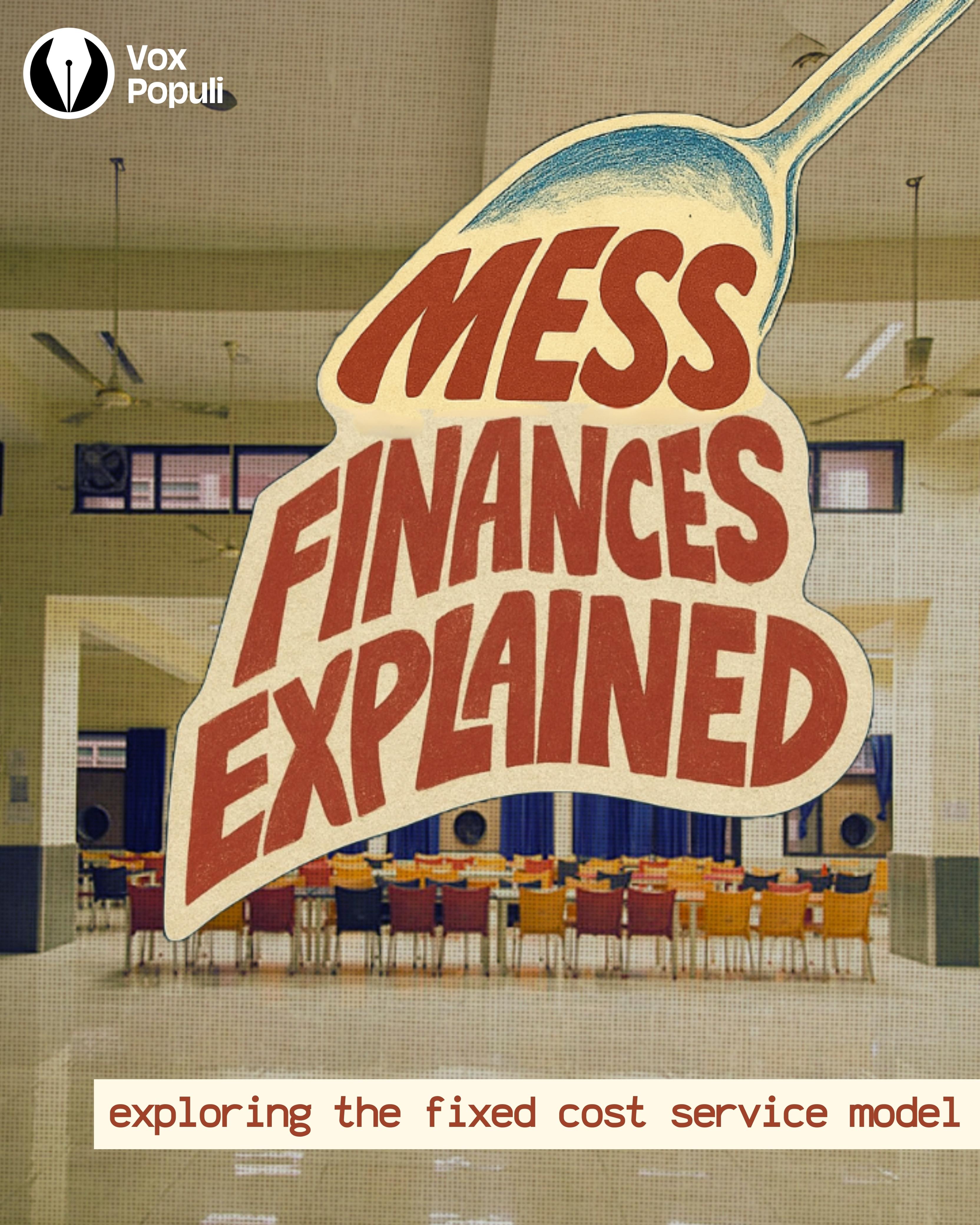
This article was published in March 2022 for the students who were coming back to the campus after the pandemic break to introduce them to the aspect of functioning of messes. This process usually happened through knowledge transfer from their seniors in pre pandemic times. We are republishing Part 1 of the mess articles with reworked numbers for the present times so that the new students can understand how the Mess functions in the Halls of Residence at IIT Kanpur. A properly functioning Mess is an essential requirement for its residents to concentrate on their academic affairs. We, at Forum for Critical Thinking (FCT-IITK), take this opportunity to pen down the details regarding the functioning of the Mess. In this first part of a series of articles we shall be discussing the Fixed Cost Service Model that is being followed throughout the messes of IITK. We shall try to briefly explain the roles of various entities in the running of the mess and discuss the financial part of its functioning to understand how our money is being used. In the upcoming parts, we will cover the mess work and working conditions of the mess workers in detail. One part will be dedicated to analyzing a mess model called ‘Per Student Per Day’ (PSPD), proposed in 2017 and 2019, but withdrawn after students’ opposition to it.
Part 1: Fixed Cost Service Model
The present mess model of IIT-K is named the Fixed Cost Service Model (FCSC). After joining IITK, registered students are allotted different halls for their stay on campus. IITK being an all-residential campus, all the registered students must join the hall and mess except for special cases with permission from the Dean of Students Affairs’ (DoSA) office. On joining Hall, its residents are automatically registered for the mess.
Students staying in a Hall are supposed to pay the following charges for availing of mess services:
- Mess establishment Charges (MEC) (paid per semester)
- Monthly Mess Bill
Mess Establishment Charges
Students are supposed to pay MEC each semester along with the semester fee. MEC for the regular semester is around Rs 15,600, and for those staying on campus in the summer semester, the MEC is around Rs 8,100. One part of MEC consists of salaries and benefits (Employee State Insurance (ESI), Provident Fund (PF)) for the workers employed in hall messes, and the remaining is the service charge (8%) paid to the mess contractor for providing services in managing the mess operations. Here, it is important to note that the normal semester runs for five months for postgraduate students and for four months for undergraduates.
IIT Kanpur is mandated by the Minimum Wages Act 1948 and the Minimum Wages (Central) Rules, 1950, to pay all contractual workers the central minimum wage. This central minimum wage is revised twice a year in April and October based on the inflation rates and other parameters by the Union government.
Every month, the mess contractor raises the bill/invoice based on the total number of workers (based on man-days) employed in the mess. This bill also contains the service charges, which are payable to the contractor. In simple words, the service charge is the profit of the mess contractor. Let us take an example to understand this structure of an Invoice. Let’s assume a Hall of Residence Y has 450 students residing and availing the mess facility. For these 450 students, 40 mess workers will be deployed to ensure the proper functioning of the mess for three meals a day. Since the mess runs for all the days in a month, the total man-days become (40×30=1200) for a month of 30 days. At present, the central minimum wage is Rs 805 for unskilled workers. Let us assume here, for the simplification of calculation, that only unskilled workers are employed in the mess. For 1200 man-days, the total wage component becomes Rs 9,66,000. If the service charge is 6% (assume), it becomes Rs 57,960. The total invoice cost will be Rs 12,08,273 for a month, inclusive of 18% GST (Rs 1,84,313). Based on this bill, the DoSA office will release the monthly payment to the contractor from the MEC collected from the students in the semester fee. Apart from this, the institute also reimburses the mess contractor the amount of Rs 1,15,920 (12% of workers’ salary) for Provident Fund (PF) and Rs 31,395 (3.25% of workers’ salary) for Employee State Insurance (ESI) that contractor deposit in the workers’ accounts at Employees’ Provident Fund Organization and Employees’ State Insurance Corporation respectively. This amount is also paid by the DoSA office from the MEC charges collected from the students. Mess Establishment Charge (MEC) simply is the labor cost (including social benefits) and service charge paid by the students for services they avail themselves of at the mess.
Sr. No. | Description | Amount (Rs) |
|---|---|---|
1. | Salary (1200-man days) | 9,66,000 |
2. | Service Charge (8% of workers’ salary)
| 57,960 |
3. | GST (18% of Sr. No. 1 & 2) | 1,84,313 |
4. | PF (12% of workers’ salary) | 1,15,920 |
5. | ESI (3.25% of workers’ salary) | 31,395 |
6. | Total | 13,55,588 |
Table 1: Approximate Monthly Break-up of Mess Establishment Charge for a Hall of 450 residents.
Monthly Mess Bill
Apart from the MEC, students are supposed to pay the mess bill every month to the hall account. The following are the four main components of the monthly mess bill:
- Basic Daily Meal Rate (BDMR)
- Hall Development Fund (HDF)
- Extra food items purchased
- External coupons
Monthly mess bill =BDMR x no. of days in month+ Extra food items purchased+HDF
Basic Daily Meal Rate (BDMR)
‘Basic daily meal’ (BDM) includes food items consumed by residents in breakfast (such as daily changing items like poha, dosa-sambar, sandwiches, etc., along with regulars like daliya, sprouts, egg, milk, tea, etc.), lunch, and dinner (one dal, one sabzi, rice, chapati, sambar, fruits, etc.). This basic daily meal does not include the items cooked on the order of individual residents (Omelets, paneer bhujia, egg rice, fried rice, dal tadka, DCBM, to name a few).
To run the mess, every hall purchases all the necessary raw items required for food preparation. Different vendors supply the hall with all the necessary raw materials against the order raised by the Mess or the hall office. The total expenditure on the monthly BDM is divided by the total number of residents to obtain the BDMR. BDMR is the average cost of food per day in a given month.
BDMR=Total expenditure on raw material in the month/ (no of hall residents x no. of days in the month)
This BDMR excludes the money generated by the mess of selling external coupons. This BDMR gets modified after these coupons are taken into consideration during calculations. This will be discussed in the coming section.
Hall Development Fund (HDF)
HDF, also called ‘Establishment Charge’ in some halls, is collected by the hall every month from its residents. HDF varies from hall to hall and is usually between Rs. 40 to 75. This fund is used for carrying out different maintenance works and purchases in the hall.
Extra food items purchased
Apart from basic daily meals, residents of the hall can purchase extra food items such as eggs, vegetarian, and non-vegetarian items. These items are prepared on order placed in the mess. The cost of these items is decided by the Hall Executive Committee (HEC) in consultation with mess managers.
External Coupons
Campus community members, like other hall residents, SBRA residents, research assistants (RAs), staff, and faculty, can also use the hall mess facilities. These non-hall residents are required to purchase cash coupons for every meal they take at the mess. The cost of these items is decided by the Hall Executive Committee (HEC) in consultation with mess managers. The cost of these coupons is higher than the BDMR paid by the regular residents of the hall. Further, the total amount of these coupons sold is deducted from the total expenditure on the raw material used by the hall. This makes the final BDMR calculation formula:
BDMR= (Total expenditure on raw material-total collection from cash coupons) / (no. of hall residents x no. of days in the month)
Mess Rebate:
Mess rebate is applicable when a student leaves the campus on a personal, medical, or academic leave for more than 3 days. The rules for mess rebate are drafted by hall HECs and vary from hall to hall. For example, if a student leaves campus for 7 days in a month of 30, then the mess bill is calculated only for the number of days that the student has taken the food at the mess, i.e., 23 days in this example. This makes the final monthly mess bill calculation formula:
Monthly mess bill =BDMR x no. of days food taken+ Extra items purchased+HDF
Above is the overview of the different fees and bills students pay at IITK to avail of mess facilities. In the next section, we will be discussing the role played by the contractor, students’ HEC, and Hall residents. wardens and the IITK administration in ensuring the smooth and transparent functioning of the hall.
Role of Different Stakeholders in the Mess
1) Hall Executive Committee (HEC) (students)
HECs are the executive student bodies of each hall of residence, elected every year by hall residents. The main purpose of HEC is to represent the hall residents in every decision-making related to the hall. Mess facility is one such avenue that requires the active participation of the HEC. HEC consists of two to three mess secretaries, among others. The mess secretaries further form a mess committee by calling nominations from the hall residents. These volunteers help mess secretaries in managing to day activities of the mess in a smooth manner.
The following are the essential responsibilities of HEC and the mess committee:
- HEC must represent the hall in all the meetings of the Hall management committee (HMC), Council of Students Hostels Affairs (CoSHA), Students’ Senate (SS), and other forums to voice the concerns and issues of the hall residents.
- Every year, HEC must take active participation in the selection procedure of a new mess contractor as described by the rules mentioned in the mess contract.
- HEC must ensure that the mess contractor complies with the terms and conditions agreed upon in the contract.
- HEC must ensure that all the meals are made available to the residents at a pre-decided time without any delay. HEC coordinates with the mess manager employed by the contractor to ensure this.
- The mess committee must ensure that the contractor is following the 11.25:1 ratio (decided in the contract) while employing workers in the mess. This must not be compromised at any cost as the decrease in workers employed in preparing and serving food directly affects the quality of food and service in the mess.
- HEC selects the vendors for the supply of raw materials in the mess by calling multiple quotations. HEC must keep the experience of the supplier, price, and quality of raw material in mind while deciding the vendor. HEC holds full autonomy while taking this decision. HEC must ensure that they have multiple vendors for every supply at all times. This avoids the monopoly of any vendor and keeps the prices of raw materials down. Active participation of HEC can ensure that the monthly mess bill is under control and the food quality is maintained.
- The mess committee makes sure that the vendors are supplying the best (or pre-decided) quality and demanded quantity of the raw materials. HEC holds full autonomy in the cancellation of the order to any vendor if it is not complying with the pre-decided terms of price, quality, and quantity. At least one HEC or mess committee member must be present during the arrival of raw material to verify the quality of the material.
- Mess secretaries of HEC ensure that the mess’s monthly bills are sent to the residents regularly. Complete transparency must be exercised in BDMR calculations and must be regularly communicated to all residents.
- HEC must ensure the cleanliness of the kitchen and dining areas through regular monitoring and issuing necessary directives.
- By conducting regular meetings where residents are asked to vote and opine for their preferred food items, HEC makes sure that residents’ choices are incorporated in the menu. Mess committee members ensure that food quality and taste are not compromised and no adulteration is done by carrying out checks in the kitchen, cold storage, and other storage for pulses, etc. HEC must arrange regular meetings with residents to know their grievances and opinions on food.
- HEC should make a menu keeping in mind the practical constraints like fixed labor force and seasonal availability of raw materials. Including too many items in the basic or extra menu can affect the taste of food due to the workers being overburdened. By judiciously choosing seasonal vegetables and other locally sourced materials, HEC also helps regulate the cost of the menu.
- HEC must make sure that the contractor is releasing the salaries of the workers by the first week of every month, along with their ESI and PF.
- HEC must address the grievances of mess workers by coordinating with the mess manager or contractor as and when required, as the problems faced by workers in their working area can affect the quality of services.
2) Role of Hall Residents
Residents are the primary users of the mess. To ensure the proper functioning of the mess, residents must actively participate in the mess affairs. Residents must provide HEC with essential feedback on mess-related issues from time to time. Residents must hold their elected HEC members accountable for the transparency in the functioning of mess affairs. Residents must ensure that HEC is performing its roles as mentioned above (see “role of HEC”). Residents must provide support to HEC to make sure that their voices are heard at platforms such as HMC, CoSHA & SS.
The mess is a form of community kitchen where residents from different regions, food habits, and economic backgrounds have their food. Every resident must keep in mind that the mess provides only basic food, and it cannot function like a restaurant. Every individual’s choice of food cannot always be accommodated due to different constraints such as the cost of food, seasonal availability of vegetables and fruits, training of the cook in food preparation, etc. Residents must be reasonable while presenting their opinions to the HEC members and must never forget that HEC members are fellow students who are devoting their valuable time voluntarily from their academics, so that the mess can function smoothly for everyone’s benefit.
3) Contractor
The service of every mess facility at IIT Kanpur has been outsourced to the contractors, who provide services and manage the daily functioning of the mess. Contractors have to ensure that the required number of workers needed to run the mess facility in the hall are employed every day. The contractor is responsible for the timely preparation of food, the cleanliness of the kitchen, and the dining area. The contractor, through its manager, in coordination with Hall HEC, ensures the smooth functioning of the mess facility.
Every contractor is responsible for ensuring that for every 11.25 residents, 1 worker is employed in the mess. The contractor must pay the salaries according to the Minimum Wage Act of 1948 and the Minimum Wages (Central) Rules, 1950, to every worker by the first week of every month. The contractor must make sure that they are depositing the ESI & provident fund of workers to the concerned government departments regularly. The contractor must facilitate the paperwork regarding salaries, ESI, and PF. The contractor must address the grievances of the workers as and when they are reported.
For the services provided by the contractor in the mess, it is paid a fixed service charge decided during the allocation of the contract through a tendering process.
3) Role of Wardens
Each hall of residence has three faculty members as wardens appointed by the institute administration on the recommendation of HECs. Each hall has a dedicated warden for mess affairs to advise HEC and the mess committee regarding the functioning of the mess facility, as and when asked for. Wardens are the signing authority for the banking affairs for the payments to the vendors and other service providers.
4) Role of IITK administration
The following are the essential responsibilities performed by the IITK administration through the offices of DoSA, ADHA, and wardens:
- The institute, every year, calls for a tender for the running of all the mess facilities on the campus. Transparency in the allocation of mess tender is an important and foremost responsibility of the administration.
- Through wardens in coordination with HEC, the administration makes sure that contract conditions are being complied with by the contractors.
- Administration ensures that no malpractices such as favoritism, corruption, etc. are practiced by the contractor during employment and deployment of workers by regularly issuing necessary directives to halls and contractors.
- The institute administration ensures that the DoSA office clears the contractor bills well in time, so that the contractor can make salary payments to the workers by the first week of the month.
- IIT Kanpur administration is the principal employer of workers working on the campus. Being a central government institute, the IITK administration ensures that contractors are following the Minimum Wages Act 1948 and the Minimum Wages (Central) Rules, 1950.
- The institute makes sure that necessary funds are made available to the hall for upgrading and maintaining mess facilities as and when required.
This is the overall functioning of the present working model of the hall mess facilities on the campus. From the students’ point of view, the strength of the present mess model is that at every step, the participation of the students (primary service users) is ensured. Students actively participate in the selection of new contractors, the selection of vendors, deciding food quality, the mess menu, etc. The effective participation from HECs and residents can ensure that they are served quality food at a low price in the mess, as they are the main decision-makers in the mess affairs. This mess model is also very convenient for the IITK administration as students share a majority of the day-to-day responsibilities necessary for the smooth functioning of the mess facilities on the campus. This system is very important from the point of view of the workers whose hard labor makes sure that we are served with food well on time every day. This system ensures that they are paid with central government-mandated minimum wages along with social benefits of the provident fund and health security scheme of ESI.
Forum of Critical Thinking (FCT-IITK)
Educate, Agitate, Organize
Place: IIT Kanpur
Date: 18.08.2025
Forum of Critical Thinking (FCT-IITK) is an informal group of IIT Kanpur students and community members aiming to develop a critical understanding of issues facing the institute and the country. FCT-IITK was formed out of a series of discussions amongst students who were concerned about the erosion of democratic values both within the campus and in the country. This forum aims to understand the systemic reasons that underlie the problems faced by the campus community, and attempts to understand it in relation to the socio-political context we occupy within the larger body politic of the nation.
Follow us @ https://www.facebook.com/iitkfct.
You can reach us @ criticalthinkingforumiitk@gmail.com.