



Disclaimer: Vox Populi, IIT Kanpur, is the exclusive owner of the information on this website. No part of this content may be duplicated, paraphrased, or interpreted in any other way without written consent from Vox Populi. If you want to reproduce any of the content on this page, please contact our chief editors directly or reach out to us by email at voxpopuli@iitk.ac.in.
Breaking the Ice: How Students Really Interact Across Genders
Think about your everyday interactions – chatting with classmates, joking with colleagues, or just hanging out with your friends. Whether it’s the nerves of starting a conversation, decoding that Instagram story like, or trying to figure out if someone’s flirting or just being friendly, inter-gender interactions are often more complex than they have to be. To get a better idea of how students truly feel and behave in these situations, we ran a survey with 740 responses to gain a deeper insight. From who’s more likely to make the first move, to how we interpret those subtle digital cues, we’re diving into the quirky (and sometimes awkward) side of interactions between genders on campus. Let’s see what we uncovered!
How Does One’s Background Influence Comfort Levels In Inter-Gender Interactions?
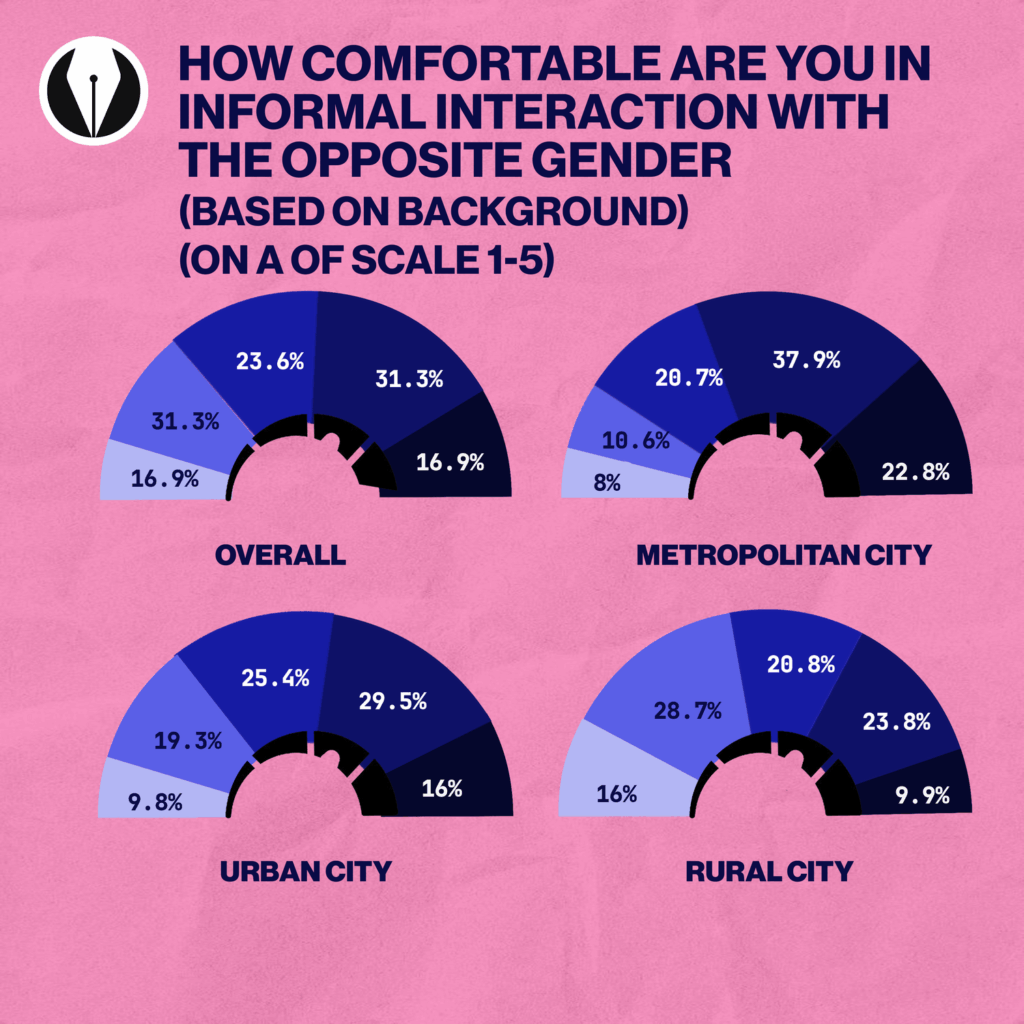
It’s interesting how some people navigate mixed-gender interactions effortlessly, while others struggle even with conversations happening around them. A key factor influencing this is the environment in which a person grows up. It seems those from metropolitan cities report the highest comfort levels in such interactions, while individuals from rural and smaller urban areas tend to feel less at ease.
This is also evident in family openness to inter-gender interactions.
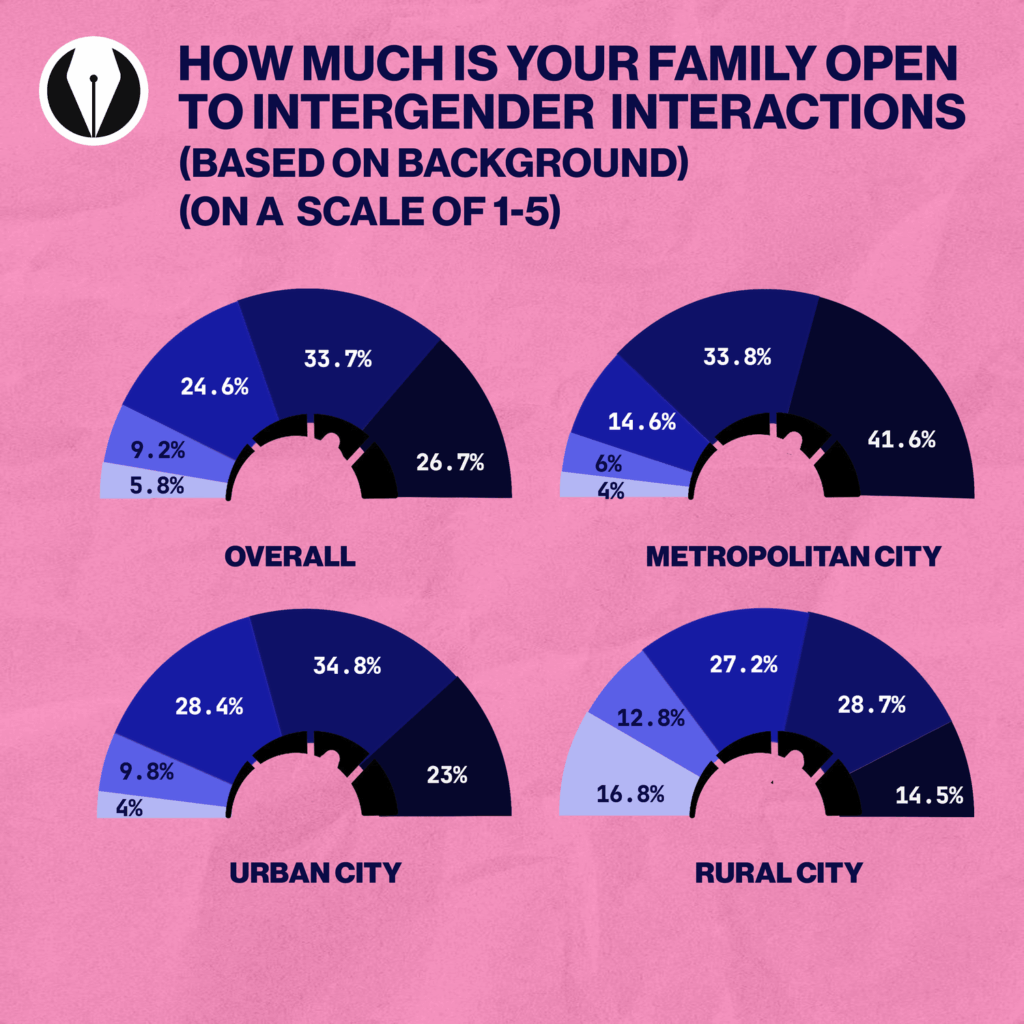
These findings highlight how the background that you grew up in shapes social confidence, as students from a metropolitan background report being more comfortable in interacting with the opposite gender compared to those from rural areas.
Changes In Interactions Over The Years –
College appears to be a transformative period for many of the respondents. Some find themselves socializing more than ever, meeting new people, and becoming more comfortable in mixed settings, but a lot of them also feel their interactions have actually decreased.
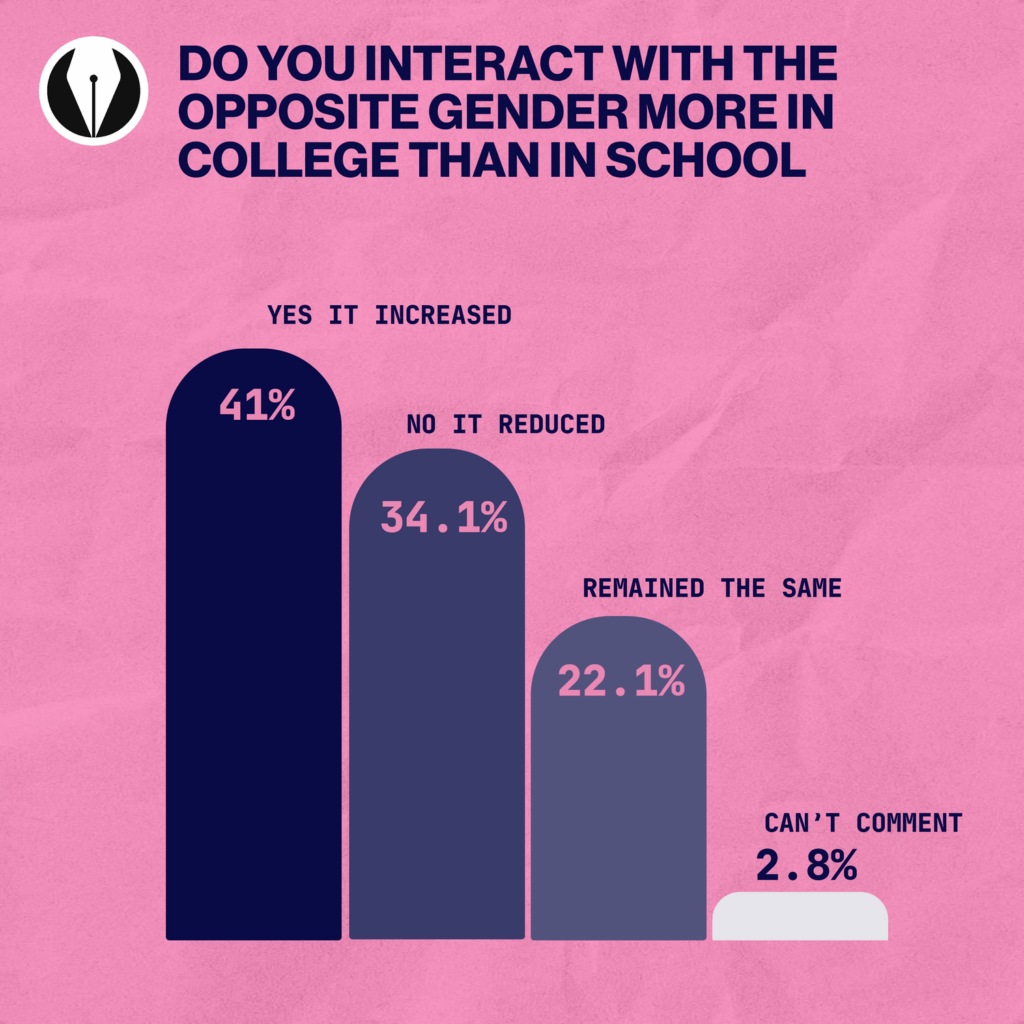
It is indeed interesting how 34% of the respondents reported a decreased interaction despite our college having a relatively liberal environment with regard to intergender interactions! While 40% of the men reported a decrease in interactions, only 15% of the women reported the same. 60% of the women reported an increase in intergender interactions while only 38% of the men reported the same. This indicates our campus environment is much more conducive for intergender interactions for women compared to men.
How early do students interact with the opposite gender?
It turns out, nearly 60% of respondents had their first inter-gender interaction within the first week of being on campus. 25.3% took a little longer, interacting within the first month, and 8.4% waited until their first semester was done. There’s a gender disparity in the responses with 79% of the women interacting within the first week compared to 54% of men.
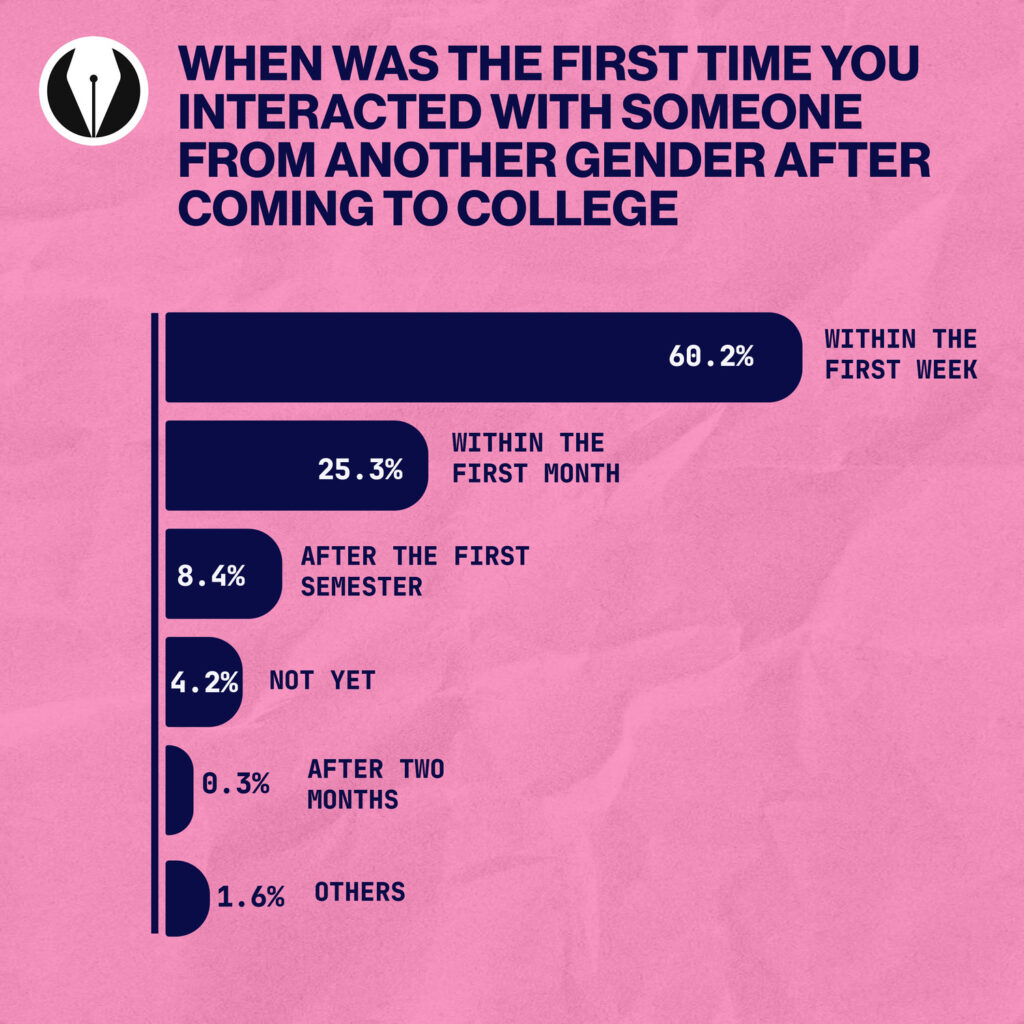
This trend of waiting to interact seems to stick – among those who didn’t interact within the first week, the percentage of people with no friends of the opposite gender is almost 4 times that of those who connected within the first week.
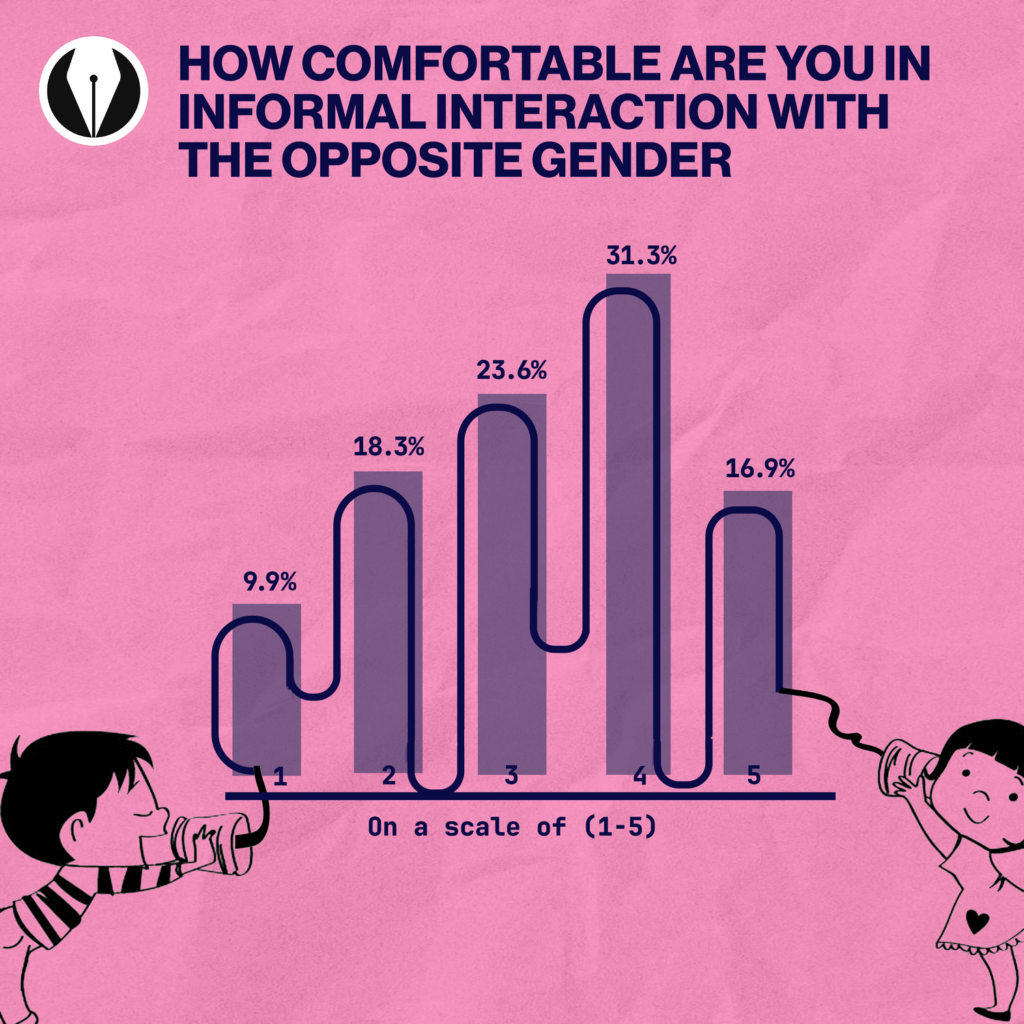
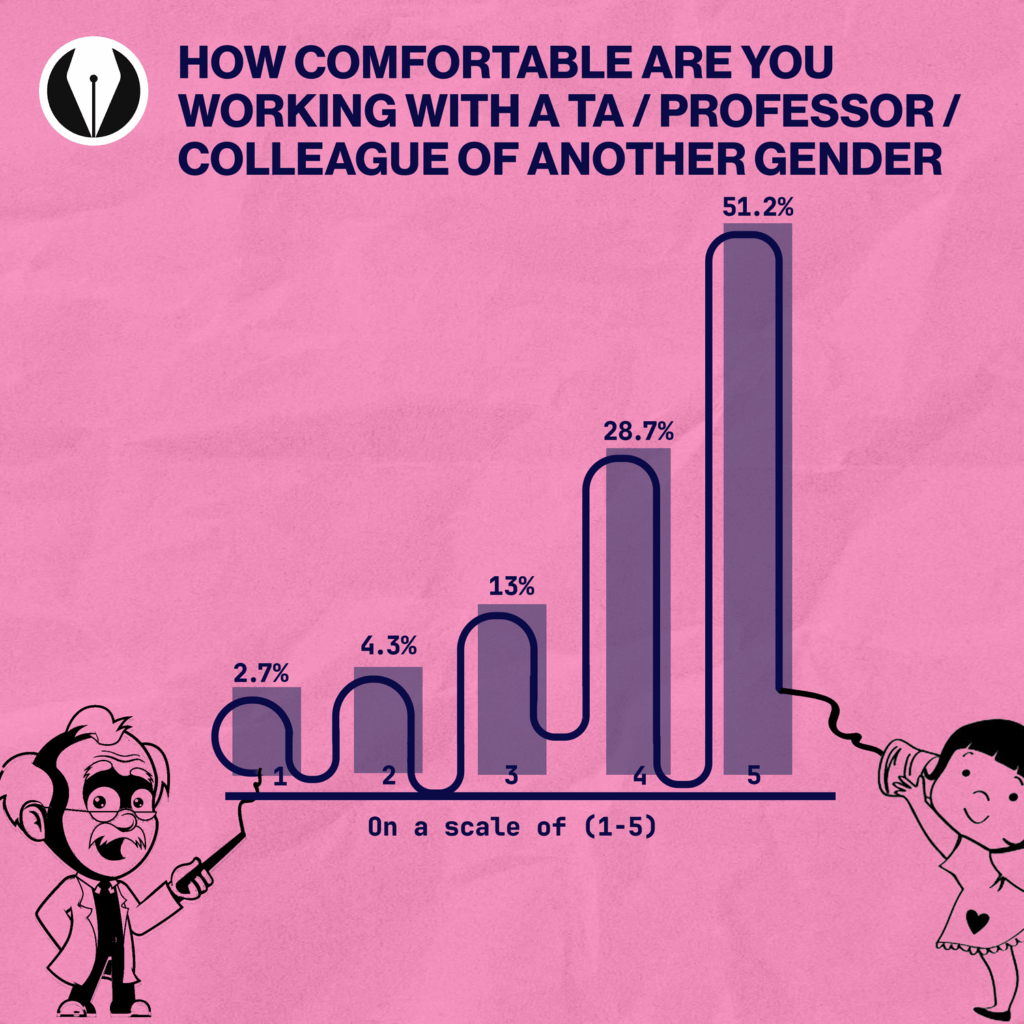
How Comfortable Are Folks Of IITK In Inter-Gender Interactions In Formal Settings vs Informal Settings :
Our findings show that comfort levels vary widely in a formal and an informal setting.
Cross-Gender Friendships :
How many of your close friends or even just friends are from another gender? Do you think it’s different/same for others as well?
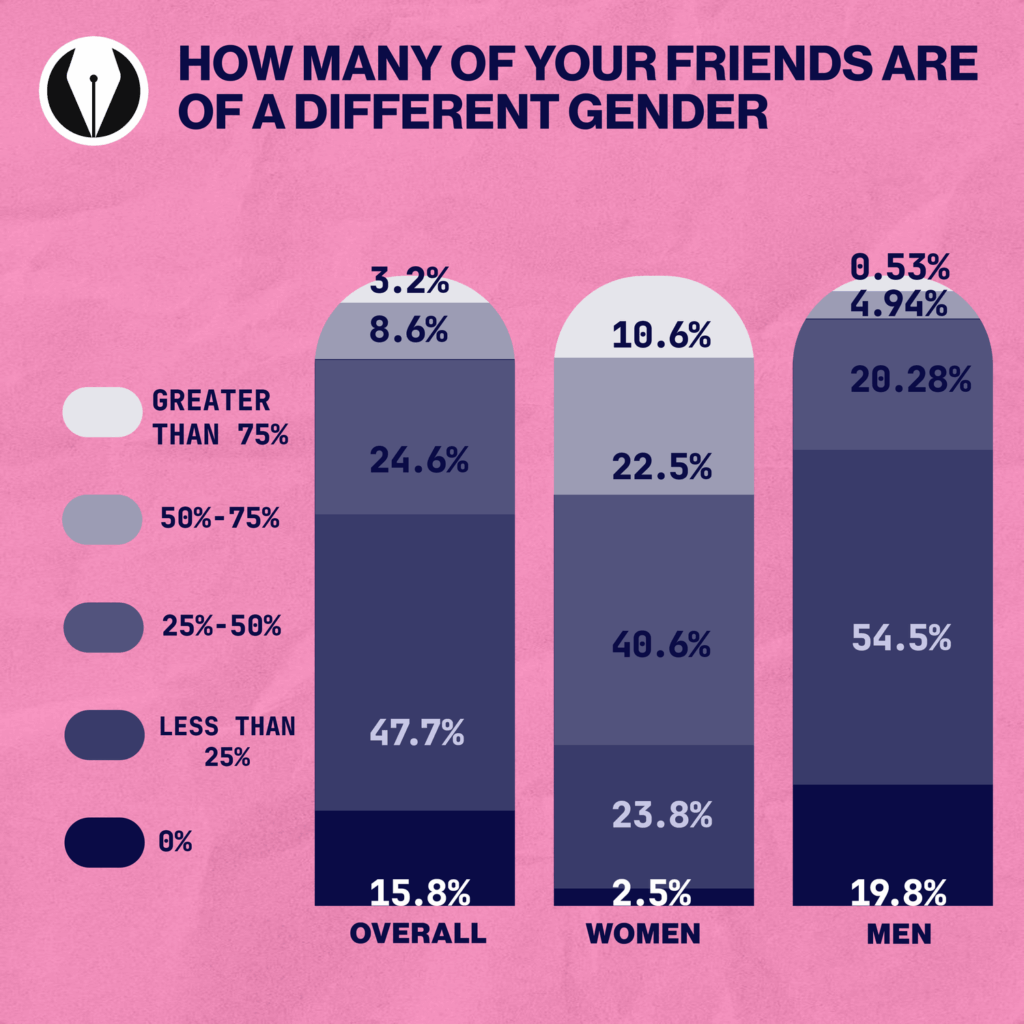
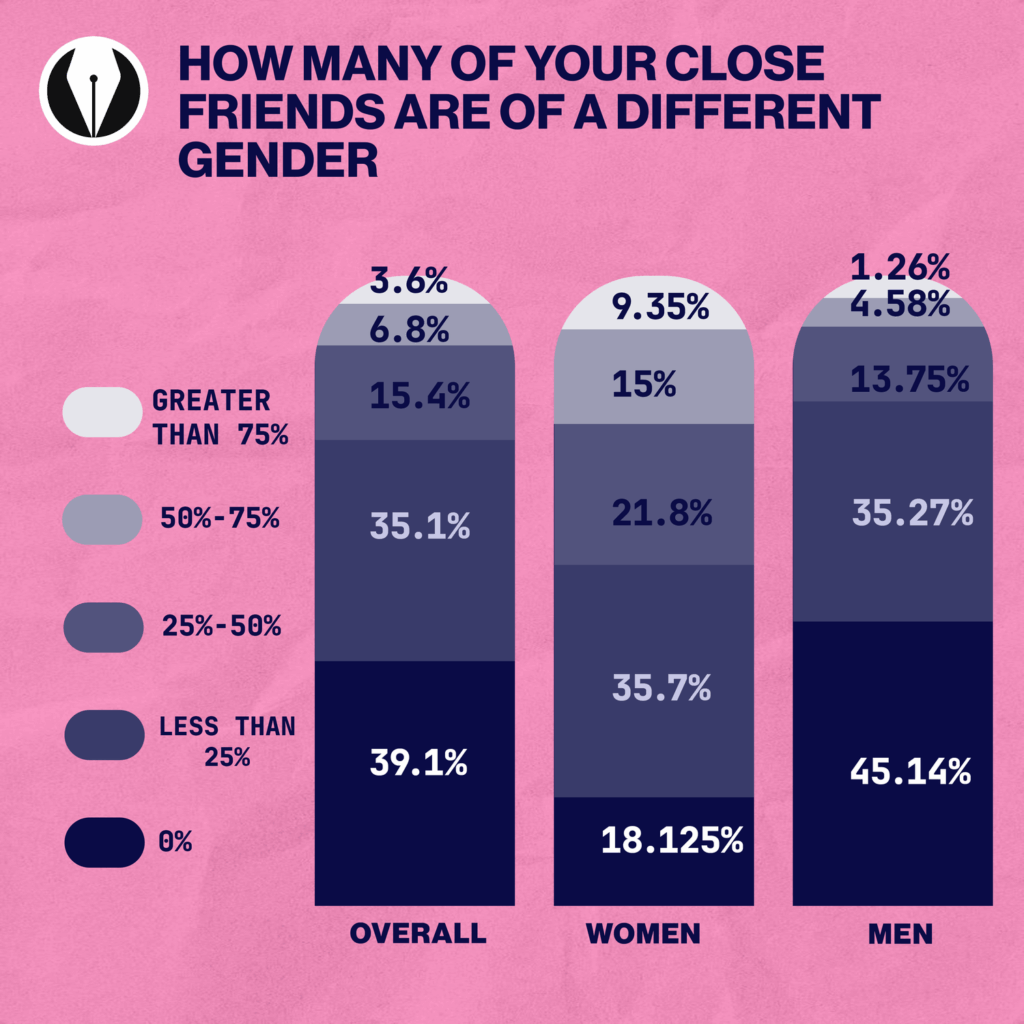
Looking at the data we have collected, there seems to be a clear contrast between the friend circle of men and women.
Women are more likely to have a balance of both genders in their social circles, whereas most men say that a large majority of their friends are from their own gender.
So, why does this happen?
“I kind of sense a lot of “ek ladka aur ek ladki kabhi dost nhi ho sakte vibe here idk why. It’s also that like if I’m helping someone I’m trying (to hit) on them, which is the kind of vibe I’d like to be changed.”
“I am of the opinion that the highly skewed gender ratio in IITK affects inter gender relations very much”
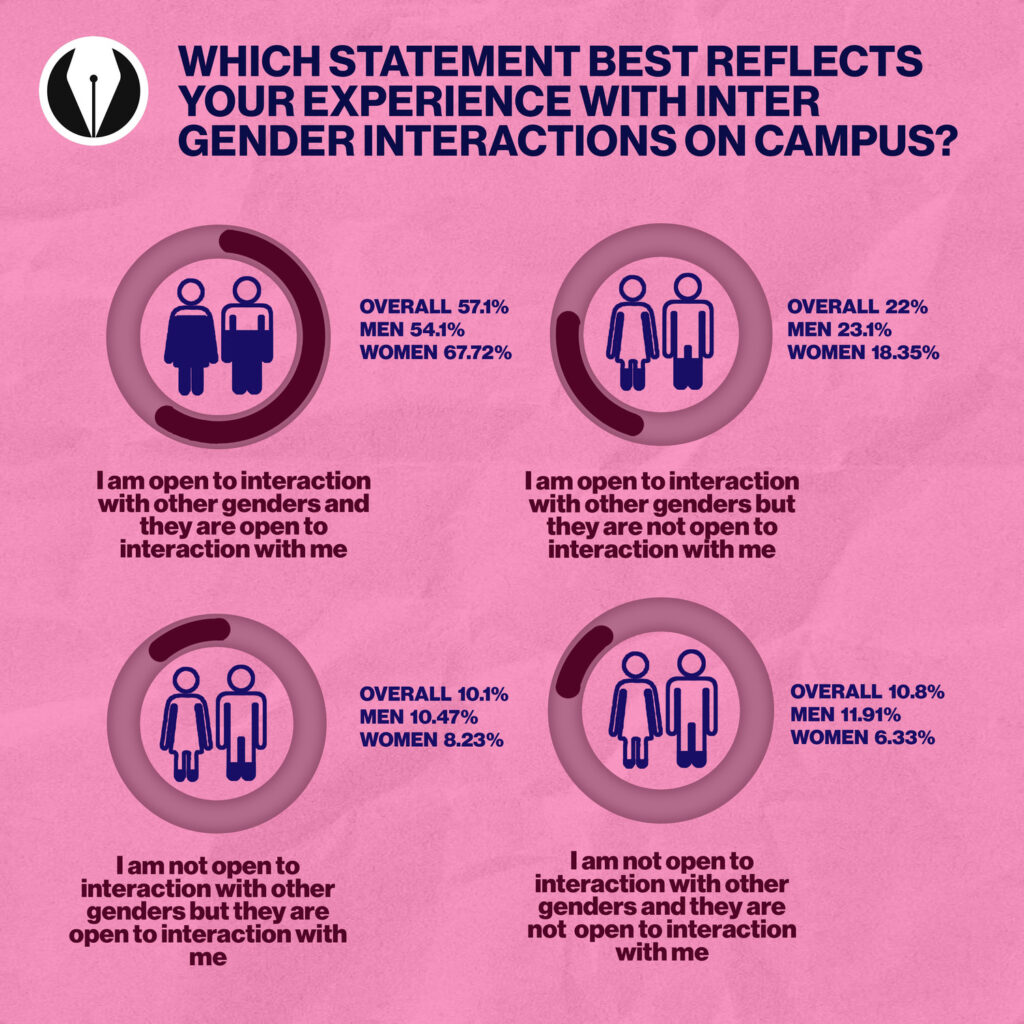
Is the Openness to Interaction Mutual?
The survey reflects a generally open environment for intergender interactions on campus, with 57.1% of students stating that they are open to interacting with other genders and feel that this openness is mutual. This response was more common among women (67.7%) than men (54.5%), indicating a stronger sense of ease or comfort with such interactions among female students. At the other end, among the 10.8% of respondents who said that neither they nor the others are open to interaction – this view was more frequently reported by men (11.9%) than women (6.3%). Meanwhile, 22% of students felt open to interaction but sensed that the feeling wasn’t mutual, with more men (23.1%) than women (18.4%) selecting this option. These differences suggest that men may be slightly more likely to encounter – or at least notice – barriers in forming such connections
Where do Interactions Begin? :
The majority of interactions with other genders start through mutual friends (55.3%), followed by lectures (50%), and clubs (48.9%). Social events like fests and workshops also contribute to 43.6% of interactions. Social media accounts for 26.5%, while hangout places like canteens, cafes, and open spaces make up 19.5%. Fewer interactions begin in hostels, with only 5% of respondents mentioning this.
Clubs play a role in increasing cross-gender interactions by bringing people together through shared interests. Many students find that participating in such groups helps ease initial awkwardness and fosters friendships beyond the formal classroom setting, with a respondent saying-
“My interaction has increased in the second year compared to the previous year i would purely say the reason for it being the club interactions.”
However, breaking that initial barrier still remains a challenge for many, even for situations where collaboration is necessary – group projects, with one respondent saying.
“If we are in a group project, the boys talk among themselves and same with the girls. This reduces team’s efficiency. I wish people would talk with each other without gender bias”
Interaction Comfort : Texts vs In-Person :
The survey results show that 37.4% of respondents are equally comfortable interacting with other genders both online and offline. A slightly smaller group, 33.2%, feel more comfortable interacting online, while 21.9% prefer offline interactions.
What might be the reason that some people prefer offline interactions? One of the survey respondents quotes –
“ Usually other genders who are interested in talking to me approach me through social media. I can’t judge them properly on texts and know their intentions. So I find it difficult to interact on texts. I would prefer if they approach me in person.”
Social Media Metrics To Interpret Inter-Gender Interactions:
Have you ever hesitated before sending someone a follow request? Do you hesitate more if it’s someone of the opposite gender? We asked the same to the students.
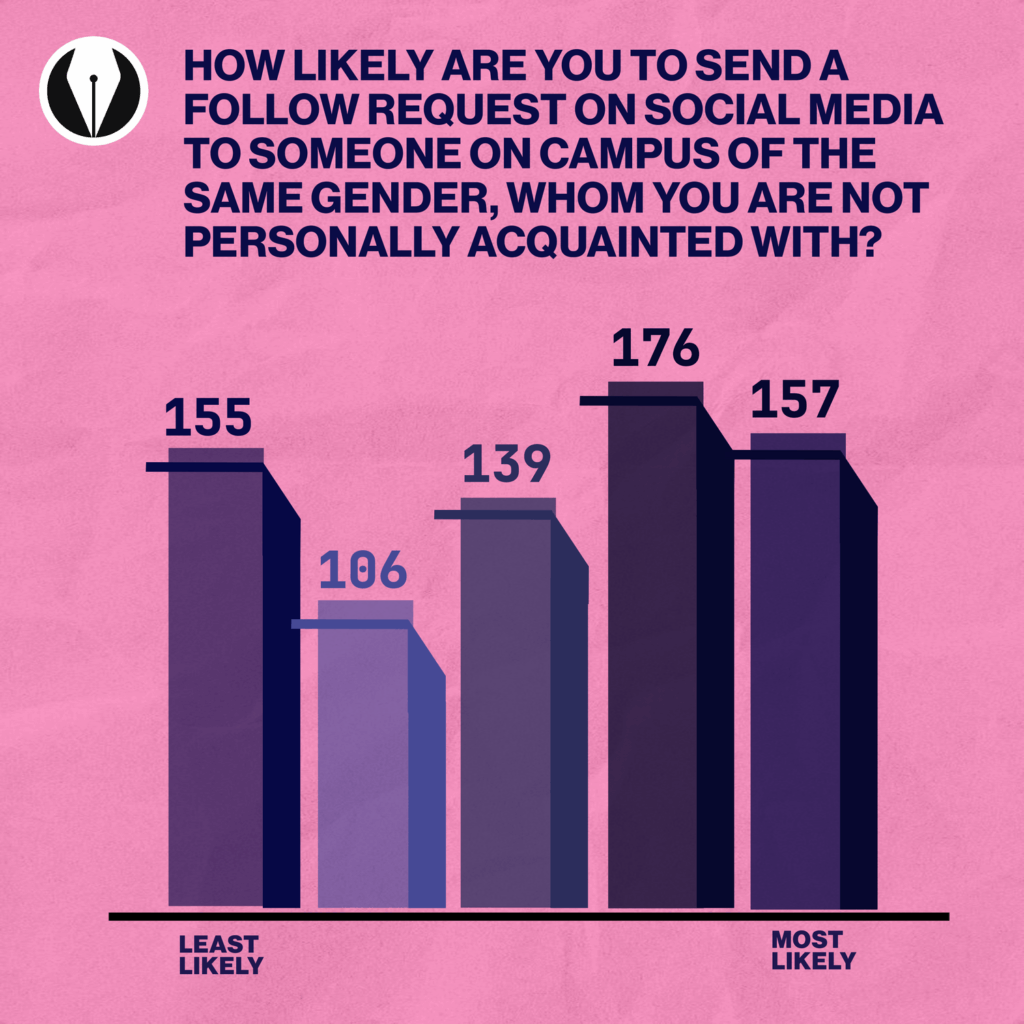
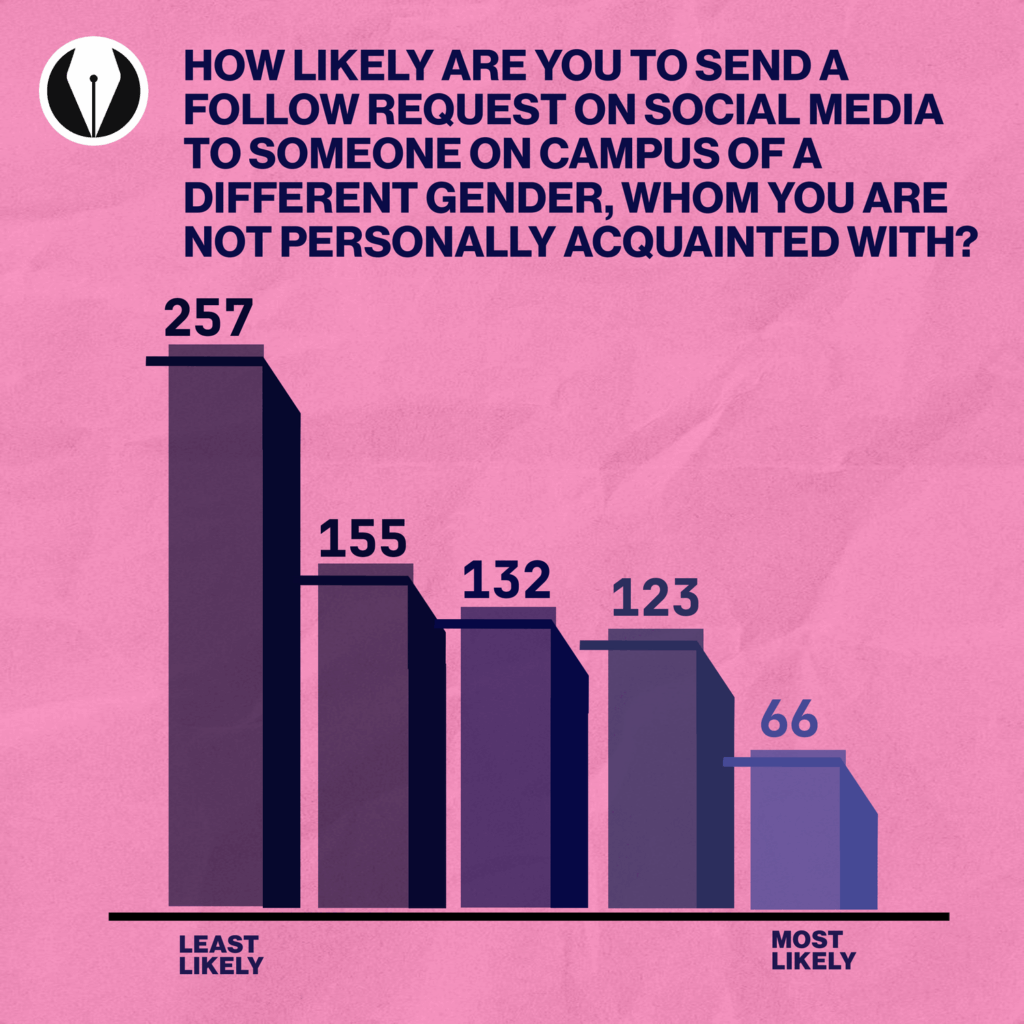
We see a significant contrast in people sending a follow request to the same gender and the opposite gender. What might be the reason for this? A fear of being judged? Not wanting to seem too eager? Or just plain overthinking?
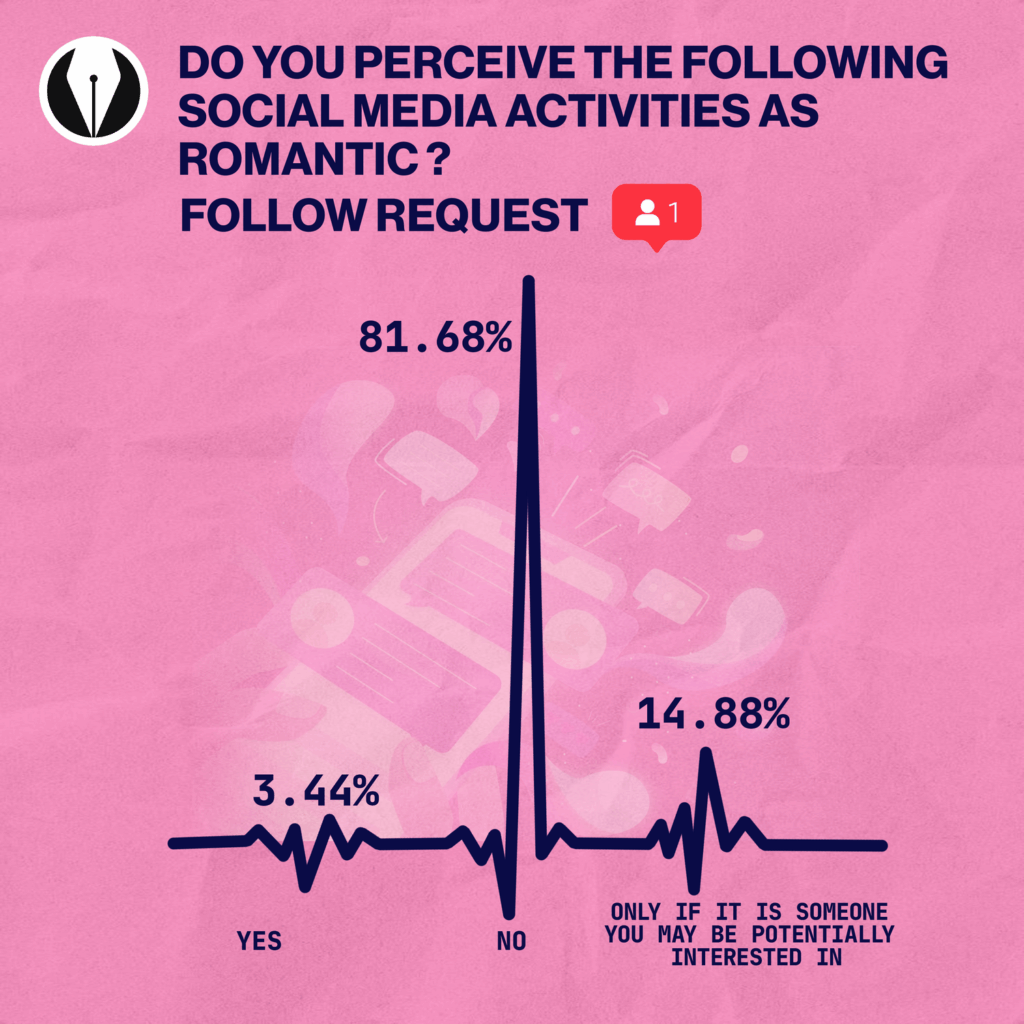
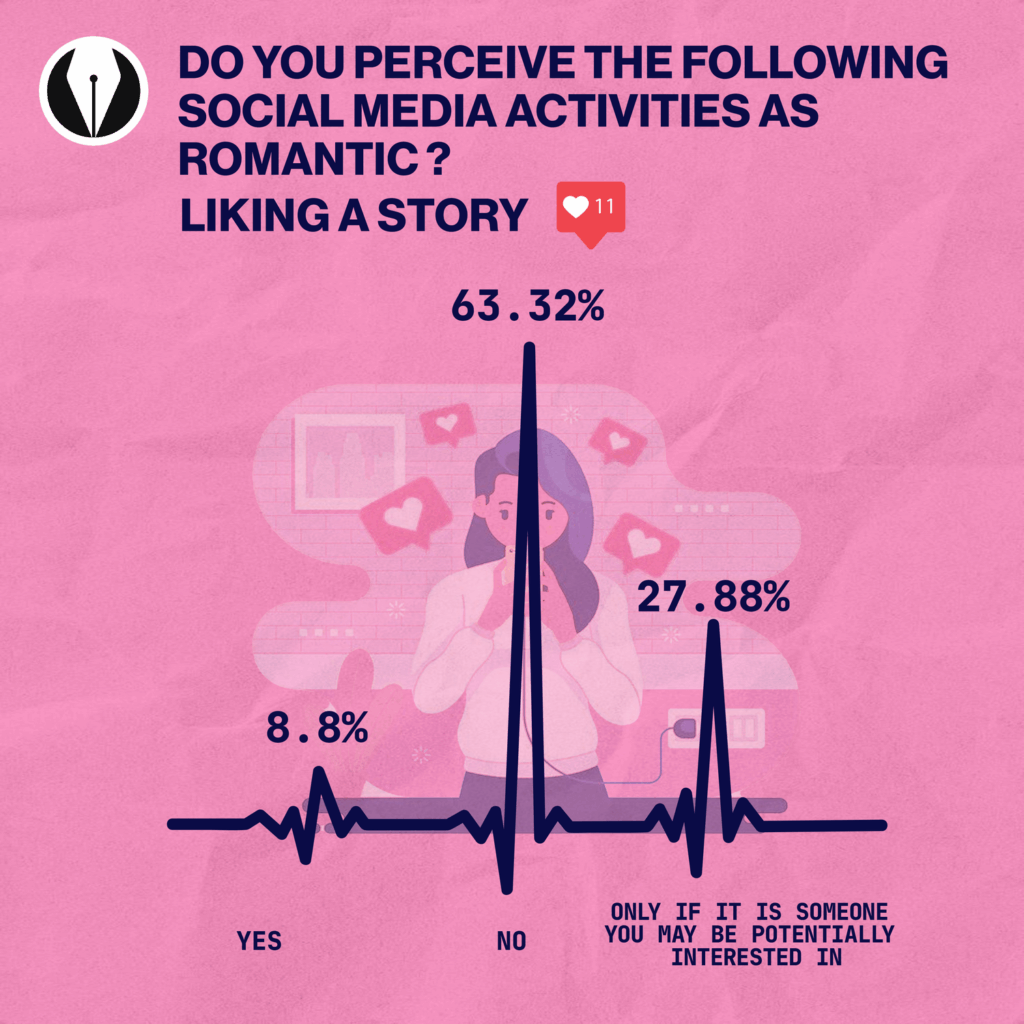
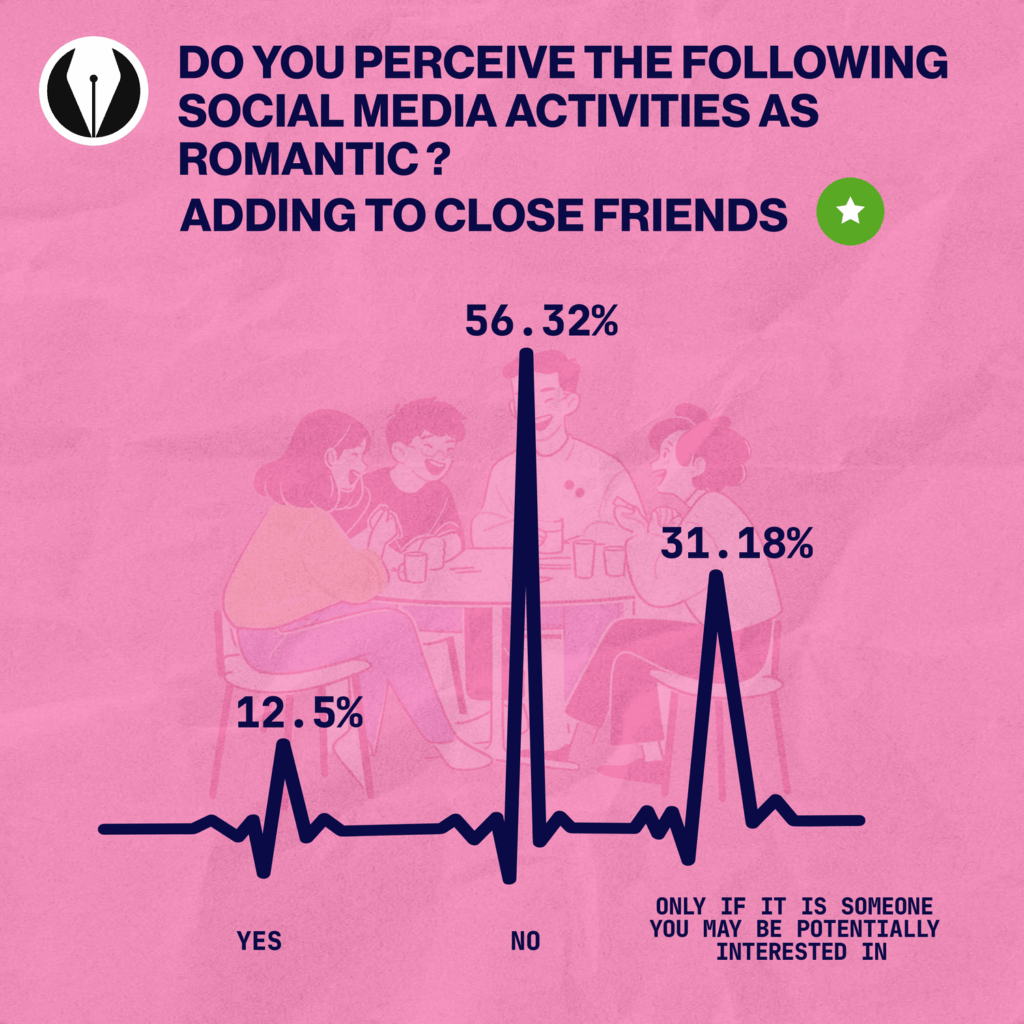
Stuff like liking stories/notes, adding someone to their ‘close friends’ list, getting follow requests from the other gender might seem like a huge deal but they aren’t generally considered all that romantic by most people. So yes, you indeed are overthinking and it’s not that serious!
PERSONAL INTERACTIONS
Interaction Settings: Solo or Group?
A large fraction of people, nearly half (48.8%) feel most at ease when it’s just the two of them. Group hangouts where everyone has their own set of people, come in second at 41.2%. But things get a little uncomfortable when the balance is off – only 6.7% prefer being in a group while the other person’s alone, and just 3.3% prefer talking to an entire group alone.
It’s clear that women are more inclined toward group interactions than men are. While 51.1% of men prefer one-on-one interactions, only 39.6% of women do. In contrast, 48% of women favor group-on-group interactions, compared to just 39% of men.
Opening Up Dialogue :
Ever tried to say more than just “hello” to someone from the opposite gender, but then ended up awkwardly staring at the ground instead? You’re not alone: 40% of students say they hesitate to start conversations with the opposite gender most of the time, and another 40% admit to hesitating sometimes.
When it comes to hesitation, women are twice as likely as men to not hesitate or rarely hesitate to initiate conversations.
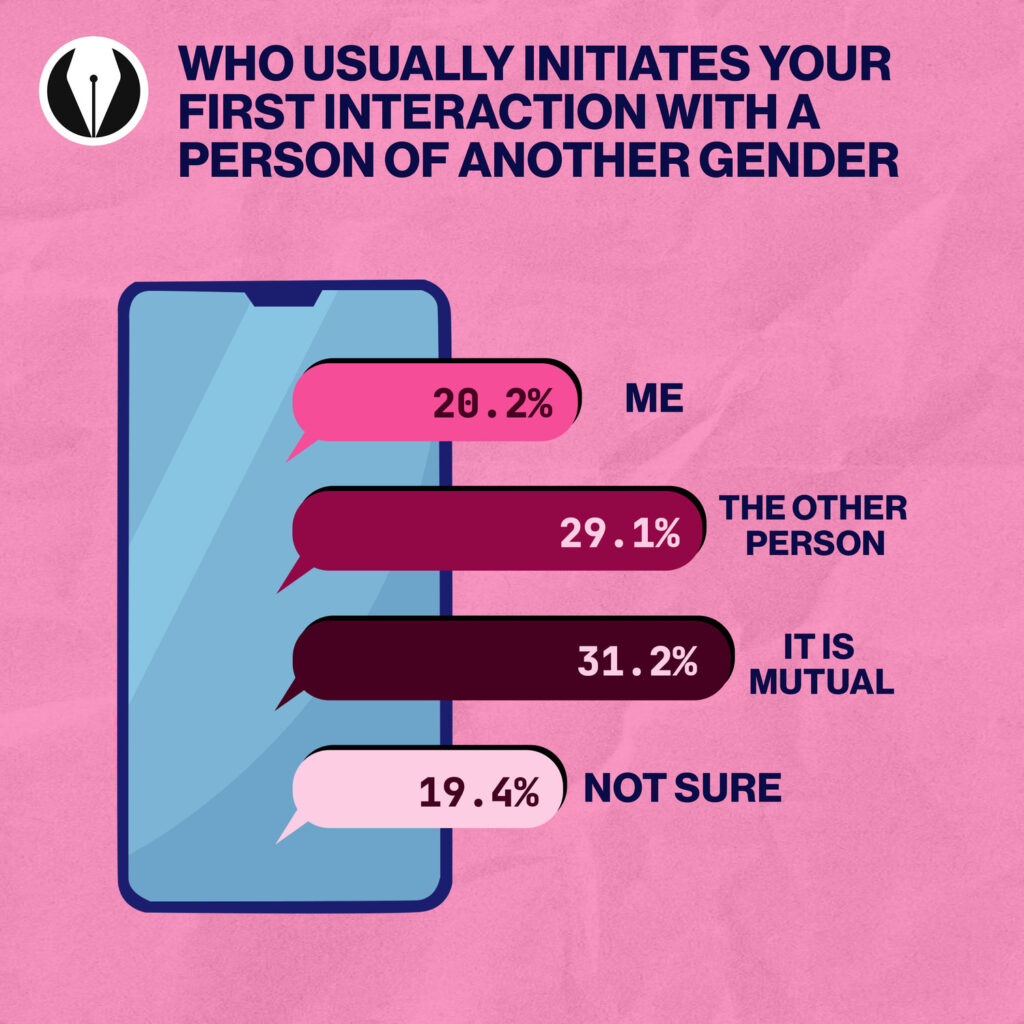
Women are also much less judgemental when their friend interacts with an opposite gender. When 43% of the female respondents say their friends do not care when they talk to a guy, for men, it’s just 27%.
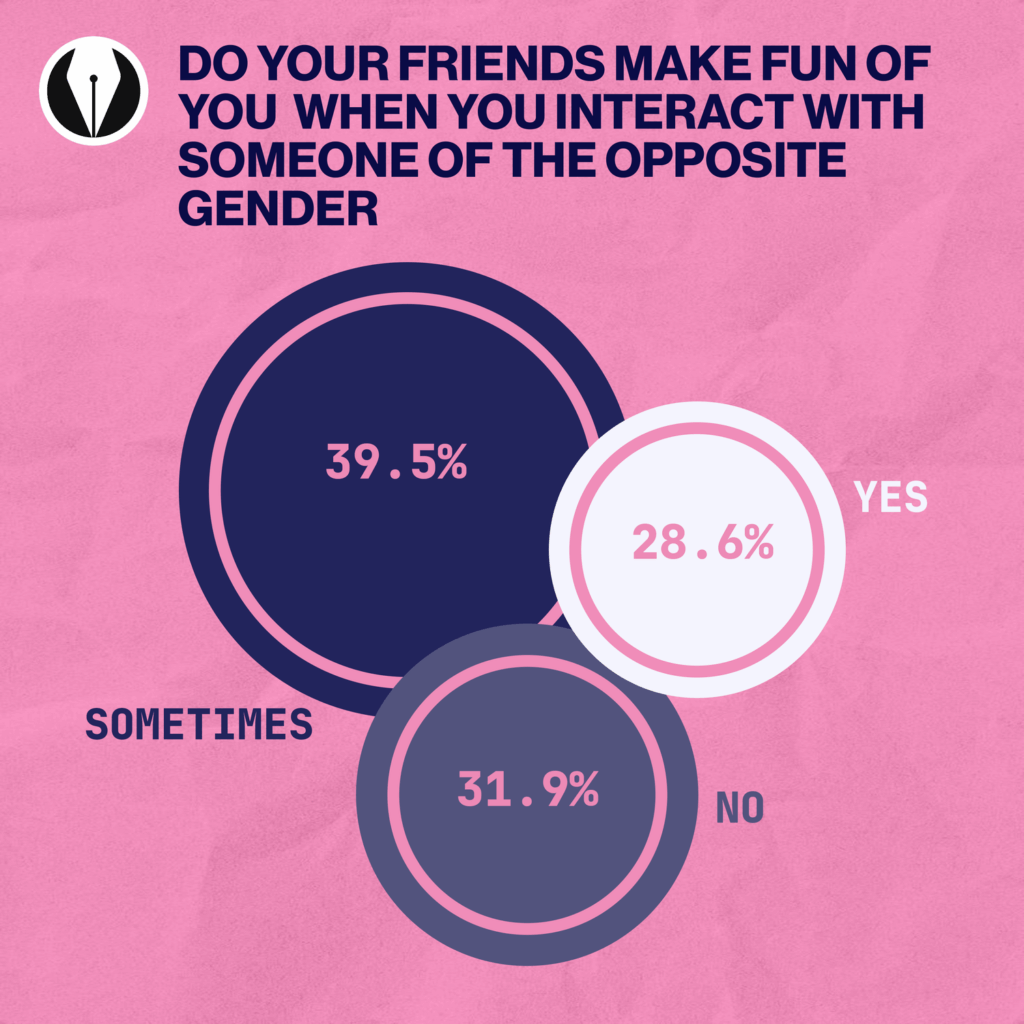
A female respondent quotes,
“When I used to befriend any guy, I have observed how wingies or his/my friends tease us for this. ”
How Do People Notice Each Other Across Genders?
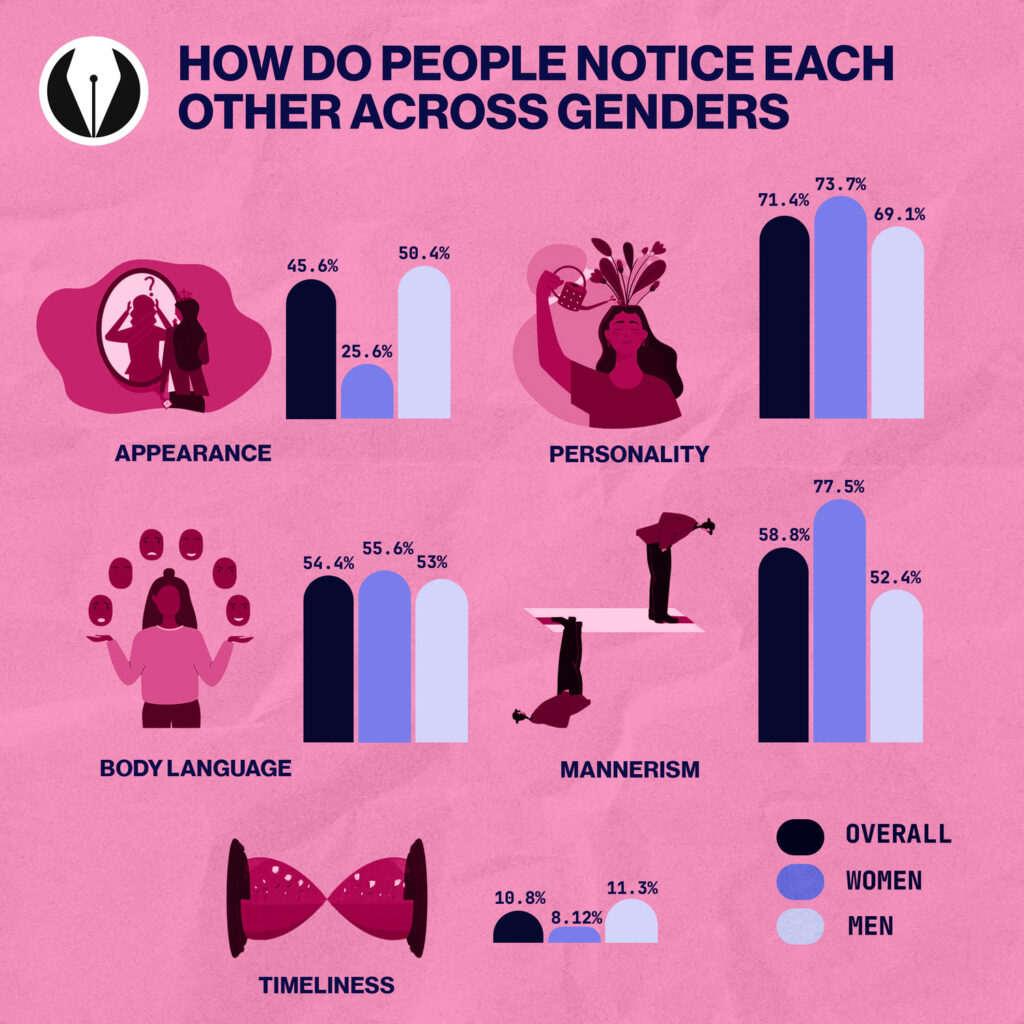
While 50.4% of men admit that appearance is the first thing they notice when interacting with someone from another gender, only 25.6% of women say the same. Women are more likely to focus on personality (73.75% vs. 69.1% for men), body language (55.6% vs. 53%), and mannerisms (77.5% vs. 52.4%).
Barriers To Inter-Gender Interactions :
Why is it so awkward to talk to someone from the other gender? Our campus survey has revealed why we hesitate.
Fear of being judged topped the charts with a whopping 58.4% of students admitting that they feel scrutinized when interacting with the other gender !
A staggering 62% of students cited introversion as their biggest barrier, with women at 55% and men at 62%.
Do you think you’re the only one worried about approaching someone from a different gender because of the way you look? Worry not, 41.2% of students feel insecure about their physical appearance! Women seem slightly less insecure than men on this front, at 31.25% compared to men’s 42.7%.
Preconceived notions about the person are also a serious roadblock, with 45.5% of students reporting this as a barrier. Sometimes, we assume the other gender finds us unapproachable. One respondent put it bluntly:
“A lot of people cook up random gossip that hurts the image of the other gender.”
This problem cuts across gender barriers, making first impressions even harder to navigate.
15% of students feel economic differences create a barrier. Academic barriers also seem to play a role, with 14.1% struggling.
The Fault in Our Interactions
The statistics reveal an unsatisfactory state of inter-gender interactions on our campus. We wanted to further explore the reason for this. Do note that all of these are subjective opinions, so it isn’t necessary that they reflect a general view of what the campus junta feels.
Casual Objectification and Entitlement
For some women, everyday interactions are tainted by inappropriate behavior and an unsettling sense of entitlement from certain men.
“Some of the boys still have the mentality of creepy school kids, they throw comments, I have seen images of girls floating in their WhatsApp groups, which is very immature and idiotic.”
“Some TAs think they are entitled to talk to you, ask you out for coffee, or send you multiple DMs on Instagram after you’ve denied them.”
Even seemingly normal conversations can feel uncomfortable when the hidden agenda is a romantic or sexual pursuit.
“The other gender should not only approach me for relationships… as it is creepy. We are not able to communicate properly and do not feel comfortable around our own future colleagues.”
“When confronted by you or your friends, they have the guts to defend themselves. It sickens me since I have faced this quite a few times.”
Boundary Violations and Stalking
Repeated instances of men crossing personal boundaries have left many women wary, forcing them to alter their approach to interactions.
“Often I have seen these guys going to extreme lengths and crossing boundaries. Even after me clearly stating that I’m not interested, the guy never really stops. As a result, it totally changes the context of the friendship. Earlier this was not the case, but after multiple such experiences, I have observed it’s better to maintain a distance as it often leads to my friendship being misinterpreted as me being interested in that guy.”
“Extreme forms of stalking and one case of a boy liking me and crossing a lot of boundaries has changed how I interact with boys. I am more careful now and make sure that I set boundaries from the start. Also, many incidents of taking photos of me without my consent and other such things done by men in public areas have made me more conscious and scared.”
Lasting Impact on Perceptions of Men
For some women, these experiences have fostered a deep mistrust towards men in general.
“Yeah. I think guys are creeps now. Sorry. It’s almost like they only talk to me for sex. It’s not even funny at this point. I can’t even take a guy seriously anymore. I literally feel like an object sometimes.”
A female respondent opined that choosing your social circle carefully is a necessity for women to traverse the rocky terrain of inter-gender interactions on campus.
“There have been many bad incidents also. But my other male friends have made me feel safe with them always. So, my perceptions about men are not negative. It’s all about wrong choices of male friends, which can be a case with female friends also.”
A male student said how him being aware of multiple previous negative experiences of women while interacting with men also led himself to be more cautious when interacting with women.
“Once my friend of opposite gender told how people keep approaching them, trying to flirt with them, unnecessarily having conversations with them and stuff, which made them feel very uncomfortable. So now whenever I am around people of the other gender, I subconsciously/sometimes intentionally avoid talking to them just so that they don’t feel uncomfortable by any chance (even though many times they wouldn’t feel so).”
Even some men recognize the issue and call for change.
“As a boy, a decrease in creepiness on our side is a change that I wish to see in inter-gender interactions on campus.”
“Talked to a close friend, girl, about all the struggles girls have, the sexual harassment cases that go silently by. This made me cognizant, but also hesitant in approaching anyone for the fear of making her uncomfortable.”
Toxic Mindsets and Social Pressures
Inter-gender interactions aren’t always organic – sometimes, they’re shaped by problematic beliefs and external pressures.
“When we first came to campus, our senior motivated us to ‘get a girlfriend.’ It was more like we were pressured into talking with girls. This made it difficult and awkward to talk to them.”
Some women have the opinion that men trying too hard can be a turn off for them.
“From some of my interactions, I have, shockingly, learned about how tedious it is for certain men to interact with women, and how sexist most of these interactions are. There are people who go around preaching about a “manual” to talk to and “get women.” I was shocked and really dejected to learn that these ideas even exist and that many men participate in furthering such an attitude.”
Evolving priorities for friendships
It’s a fact that behaviour and priorities widely vary over the long 4 years on campus. The carefree mindset in first year is the polar opposite of our experiences in third and fourth year. Some people believe that significantly alters the nature of friendships too.
“From being open and seeking opportunities of interacting to mostly closed. Now I just do my work and respond only if needed… It feels pointless now.”
While these experiences aren’t universal, they highlight how, for some students, friendships have evolved (or in some cases, dissolved) over time.
PG Problems: Barriers to Inter-Gender Interactions
Inter-gender interactions among PG students face unique challenges due to academic workload, age, and past experiences.
“Being a PG student from core engg. branch, interaction with the opposite gender is difficult… In the PG population, several factors like age, workload, previous experiences make people more guarded, judgmental, and prejudiced.”
The average PG experience is very different from an average UG experience, and this reflects in the nature of inter-gender interactions too.
“I have heard of scary stories where stalkers/perpetrators happen to work with the victim/complainant in the same lab or the same department even after a complaint is lodged.”
“As a PG student you keep getting busier and isolated… interactions, and the will to interact, drastically reduces with time spent on the campus.”
Conclusion:
Inter-gender interactions on campus are shaped by more than just opportunity, they are a confluence of upbringing, social norms, skewed gender ratios, and personal experiences. While clubs and classrooms provide space to connect, hesitation, fear of judgment, and past negative encounters continue to hold many back. The need now isn’t just more interaction, but more mindful and respectful interaction. These aren’t just numbers, they reflect the everyday realities of every single one of us. It’s time we shift from awkwardness to empathy, and from assumption to understanding, and we hope this article will prove insightful enough for everyone to make the campus a happier and a safer place!
Written by – Sruthi Subramaniam, Kaushal Jain, Vaishnavi, Raziq, Anikait Dixit, Hrishita Singh
Design by – Pankuri Sachan