![[Not So] Little Women](https://voxiitk.com/wp-content/uploads/2026/09/WhatsApp-Image-2026-09-28-at-19.21.06-240x300.jpeg)




Disclaimer: Vox Populi, IIT Kanpur, is the exclusive owner of the information on this website. No part of this content may be duplicated, paraphrased, or interpreted in any other way without written consent from Vox Populi. If you want to reproduce any of the content on this page, please contact our chief editors directly or reach out to us by email at voxpopuli@iitk.ac.in.
For decades, the number of women across IITs remained extremely discouraging. And very few of those who did qualify, made it to the IITs. But it still felt like the classrooms had assumed engineers were men.
In 2016, only 847 women were offered admission to the IITs, a mere 8% of that year’s class. By 2018, that number had nearly doubled. By 2020, it had crossed 20%.
What caused this sudden increase in female admissions in IITs?
It was the introduction of Supernumerary seats.
There is a lot of stigma and confusion around which comes down to a simple lack of awareness of what these seats actually mean, how they’re structured, and why they exist.
What then are supernumerary seats exactly about? Is it just ‘seat stealing’ in the name of gender equality?
Supernumerary seats, as the name suggests, are additional seats created to accommodate women across IITs.
Supernumerary seats were introduced in a phased manner starting in the 2018–19 academic year, requiring each IIT to create new seats so that female representation in every department reached at least 14%. This target rose to 17% in 2019–20, and then to 20% in 2020–21, where it has held steady since.
Scoring well in JEE Main and Advanced alone didn`t ensure female enrollment. The scheme started off of an observation: a significant number of women were qualifying with ranks good enough for admission, yet very few were actually enrolling. In fact, misconceptions and a lack of family support and encouragement kept many from joining in the first place.
How are the seats allocated?
Qualifying women are first allotted to the newly created female-only seats, with top-ranking candidates given priority, before the remaining seats open up to competition between men and women. Since this isn’t reflected in the admissions data, there’s no way to tell whether an individual entered through SSS or not.
Clarity behind its creation:
For the purpose of this article, we interacted with Prof. Timothy A. Gonsalves, former director of IIT Mandi, and the head of JAB sub-committee that introduced the supernumerary scheme.
We also spoke with Prof. Ravinder Kaur, a sociologist at IIT Delhi whose work on gender in STEM offers a grounded look at the barriers women face in higher technical education.
The core misconception is that these seats “take away” spots that the males would otherwise have rightfully earned. As Prof. Ravinder Kaur found in her research at IIT Delhi, many students had never even heard of the SSS scheme and once it was explained, it was still commonly read as a ‘“girls’ quota,” carrying the assumption that its beneficiaries were somehow less deserving.
In reality, these seats are added on top of the existing pool, giving women a leg up into a better institute or branch without pushing any male student below the rank he’d have secured anyway. In other words, the seats aren’t being taken from anyone. They are created fresh, on top of what already exists.
The scheme also works alongside constitutionally mandated reservations instead of replacing them: women from SC/ST/OBC and other reserved categories continue to benefit under their respective category’s provisions, while SSS separately addresses the gender gap within that same pool. So rather than diluting existing reservation, it layers gender-based support on top of it.
Beyond that, the scheme aims to push every department, not just the institute as a whole, to 20% female representation, so women aren’t clustered only in traditionally “female-friendly” branches like biotech, while remaining largely absent from CSE, electrical, or mechanical. This directly targets the stereotype that certain branches are simply too demanding or unsuited for women.
Notably, the number of supernumerary seats isn’t fixed, it varies by department and by year, shrinking as a department’s organic female enrollment grows. A department already near 20% needs far fewer additional seats to begin with.
So are we compromising with the quality of education and the overall performance of the male ‘deserving’ students, just to create female engineers?
As far as college academics are concerned, women have historically outperformed their male counterparts; the average CPI data of IIT Kanpur showed that females had an 8% higher CPI in the year 2017-18, and a 7% higher CPI in the year 2018-19 [according to data collected from the Academic Office, IITK]
Since this scheme was introduced in the year 2018, it is clear that the performance of women has no correlation with the ranks at which they were admitted.
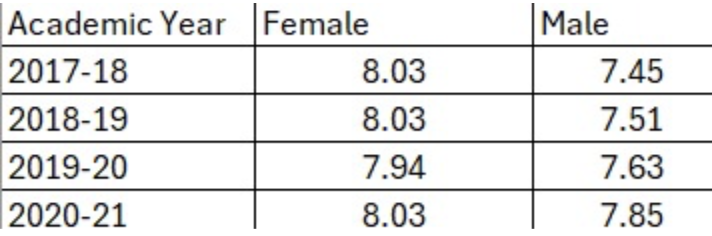
Women’s average CPI stayed steady at 8.03 both before and after the scheme (comparing 2016–17 to 2018–19), even as their numbers on campus grew. Men’s average CPI, meanwhile, stayed noticeably lower, at 7.45 in 2016–17 and 7.51 in 2018–19.
So the batch’s overall CPI went up simply because more women, all performing consistently at a higher level, were now part of the batch.
And it’s not just that women score higher on average, they’re also more consistent. Between 2017 and 2021, the standard deviation of female students’ CPI was consistently lower than that of male students (1.34 vs. 1.62 in 2017-18, narrowing to 1.27 vs. 1.40 by 2020-21). In simpler terms, women’s performance clusters more tightly around the high end, with fewer outliers, fewer academic drop-offs, and a steadier safety margin across the board.
But if women are performing just as well, why can`t they simply make it in, on their own? Why take the unfair advantage of Supernumerary Seats?
“We saw girls sitting beside us in coaching, they got the same resources, then why should they get better options for the same rank in JEE?”
Well, what you didn’t see was the isolation most female students experienced. From the highly skewed ratio of women in coaching institutes to the negligible number of female teachers to help them through. Many female students agreed upon the fact that they felt underrepresented and, more often than not, their doubts remained unresolved because the boys crowded the teachers after class. This could also be linked to the lack of faith of the teachers in their female students, and the underlying bias that boys perform better in JEE exams than girls. Their peer groups were intellectually limited because they were forced not to interact with their male batchmates, or they were shoved into ‘girls’ batches’ and not provided the same level of education.
What you also don’t see is the struggle behind reaching that same batch. For one, they have to go against the social stigma of “If it’s a son, he’ll be an engineer; if it’s a daughter, she’ll be a doctor”. That is to say, if they have equal education or a freedom of choice. And even if they do decide to pursue engineering and crack JEE, most parents don’t agree to sending their girl child to a faraway city for better education, simply because of safety or societal concerns. This affects their preparation and even their choice of college when the time comes.
According to Professor Ravinder Kaur, a study on high-school girls’ aspirations found that girls entering the math/science stream become “less confident” rather than more.
It is not difficult to picture, therefore, that after being taught to be careful their whole life and losing a part of their confidence in the process, if you ask a girl to give exams like JEE, which assesses her risk-taking skills with negative marking, she wouldn’t be able to express herself completely or freely.
So all these and other factors led to IITs having a female ratio of 8% before the introduction of supernumerary seats.
What is surprising to note is that a lot more than that 8% percentage qualified the exam, so the scale of the drop-off was staggering. In 2016, 4,570 women qualified for JEE, but only 847 took admission, barely one in five. By 2017, the gap had only widened, out of 7,259 qualifying women, just 995 enrolled, per data published by JEE Advanced. Year after year, thousands of women who had already cleared one of the country’s toughest exams simply never made it through the door.
Have supernumerary seats actually had an impact on society, besides just adding more female faces in the IIT campuses?
As Professor Timothy A Gonsalves (the head of the committee that proposed the supernumerary scheme) mentioned in the interview, “Engineering is done in teams, and diverse teams produce better ideas”.
Real engineering is human-centered and intensely collaborative .
As Prof. Ravinder Kaur (IIT Delhi) points out, Technology isn’t neutral; it carries the culture of the room that designed it. Our world has long been built around a “default male” mindset. This is why Prof. Timothy Gonsalves insisted the scheme was about better engineering, not tokenism.
Diverse teams build better systems not only because they design keeping in mind a world that is half female, which is a reality they reflect, but also because they bring up more ideas and innovative solutions due to the diversity in perspectives and experiences. The different perspectives don`t just add more ideas to the pile, they also ask well rounded questions and identify more problems to work towards. Mixed teams emphasise the importance of aspects such as accessibility, usability, and ethical boundaries alongside raw technical output, not as an afterthought bolted on at the end, but as part of how the problem is defined from the start.
Back in the 1970s, female students had no choice but to live as paying guests in professors’ homes. The campus was indeed an alienating place for women. With just one or two girls in a batch of 250, they were gazed at like museum exhibits, confined to a tight, isolated bubble, far removed from the fun, chaos, and vibrancy that defined the rest of college life. And change, it’s worth noting, was crawling along at a snail’s pace, if not slower.
Thus, it was surprising when this initiative made decades of difference in just a year. Drawing on 30 years of teaching (from all-male classrooms to today), Prof. Kaur described a marked shift after 2018: more women speaking up in class, less self-isolation, “strength in numbers.”
Supernumerary seats didn’t only give them a better college experience and better exposure, but they also increased inclusiveness for them and gave them a say in the decision-making for students on campus.
More crucially, it altered the mindset of the male batchmates. Many arrive straight out of hyper-competitive, gender-segregated coaching hubs, having rarely interacted with women as intellectual peers. Female students are no longer viewed as alien species who were too scary to be approached for collaborations; they are now seen as equals in projects and competitions who have a lot to add to the table.
What is the way forward?
The female supernumerary seat scheme was initially not intended to be permanent. Today, female representation in IITs is around 20%, but has largely plateaued. At the same time, the gender gap begins well before IIT admission: in JEE (Advanced) 2025, women accounted for 23.2% of registered candidates but only 17.3% of qualifiers. This suggests that reaching 20% IIT enrolment has addressed only part of the underlying disparity. The remaining challenge is to understand and address the factors limiting women’s participation and progression in the domain of engineering.
Our goal should be to make supernumerary seats unnecessary.
As the policy enters its next phase, its effectiveness could be assessed against broader indicators rather than enrollment at IITs alone. These could include the proportion of female JEE applicants and qualifiers, representation across branches, retention and graduation, academic outcomes, and participation in higher education and employment after graduation.
The existing 20% target could be maintained in the near term while investing in measures that increase female participation throughout the JEE pipeline, but this should be accompanied by regular review to ensure 20% does not become a permanent ceiling. In this framework, 50% could serve as a long-term parity benchmark and aspirational end goal rather than an immediate quota.
The scheme could be reviewed every three to five years, with targets adjusted according to the progression data over the years. Rather than setting a fixed end date, an outcome could be considered only when gender representation demonstrates sustained, organic growth across the broader engineering pipeline, rather than at the IIT admission stage alone, indicating that continued intervention is no longer necessary.
Hence, the supernumerary seats can be considered as a major step in evolving the engineering culture in India, creating better engineers with broader perspectives and understanding. Further bridging the gender gap by helping girls find a boat to row against the tide of societal norms and pursue their dreams.
Edited By: Pratyush Sandhwar
Written By: Vedika Mimani, Amirtha Sreya S, Anushka Bhushan, Dishita Bajaj
Researched By: Harsh Kothari, Sarwesh Barnwal
Design: Kashish Varshney