


Disclaimer: Vox Populi, IIT Kanpur, is the exclusive owner of the information on this website. No part of this content may be duplicated, paraphrased, or interpreted in any other way without written consent from Vox Populi. If you want to reproduce any of the content on this page, please contact our chief editors directly or reach out to us by email at voxpopuli@iitk.ac.in.
On 29th July, 2026, a mail was sent out to all students of IITK about the initiative of a mandatory annual health checkup being conducted under directions from the Ministry of Education. The mail stated that this checkup is “conducted once every academic year”, which could misdirect one to think it had been in place for some time. However, this was the first time that such a health checkup was being conducted at IITK, and at such a large scale.
The mail mentioned that the checkup would begin in 2 days, i.e. 1st August, and would be conducted hall-wise. The first drive has since been conducted across most student halls. A second drive has also been planned in each hall for students who may have missed or avoided the tests earlier.
In general, a health checkup sort of sounds like a routine exercise involving, say, a blood test, basic health parameters and a general assessment of wellbeing. However, this initiative at IITK consists of two distinct components: a mandatory general pathology check for students across batches, and a separate, voluntary substance-use screening currently being conducted for the incoming Y26 batch.
With conversations around substance use and the ongoing Nasha Mukt Bharat Abhiyaan by the Government of India, the two exercises raise questions that go beyond the mechanics of the tests themselves. What was the need for such a checkup? Why has the government chosen institution-wide screening as a mechanism for student wellbeing? And once a student is identified as having a potential health or substance-use concern, what happens next?
The mandatory health checkup
When asked about the specific purpose and rationale behind introducing a new health-screening drive for senior batches, the Dean of Students’ Affairs (DoSA), Prof. Pratik Sen, explained that the initiative stems from the National Education Policy (NEP) 2020.
Following a directive issued by the Ministry of Education in December 2025 for implementation from the 2026 academic year, institutes are required to conduct routine pathological tests for students.While the directive provides for mandatory testing, individual institutes have been given autonomy to determine the specific tests to be conducted, with the option of seeking expert guidance from either AIIMS Delhi or the National Institute of Social Defence (NISD).
At IIT Kanpur, the Health Centre (HC) finalised the tests in consultation with AIIMS Delhi. DOSA clarified that the Ministry of Education had issued two distinct letters: one for a voluntary drug test and another concerning a mandatory pathology check.
Consequently, the administration of IITK conducted an optional drug screening exclusively for the incoming Y26 batch, both UG and PG, alongside a mandatory pathology drive covering all batches — Y26, Y25, Y24, Y23 and earlier.
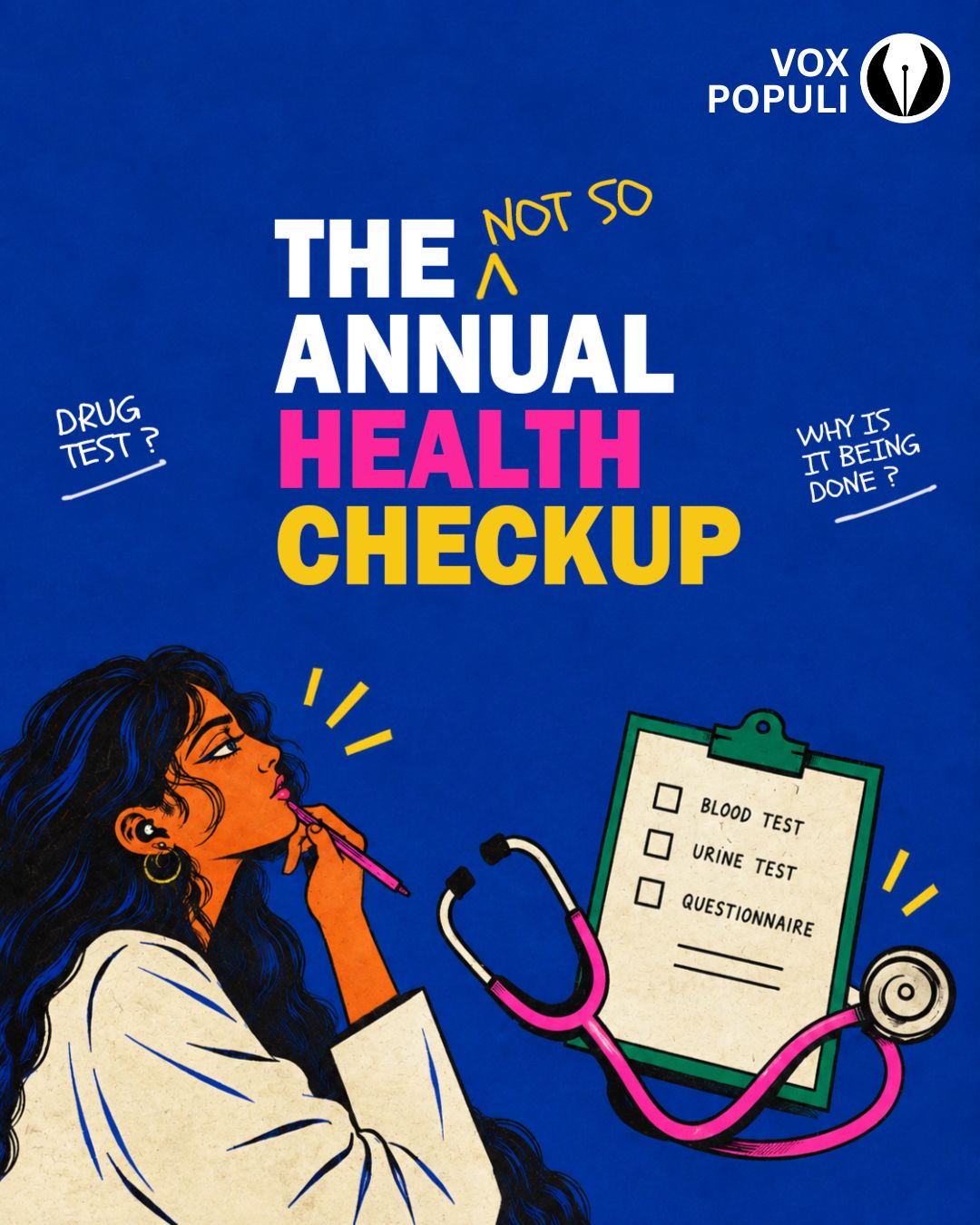
The mandated pathology assessment consists of a blood sample, urine sample and questionnaire, along with standard physiological measurements. The blood tests include haemoglobin, blood sugar, SGPT and serum creatinine, while the routine urine examination (R/M) includes parameters such as colour, pH, protein and glucose. Standard vitals including blood pressure, body temperature, pulse, oxygen saturation, height and weight are also recorded.
What happens to the results?
Addressing concerns regarding student privacy, DOSA assured that the administration would not have access to individual test results and that the data would remain strictly confidential and accessible only to the Health Centre. The medical staff would screen the test data to identify any underlying illnesses or health concerns. In case a medical issue is detected, the HC would reach out directly to the affected student to offer appropriate treatment.
Students, however, retain the choice of whether to pursue the treatment or counselling recommended by CMHW. They can decline or opt out of the process if they do not wish to continue.
However, there remains a question about access to the results themselves.
At the time of reporting, the results of the pathology test as well as the drug screening have not yet been made available to the students themselves. When initially asked about the reasons for this, DOSA said that he would look into the matter and would try to at least provide the results of the pathology test, although he could not promise the same for the drug test. He added that details regarding the drug test could be sought from the CMHW head.
After undergoing the process and providing their blood and urine samples, why are students not being given access to the results of their own tests? The same information is being used by the Health Centre to identify potential medical concerns and determine whether follow-up is necessary, but the student who provided the sample has not yet been given the opportunity to see those results.
A few students have already begun receiving emails from CMHW regarding counselling, apparently based on their scores on the questionnaire. So even if it is intended for the results of these tests to be provided later, why does the HC or CMHW have access to them before students themselves?
To facilitate the large-scale testing, the Health Centre organised a hall-wise setup. The primary drive was conducted over the course of nearly a week. To accommodate students who missed their initial slots, the HC arranged a follow-up screening setup a few weeks later to ensure maximum coverage.
The mandatory nature of this test should also be under scrutiny. Even if the test is done with the best intentions and only intends to assist & identify any potential healthcare concerns, why has it been made compulsory for students? What about the students who are genuinely uncomfortable with the process, given its invasive nature of requiring blood & urine samples?
Some students have also expressed concerns about the consequences of not participating. Students from certain halls, including Hall 2 and Hall 5, have reportedly received emails stating that failure to complete the mandatory test, without providing a valid and duly approved reason, would result in a ₹1,000 fine, which would be added to the student’s Pingala portal.
Another question that comes out of this is: even if a student is comfortable with the nature of the test, they may not want to proceed with it and should have the autonomy to opt out , why then are they being charged with a fine? Why is it so necessary for the administration to have everyone undergo the checkup?
The drug screening
Alongside the mandatory health checkup, a separate substance screening has been introduced for the incoming Y26 UG and PG batches. While the current exercise is limited to the freshers, there are potential plans to extend it to other batches in subsequent phases.
Unlike the mandatory pathology check, the drug screening is voluntary. Both UG and PG freshers were informed about the test and its voluntary nature during their orientation. Subsequently, a consent form was circulated through Pingala, through which 944 freshers- 269 UG, 675 PG initially signed up for the screening.
To ensure that participation was based on informed consent, personal emails were sent to all those who had volunteered earlier, asking them to provide permission again. Following this second round of consent, approximately 200 of the original 944 students withdrew.
In a conversation with Prof. Sudhanshu Shekhar Singh, Head of CMHW, he emphasised that students were asked for their consent again and that any student remains free to withdraw from the process at any point.
Nature of the test
The screening consists of two stages.
The first is the WHO ASSIST – Alcohol, Smoking and Substance Involvement Screening Test , a World Health Organisation-developed screening tool designed to identify substance-use risks and possible disorders.
The questionnaire uses a standardised scoring system to assess the frequency and extent of substance use. This is followed by a urine test screening for six commonly abused narcotic substances, including cannabis, cocaine and opioids. Only 3 of the 6 substances were identified to us by CMHW.
Students retain the option to withdraw at multiple stages of the process, either initially through the Pingala consent form, at the Health Centre, or even after completing the questionnaire.
During the first cycle, only 113 students finally reported for the screening. CMHW subsequently transitioned to a dedicated portal and began reaching out to students by phone to reconfirm consent. At the time of reporting, approximately 100 students were yet to confirm or decline participation, while CMHW expects roughly 250 additional students to participate during the ongoing second cycle.
What happens after a positive screening?
According to CMHW Head , the screening has been designed to assess health rather than taking disciplinary action.
Each sample is assigned a unique identification number before the test is conducted. According to CMHW, nobody other than the CMHW has access to the information linking these IDs to individual student roll numbers, not even the personnel conducting the test.
Once the screening is complete, the data will be used by CMHW to reach out to students identified as potentially exposed to substance abuse and encourage them to seek counselling and rehabilitation through the already-operating de-addiction centre on campus.
Prof. Shekhar emphasised that CMHW operates exclusively through a wellness and healthcare lens. To ensure sensitive handling of the process, the first round of staff sensitisation has already been completed.
WHAT WAS THE NEED?
The Ministry of Education in its official letter, makes a broader demographic argument: with 65% of India’s population under the age of 35, students in higher educational institutions form an important part of India’s young population, and their physical and mental wellbeing is necessary to “reap the demographic dividend.”
The Ministry therefore presents health screening as a preventive intervention. Its stated purposes include assessing students’ physical wellness, identifying disease incidence and potential substance abuse, and enabling remediation through medication and counselling. It has asked institutions to conduct initial and annual health check-ups of all students from the 2026 academic year.
But this raises a more fundamental question: why does improving student healthcare require universal, recurring screening in the first place?
There is an important distinction between providing healthcare and screening an entire population for health problems.
The government’s policy assumes that routinely screening all students will identify problems early enough for intervention to improve outcomes. Whether that assumption holds depends on the conditions/tests being screened for, the prevalence of those conditions, the accuracy and usefulness of the tests, and what happens after a positive result.
The World Health Organization notes that screening is intended to identify apparently healthy people at higher risk so that early intervention can be offered, but cautions that screening programmes require evidence of effectiveness and can also create costs, unnecessary follow-up and harms such as false positives and overdiagnosis.
Thus the letter by the Ministry of Education, makes its mandate of screening students each academic year clear but does not provide an epidemiological explanation for why an annual health checkup is necessary for the general student population.
There is another question about where the resources devoted to this exercise are being directed. A programme of this scale requires medical personnel, laboratory capacity, data management, follow-up and counselling infrastructure. The government has also called for capacity-building of institutional health personnel and campus-level counselling support. But the screening itself remains the most visible component of the intervention.
This raises a question about whether the priority should be identifying more students with potential health concerns, or strengthening the facilities available to students who already seek help.
At IITK, students who actively seek medical or psychological assistance already interact with the Health Centre (HC) and CMHW. If the objective is to improve student health and wellbeing, resources could alternatively be directed towards strengthening these services from the ground up through measures such as increasing the availability of doctors and counsellors, reducing waiting times, expanding appointment availability, improving specialist and psychiatric support, strengthening follow-up mechanisms, and making treatment and rehabilitation more accessible to students who need them.
*Note : The claim isn’t that these institutions are currently failing at providing support to students, rather a question of whether priority should be given to improving the existing infrastructure and making it more accessible or screening students.
According to our sources only IITK and IITKGP so far have conducted either ( or both) of these checkups amongst the older IITs. And IIT Goa being the only other IIT that’s publicly reported of conducting a drug test for its incoming freshers batch.
Edited By: Manya Dixit
Written By: Pratyush Sandhwar, Lavanya Srivastava
Researched By: Amirtha Sreya S, Shubham Singh, Vedant Nagmoti
Design: Sameer Baranwal, Kashish Varshney