
![[Not So] Little Women](https://voxiitk.com/wp-content/uploads/2026/09/WhatsApp-Image-2026-09-28-at-19.21.06-240x300.jpeg)

Disclaimer: Vox Populi, IIT Kanpur, is the exclusive owner of the information on this website. No part of this content may be duplicated, paraphrased, or interpreted in any other way without written consent from Vox Populi. If you want to reproduce any of the content on this page, please contact our chief editors directly or reach out to us by email at voxpopuli@iitk.ac.in.
From its early reputation for producing some of the country’s finest engineers in traditional disciplines such as Mechanical and Civil Engineering, IIT Kanpur has continually expanded its academic offerings with changing times. The latest addition to its long-standing academic structure is the Department of Intelligent Systems. This article looks at the department’s formation, its academic structure and the challenges surrounding its implementation, along with the related academic reforms that may shape its future.
Motivation and Rationale
In recent years, Artificial Intelligence has emerged as a major technological paradigm, with far-reaching applications across almost every walk of life. This has been accompanied by a rapid proliferation of AI tools and growing public demand for AI-related education. Where, then, does IIT Kanpur stand in this rapidly evolving landscape?
The institute houses several centres and research initiatives working in areas closely related to AI and intelligent systems including the Center for Developing Intelligent Systems (CDIS) and the Center for Cyber Security of Critical Infrastructure (C3i). The idea was now to scale this work into formal degree programs.
On this idea, Prof. Indranil Saha (HOD of DIS) says, “A market study was done to assess student interest and job prospects. Alumni and industry stakeholders were consulted. Research showed a strong recognition that AI and related sciences have matured enough to justify a dedicated academic program.”
He further explains that while the field draws from already existing departments such as CSE, Mathematics, EE and Mechanical Engineering, these departments primarily aim for broader coverage. The new department, on the other hand, will focus on specialised research and industry-driven training in AI and Cyber-Physical Systems.
Establishment of the Department
The proposal for coming up with such a department was first discussed in the SEPC meeting held on 27th Dec 2024. The planned programs under the department are of four types:
- B.Tech. in Intelligent Systems (BT-IS) and variants (BTM-IS, BTH-IS)
- Double major in IS (DM-IS)
- Minor programs (Digital IS, Cyberphysical IS)
- M. Tech. in Intelligent Systems (MT-IS) and dual degree variants (BT-MT-IS, BTM-MT-IS, BTH-MT-IS)
The department is hosted under the aegis of the recently formed Wadhwani School of AI and Intelligent Systems (SIS) with significant funding being provided by Dr. Ramesh Hodani through his foundation in the USA. The School does not run these academic programmes or degrees. Its role is to undertake projects and large-scale research initiatives. Core teaching and degree programmes are handled by the Department and will take place within the usual academic framework of the institute.
The department has launched undergraduate (B.Tech.) and postgraduate (M.S.) programmes in Intelligent Systems for the 2026–27 academic session. Admissions to these programmes are integrated into the institute’s established pathways, through JEE for the B.Tech. programme and GATE for the M.S. programme. The department has welcomed its first cohort of students to campus. As of now, the department has admitted 31 B.Tech. students, 16 M.Tech. students and 2 M.S. students”. The department has also admitted 6 PhD students this year, taking the total number of PhD students to 10.
The faculty hiring for the dept. is under process, with the hiring target currently being 4 new faculties each year on average, over the next 10 years to have a total of 30-40 faculty positions. At present, the faculty members associated are primarily affiliated with established departments like CSE, EE, ME, and ECO.
The current faculty composition includes:
Under the Department:
5 faculty from CSE
3 from EE
1 from Mechanical Engineering
1 from Economics
Prof. Rajiv Ratan Shah from DIS
Total ≈ 11 core departmental faculty
Under the School :
1 Professor of Practice
About 3 visiting faculty
Those under the School generally have lower teaching loads and more responsibility for large projects and centers.
Academic Course Structure & Curriculum
The curriculum of the Department of Intelligent Systems combines courses developed within the department with existing courses from allied disciplines.
Department Compulsories
The department-specific compulsory courses include:
- IS201: Probability and Statistics for ML
- IS203: Fundamentals of Data Engineering – Part II (Things)
- IS301: AI Ethics
- IS302: Fundamentals of Data Engineering – Part III (OPS)
In addition, the department has incorporated DCs from other departments, including:
Electrical Engineering
- EE200: Signals, Systems and Networks
- EE250: Control Theory / Control Systems
- EE320: Principles of Communication
Mechanical Engineering
- ME381: Robotics
Computer Science and Engineering
- Courses such as CS771, which is also offered as a DC for Intelligent Systems.
Beyond the compulsory courses, the department has organised its electives into two broad baskets, allowing students to specialise in different aspects of Intelligent Systems.
Digital AI (D Basket)
The Digital AI basket focuses on software-based intelligent systems, including Large Language Models (LLMs), recommendation systems and data-processing pipelines.
- IS614: Software Engineering for Intelligent Systems (new)
- IS611: Probabilistic Machine Learning (CS772)
- IS612: Modern Cryptography (CS641)
- IS613: Human-AI Interaction (CS698Y)
Cyber-Physical Systems (C Track)
The Cyber-Physical Systems basket focuses on intelligent systems that interact with the physical world, with applications such as autonomous vehicles and surgical robotics.
- CS625: Robot Dynamics (new)
- IS621: Embedded and Cyber-Physical Systems (CS637)
- IS622: Computer-Aided Verification (CS652)
- IS623: Convex Optimization (EE609)
- IS624: Basics of Modern Control Systems (EE650)
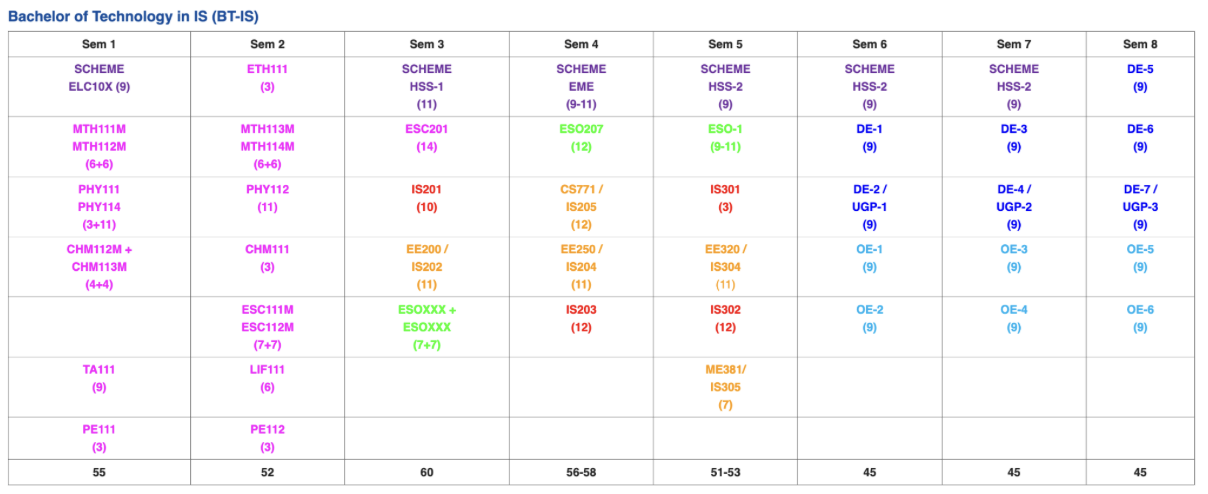
It is expected of the BT-IS students to take at least 9 Basket DE(BDE) credits from the C-track and at least 9 BDE credits from the D-track. The remaining 27 BDE credits may be taken from either track. The courses are expected to be generally lab-intensive.
Initially, the proposal also included Minor and Double Major programmes. However, Prof. Nitin Saxena said these would not be introduced immediately, citing limited full-time DIS faculty. He noted that existing AI/CS minors largely rely on CSE courses and do not offer much new. Once DIS has 5–6 full-time faculty and its own electives, it could launch these programmes.
Major Challenges And Roadblocks
The course structure of this new department brings into focus its overlap with existing programmes. More than half of its DCs are courses from existing departments, all of which, barring CS771, are themselves DCs in their respective departments. Similarly, over 75% of the DEs are drawn from existing departments. This brings up questions about accommodating DIS students alongside existing enrolments and, more importantly, how much of the programme, in its current form, is actually distinct from what is already being offered across the institute.
Similar concerns were shared by several departments during the feedback process discussed in the SEPC meeting. Vox spoke to Prof. Sagar (SUGC Chairperson), he mentioned, “students of Intelligent Systems would attend these common courses along with students from the respective departments. A Special Permission has been obtained from the HODs of CSE, EE and ME departments, under a three-year agreement, with course instructors and TAs taking on this additional teaching responsibility.”
The current B.Tech. intake of the department is around 31 students. Given the relatively large class sizes of these existing departments, accommodating this additional cohort is unlikely to be difficult at the present scale. As the department grows, though, the same arrangement may have to be revisited depending on student intake and the teaching capacity of the departments involved. The departments agreeing to the arrangement asked for improvements to lab facilities and other infrastructure, which SIS committed to providing.
The overlap also brings up a more specific question: how should these common courses be numbered? There were initial discussions around renumbering or dual-numbering these courses as ISXXX course codes, with the proposal that any course in the template not offered natively by the IS department would have to be renumbered or dual-numbered before IS students could count it towards their DC or Basket DE requirements. Under this arrangement, it was to be mandated that the students would have to register only for the IS-numbered version to fulfil these requirements, and a student could not register for the same course twice under different numbers,e.g., taking IS271 as a DC and CS771 as an OE in a subsequent semester. However, this proposal was later dropped, citing logistical difficulties in offering the courses and checking for overlaps. The institute has been rather reluctant to adopt such a system in the past.
Another option considered was to offer these common courses as Inter-Disciplinary Courses (IDCs). Under the IDC mechanism, a course is jointly offered by multiple departments, with the participating departments sharing the teaching responsibilities among faculty and TAs. So far, this mechanism has been used primarily for postgraduate courses only.
With the faculty hiring still under way and a limited number of PhDs to serve as TAs, offering these courses as IDCs is not particularly feasible at this stage. Moreover, given that many of the borrowed courses are central to their respective branches, it did not make sense to offer them as IDCs by stripping off their original numbering.
The remaining option, therefore, was to retain the existing course codes. While this does not pose a logistical difficulty, it does result in an unusual situation where around two-thirds of all DCs and DEs in the DIS curriculum carry course codes belonging to other departments.
Beyond these directly shared courses, there is also a considerable overlap in course content with existing offerings in AI/ML across the institute. To address this, it was initially suggested that a warning be placed on the Pingala student pre-registration portal stating that “IS students would not be allowed to claim credit for courses with more than 40% overlap with a compulsory course (IC, DC, ESO, SCHEME) or an already credited course.” The IS School asked to facilitate the DUGC/DPGC in identifying and blocking such requests.
However, enforcing such a provision could present a practical challenge, especially when it comes to identifying the extent of overlap between courses. Ensuring that such overlaps are consistently identified and accounted for could therefore remain an important consideration as the programme expands.
When Vox Populi last reviewed the curriculum in late June, out of the 7 new courses being offered, proposals for five courses had been sent for review under the Academic Senate, four of which had been approved. The proposed “Ethics of AI” course was still under discussion, with a similar course already being offered by the Department of HSS. It was not made clear whether the new course would take a more technical approach or follow the HSS perspective in terms of its content.
New IC Course & IC Basketization
Among other considerations, it was recognised that the applications of AI/ML have become pervasive across various science and engineering fields, creating a need for all UG students to receive some exposure to these techniques. The School of Intelligent Systems (SIS) therefore proposed a new IC course, IS200 (Fundamentals of Data Engineering – Part I), aimed at introducing UG students to the basic use of AI/ML techniques for creating data pipelines and building end-to-end web-based applications.
With the introduction of IS200 as an IC course, the total number of IC credits required across UG programmes would rise to around 121–123, increasing the overall IC credit burden. To address this, the idea of IC basketization was considered. Under this proposal, the UG curriculum guidelines would be restructured to require all BT/BS programmes to fulfil their IC requirements by selecting courses from a common “basket” of IC courses, while keeping the overall requirement within the existing range of 101–109 credits. Currently, ESC-111 is compulsory; under the proposed system, departments may have the flexibility to retain ESC-111 or opt for IS200 (FDE-I) instead.
The proposal for IC basketization has been discussed in the Academic Senate on several occasions. “The Senate has partially approved IC reforms, so departments will be allowed more freedom to choose which ICs they want in their templates. To support IC reforms, this proposed course FDE-I is currently being taught as an ESO to B. Cyber students, it is expected to be open for all UG 1st year students next year onwards.” says Prof. Nitin Saxena.
Student Response and Way Forward
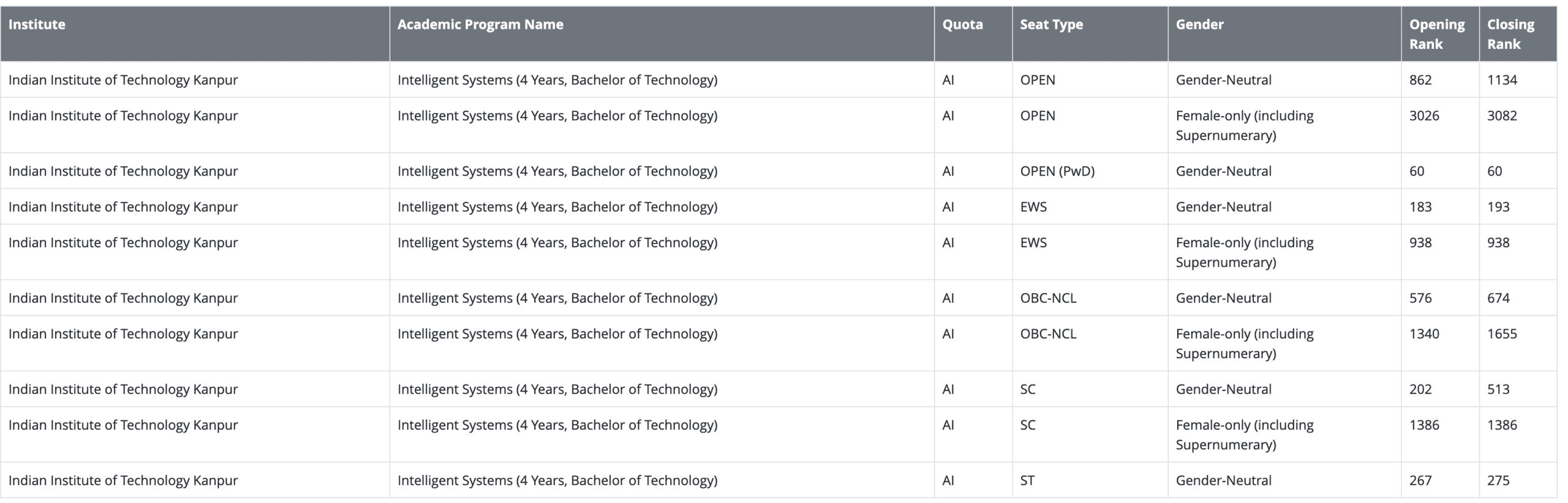
The department saw a positive response in its first year, with its first batch of UG students joining the programme this year. The opening and closing ranks for the department were in a comparable range to Electrical, Mathematics and other circuital branches.

Looking ahead, Prof. Nitin Saxena, faculty member at DIS, believes that the department could eventually develop a strong position in the AI job market. “Companies may start to prefer DIS graduates over even CSE, because DIS students will have more exposure to practical, client-facing AI work,” he says.
Speaking about the next steps for the department, HOD Prof. Indranil Saha identifies several priorities. These include attracting a strong pool of PhD students in the early years, strengthening infrastructure, securing greater funding and alumni support to develop the planned facilities and programmes and expanding the department’s faculty strength.
Conclusion
With AI and ML increasingly shaping the job market, the creation of a separate programme in Intelligent Systems was perhaps only a matter of time. The response during the JoSAA counselling process reflected strong interest among students, and the new branch could potentially give IIT Kanpur another avenue to strengthen its position in AI education among the IITs.
At the same time, it is important to realise that the department has begun its journey with several important questions still being worked out with several of its courses shared with existing departments, overlaps among other courses, and faculties drawn from across the institute. It will also be important to notice how the institute approaches the proposed changes: the basketization, IDC frameworks for UG courses, and mechanisms for handling course overlaps.
The success of DIS will ultimately depend not only on the demand for AI professionals or student interest, but on how effectively IIT Kanpur translates this demand into a curriculum, faculty base and academic ecosystem that offers something meaningfully different from what already exists
Written and Researched By: Pratyush Sandhwar, Suhani Joshi
Edited By: Rohan Sawlani
Design: Sameer Baranwal


![[Not So] Little Women](https://voxiitk.com/wp-content/uploads/2026/09/WhatsApp-Image-2026-09-28-at-19.21.06-768x960.jpeg)