

Disclaimer: Vox Populi, IIT Kanpur, is the exclusive owner of the information on this website. No part of this content may be duplicated, paraphrased, or interpreted in any other way without written consent from Vox Populi. If you want to reproduce any of the content on this page, please contact our chief editors directly or reach out to us by email at voxpopuli@iitk.ac.in.
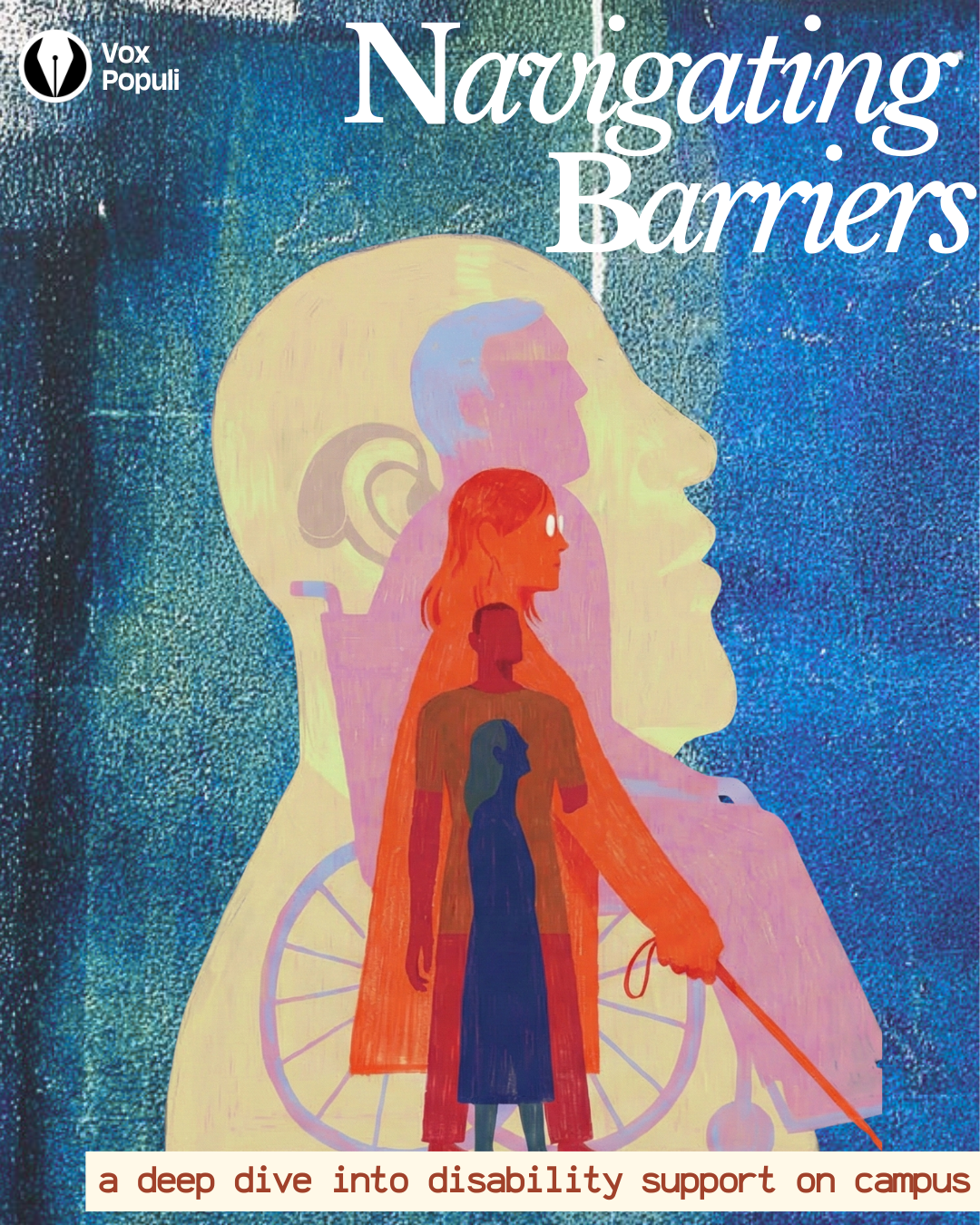
Established in 2017, the Cell for Differently-Abled Persons (CDAP) at IIT Kanpur supports students with both visible and invisible disabilities. As a central resource on campus, CDAP is committed to providing essential services and fostering inclusive practices that enable differently-abled students to thrive academically and socially.
The cell was reconstituted on February 1, 2024, for a term of three years. Its structure brings together a collaborative team: A coordinator and two faculty members, 2 staff members, four student representatives (2 UG and 2 PG) and 3 section representatives (one each from DOSA, library and SPO).
We at Vox, conducted a survey among differently abled students at IIT Kanpur to understand the current state of facilities and support. The responses highlighted areas for improvement in maintenance, accessibility, academic inclusion, and institutional engagement.
We spoke with CDAP official Ritika Gupta, as well as the student nominees of CDAP for the 2024–25 tenure-Shruti and Supritum. These conversations enriched our understanding of the mechanisms in place, the challenges students face, and the efforts being made to bridge existing gaps.
Campus Accessibility and Infrastructure Challenges
Many students pointed out that spaces like the Open Air Theatre (OAT) and Lecture Hall Complexes (LHCs) are still not fully accessible. In response, Ma’am Ritika stated, “A survey of all buildings is conducted annually, and necessary changes are forwarded to the Dean of Infrastructure and Planning (DOIP). However, participation by differently abled students in the survey remains limited.”
CDAP’s end-term report, prepared by student representative Supritum, mentions that the library section representative raised accessibility concerns regarding the library building during a CDAP committee meeting. He proposed constructing a wheelchair-accessible ramp and installing a modernized lift with braille integration to support SwDs. However, despite repeated reminders in subsequent meetings, no concrete action was taken.
In their response, the CDAP authorities acknowledged that IIT Kanpur is committed to making the campus accessible for all and that the library accessibility poses challenges for SWDs. However, they noted that infrastructure modifications are constrained because the library is a heritage building, which severely restricts structural changes.
A functional lift was installed at the OAT by the Institute Works Department, in order to make rooms of the New SAC accessible. When the issue of the extended period for the installation of a lift within the Open Air Theatre (OAT) was raised, authorities acknowledged that infrastructure built decades ago poses challenges in implementing accessibility improvements and that student-led initiatives are warmly acknowledged and have been crucial in pushing for these changes.
Funding Constraints
While some students received aids like binoculars and battery-operated cycles, maintenance and aftercare remain lacking. For instance, a student struggled to get his equipment repaired, as CDAP could not provide after-sales support. A Y20 student reported that, “I had to bear the cost of a ₹24 lakh wheelchair during the COVID era, with CDAP unable to extend financial assistance.”
The cell operates within a limited budget, but the administration tries to provide support within its capacity. The cell has sought funding from Corporate Social Responsibility (CSR) initiatives, which have helped procure electric wheelchairs, assistive devices, and specialized software for visually impaired students. However, some proposed initiatives, such as real-time lecture board projection for students with disabilities, have faced logistical and privacy-related challenges.
Shruti (student nominee) mentioned that despite her efforts, many requests such as recorded lectures, hearing aids, accessibility devices and dictation tools remain unmet due to funding limitations. CDAP also largely relies on alumni donations, which only began post-2017.
Academic Inclusion
Students raised concerns about the Physical Education (PE) curriculum. Some reported having to wait long hours in extreme weather for classes and expressed frustration over the lack of proper written-exam seating arrangements and proper desks. According to CDAP, special seating arrangements are made available on student requests.
The CDAP end-term report noted that the CDAP committee raised the issue of PE111 and PE112 courses being inaccessible to differently abled students.The committee resolved to explore alternatives such as yoga, citing its mental health benefits, but no action followed despite assurances of contacting the SPEC Chairman.
One student shared, “Some professors ignored the extra 20 minutes allotted.” In response, CDAP authorities told us that since the past 3 years professors are regularly informed about the requirements of SWDs by email prior to exams.
While IITs like IIT Kharagpur and IIT Delhi provide separate rooms for conducting exams for differently-abled students, CDAP authorities shared a different perspective. They explained that IIT Kanpur follows an inclusive model, preferring not to isolate students in separate rooms. Instead, efforts are made to ensure that extra time and necessary support are provided without singling them out.
Placement-Related Concerns
A Y20 student reported that “SPO members forgot to provide necessary accommodations during internship and placement season.”
Ma’am Ritika stated that the Student Placement Office (SPO) is sensitized to the needs of differently abled students and holds discussions with the SPO Chair to address concerns. For the past months, SPO has been actively working to support differently abled students. Measures include:
- Setting up a dedicated room near Kargil Chowk for activities like written tests and group discussions, especially for students unable to access midnight venues like NCL or LHC.
- Conducting a special placement drive for differently abled students who have not yet been placed.
- Appointing an OPC to connect with companies for DAP recruitment.
According to the end-term report, the CDAP committee discussed the lack of accessible washroom and drinking water facilities at the Media Centre, a designated placement exam venue. A letter had already been sent to DOIP by the CDAP Coordinator and PI. The committee recommended following up via email with SPO, reiterating CDAP’s communication with DOIP and the need for temporary facilities if renovations are delayed.
Despite SPO’s support, there are challenges like miscommunication between companies and HR managers where HR is often unaware of the DAP category. Technical issues and standardized criteria often result in indifferently abled students not meeting cutoffs. However, a co-placement drive with IIT Madras was successful and a separate exam room for differently abled students has been made available near the media room.
Insights from CDAP Student Nominees
When we asked about student involvement, Ma’am Ritika remarked, “Student representatives are rarely involved in resolving concerns, and since officials leave after 5 PM, it’s their responsibility to handle these matters.” In response, we spoke with two student nominees who offered their perspective.
Shruti’s (student nominee) motivation stems from personal experience. Diagnosed with Rheumatoid Arthritis in her first year but ineligible for a disability certificate, she became aware of the many challenges differently-abled students face.
As a nominee, Shruti organized events, assists students with concerns, conducts separate orientations for differently abled students, and acts as a first responder during emergencies. Earlier, as a volunteer, she and her team checked in with students before major exams. Now, her focus is on broader coordination and event planning.
A recent volunteer drive brought in 14 responses , up from just 3 in 2022 helping bridge the support gap, though more participation is still needed.
Despite the many challenges the differently abled students face, there have been several inspiring stories. Shruti shared a few remarkable ones: of a blind student she continues to assist, a student who writes using his feet, a scholar with albinism who received the President’s Award, and a visually impaired alumnus who played a key role in shaping CDAP during its formative years.”
Another student nominee, Supritum, highlighted several developments during his tenure. He made the end term report for CDAP. A key issue addressed by him was the proposal to charge differently-abled students for campus commute services. He opposed the plan, citing financial constraints faced by some students, which ultimately led to a reversal of the decision. Additionally, he worked to improve representation of differently-abled students in the Student Senate by proposing that, in the absence of elected candidates, one undergraduate and one postgraduate student should be nominated to ensure continued representation.
Concerns regarding transparency in CDAP’s internal operations were raised by him, particularly in relation to the handling of student volunteer responses for projects such as website revamping, orientation programs, and the CDAP anniversary. The nominee observed a degree of reluctance among faculty members to share details of these processes with student representatives. In their response, the CDAP authorities stated that they are committed to maintaining the confidentiality and privacy of students with disabilities on campus and therefore do not share any information that would violate it.
He also spearheaded a proposal to allow students with mobility issues to carry their bags into the library by issuing special library cards, an initiative aimed at enhancing access for those with physical limitations.
Administrative cooperation, however, he said ,was inconsistent. In a meeting held on December 3rd, Supritum requested updates on the progress of recommendations made post-protest. While he was advised to follow up with the new DOAA in January, the discussion was not formally recorded in the meeting minutes. Despite repeated reminders, the minutes remained unapproved, prompting him to withhold his signature until the dialogue was officially documented.
Moving Forward
Authorities state that while CDAP has achieved several milestones, like conducting India’s first Indian Sign Language Workshop at an IIT and organizing UDAAN, a para-sports event for differently-abled students, low participation sometimes leads to cancellations. While CDAP creates opportunities, students must take the initiative to engage.
While CDAP is not a research center, several faculty members contribute to developing assistive technologies, including machine-assisted tools and navigation apps. With the upcoming medical school at IIT Kanpur, more interdisciplinary innovation is expected.
IIT Kanpur is also a founding member of the Inclusive University Alliance (IUA), a network of 18 institutions committed to improving accessibility in higher education. CDAP is currently exploring mentorship programs with alumni to further strengthen support for differently abled students.
With ongoing efforts and growing collaboration, CDAP continues to move toward a more inclusive future.
Written by : Archit Rahalkar, Ojas Bajpai, Aryaman Oberoi, Sumit Yadav, Kumar Shubham, Ashutosh Sharma
Edited By : Yeva Gupta
Designed by : Pragya Puri