



It’s 2 AM after a fest night. Two people are laughing, talking, maybe flirting. One thinks the moment is right; the other isn’t sure. Nothing dramatic has happened yet but something important is unfolding in that small space of uncertainty. On college campuses, especially during late-night hangouts, end tenure parties, and high-energy fests, the line between comfort, curiosity, and pressure often blurs. In moments like these, assumptions quietly step in where communication should be.
And assumptions, as we all know, are terrible communicators.
Consent, then, isn’t just about avoiding a “wrong move.” It’s about whether an interaction is built on trust, respect, and mutual clarity. And before we talk about healthy relationships, safe intimacy, or even basic boundaries, there’s one uncomfortable truth we need to confront: many of us think we understand consent, but often, we don’t.
Brief on Survey:
Our campus-wide anonymous survey drew 1,404 responses. Most were undergraduates (75%), with postgraduates making up the rest. A large majority identified as male (76%), about one in five as female (22%), and a small share chose other identities. The survey set out to map where students stand on issues like contraceptives, STIs/STDs, consent, pornography and sexual identity aiming to understand the levels of awareness and perspectives across the student body.
In this article, we present our findings with an objective lens, focusing on awareness levels, perceptions, and experiences rather than rushing to definitive conclusions. The aim is to highlight key trends and gaps that can inform meaningful conversations and solutions.
What do we mean by ‘SEXUAL CONSENT’?
Sexual consent is a clear, explicit, and voluntary agreement between all parties to engage in a specific sexual activity. For consent to be valid, every person involved must have the capacity to consent (they must be sober enough and mentally capable of making decisions), must be fully informed about what the activity involves, and must give their agreement freely, without any form of pressure, fear, manipulation, or obligation. Consent must be communicated clearly, applies only to what is agreed upon, and can be withdrawn at any time, even after the activity has begun.
In simpler terms: everyone involved should genuinely want to be there and feel free to say yes or no without consequences. If you have to guess, it’s not consent. If you’re unsure, it’s not consent. And if you’re hoping silence means yes… it doesn’t.
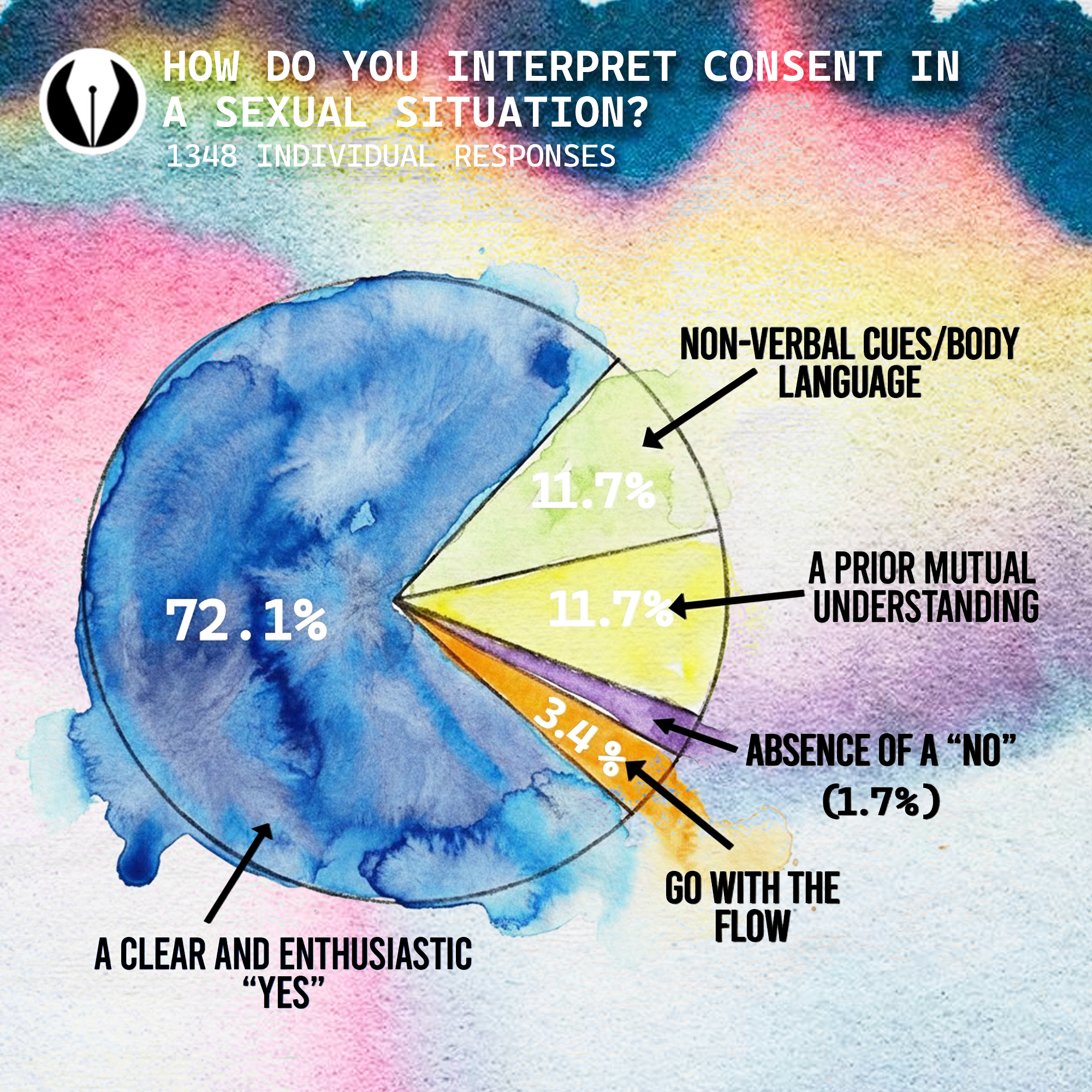
Our survey shows how differently this is understood. When asked “Which of the following best describes how you interpret consent in a sexual situation?”, 72.1% of respondents said consent requires a clear and explicit verbal “yes”, aligning most closely with this definition. However, 11.7% reported relying on non-verbal or behavioural cues, and 11.7% felt that previously agreed-upon boundaries were sufficient, while 1.7% interpreted the absence of a clear “no” as consent. 3.7%, said they rely on the situation without consciously reflecting on consent in the moment.
This matters. Consent isn’t a puzzle you’re supposed to solve. If you’re replaying pauses, decoding silences, or trying to interpret “signals,” you’ve already gone past the point where someone should’ve just asked. Silence, body language, or something that was said earlier are way too easy to misread, especially when discomfort, fear, alcohol, or social pressure make it hard for someone to speak up. If you’re guessing, it’s probably time to stop guessing and start communicating.
CONSENT IS A PROCESS, NOT A ONE-TIME CHECKPOINT
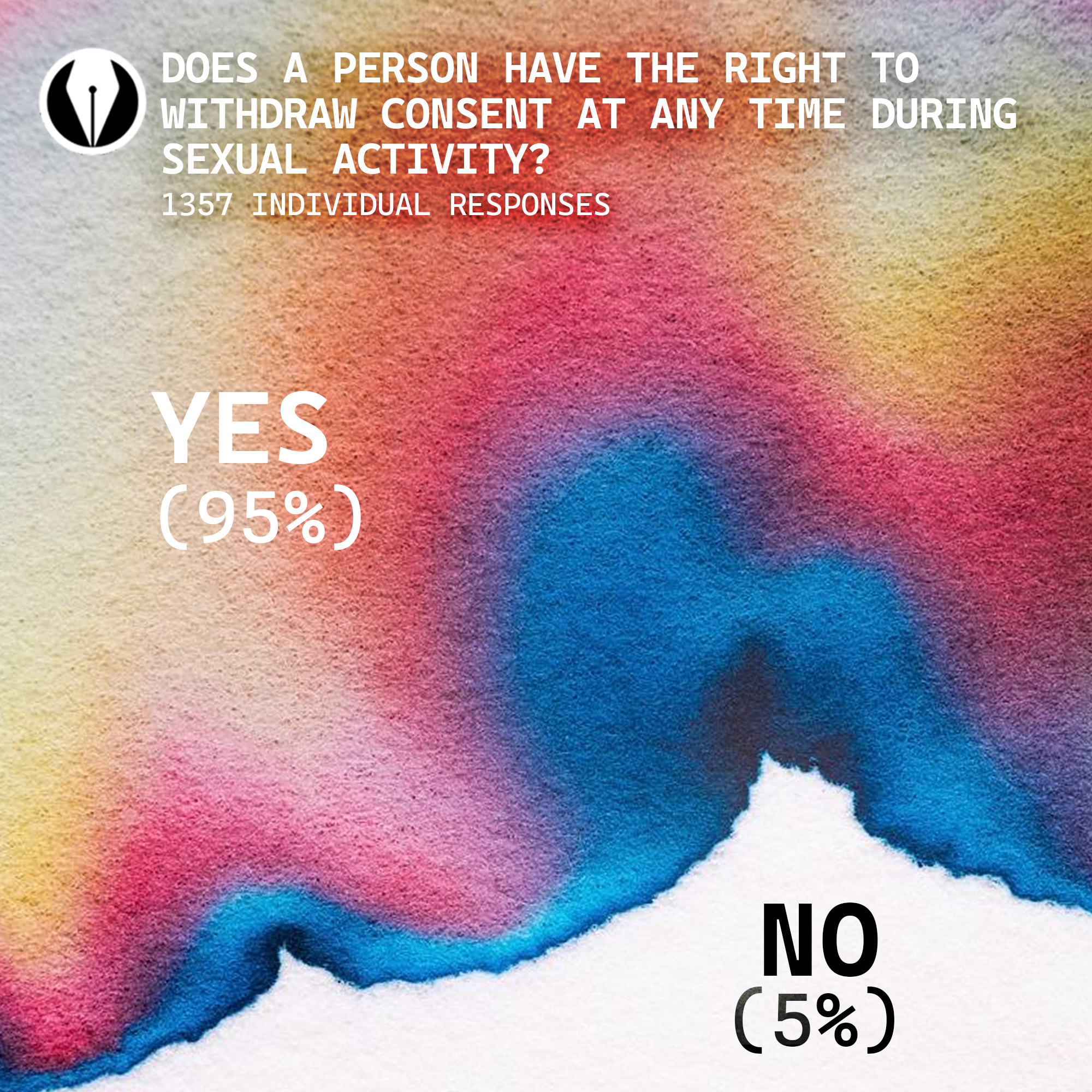
Consent doesn’t end once something begins. It has to be ongoing. In our survey, about 95% of respondents agreed that consent can be withdrawn at any stage, recognising that consent is not a permanent contract. People agree to things based on how they feel in a moment and those feelings can change. Respecting that change is part of respecting consent.
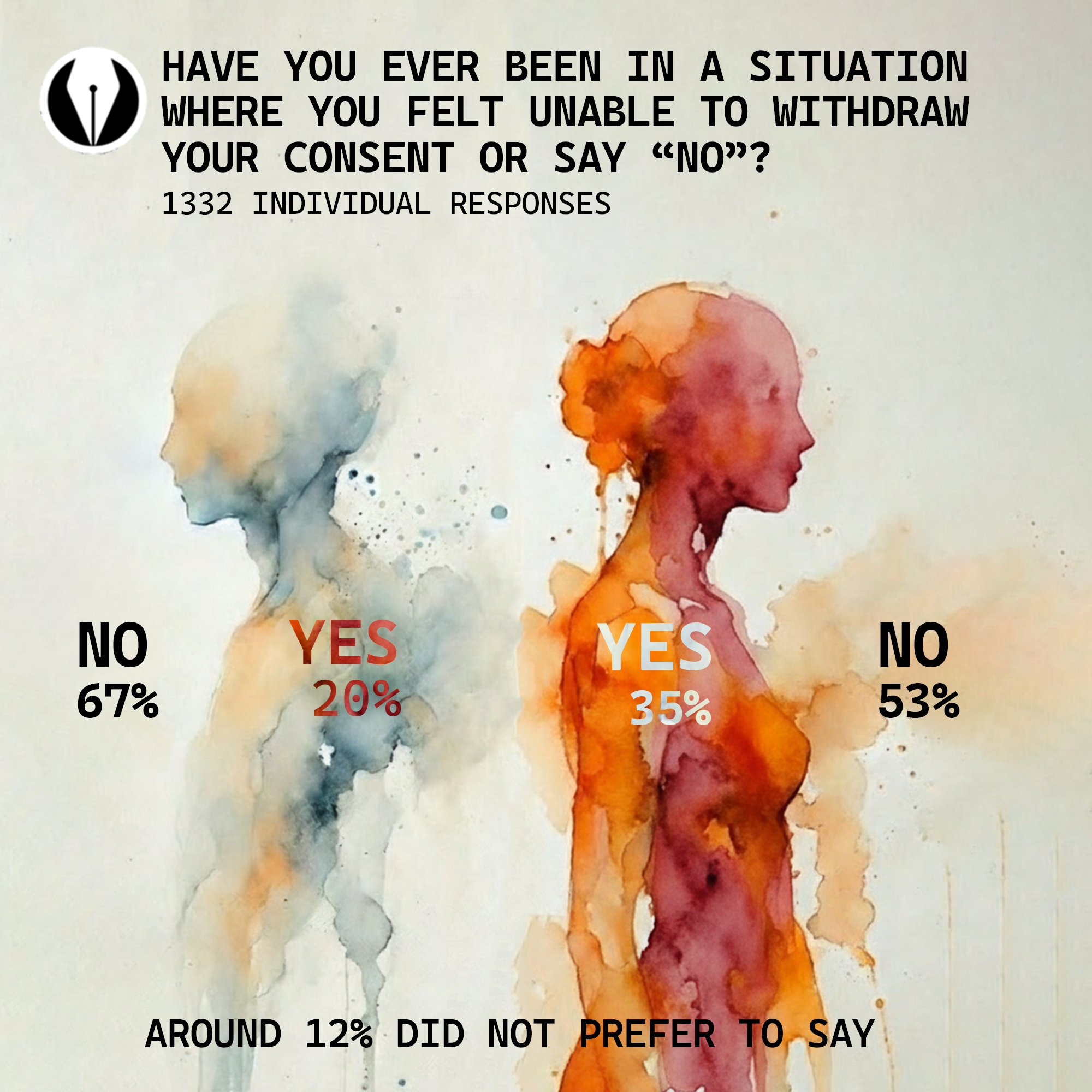
But this understanding does not translate equally into lived experience. A closer look at the data reveals a clear gender gap. While about one in five male respondents (20.4%) reported being in situations where they felt unable to withdraw consent or say “no,” this figure rises sharply among women, with over one in three female respondents (34.9%) reporting the same experience. Men were also significantly more likely to report never having faced such a situation.
This difference is not accidental, and it is not about individual hesitation alone. It reflects unequal power dynamics, safety concerns, and social conditioning that shape how freely people feel they can say no. For many women, withdrawing consent is weighed against fears of escalation, judgment, or being blamed for “leading someone on.” When one group has to calculate the cost of saying no more than another, consent stops being just a personal choice and becomes a structural problem.
That imbalance matters because consent cannot be considered freely revocable if the consequences of revoking it are unevenly distributed.
Withdrawal of consent is not always verbal. While 89.5% of respondents agreed that clearly saying “no” is sufficient, many also recognised non-verbal cues such as pulling away (83%) or going silent (63%) as indicators of withdrawal. These cues matter. When signals are unclear, the responsible response is to pause and ask, not assume. Clear communication, both in expressing and checking consent is key to preventing harm.
LEGAL CONTEXT (INDIA)
Under Section 90 of the Indian Penal Code (IPC), consent is invalid if given under fear, coercion, intoxication, or misconception of fact. Section 375 (Explanation 2, IPC) defines consent as an unequivocal and voluntary agreement and clearly states that absence of physical resistance does not imply consent. Sexual activity without valid consent constitutes rape under Section 375, punishable under Section 376 IPC with imprisonment ranging from seven years to life, depending on circumstances. These principles are reflected in UGC regulations and institutional sexual misconduct policies.
Alcohol and Consent: When Capacity Is Compromised
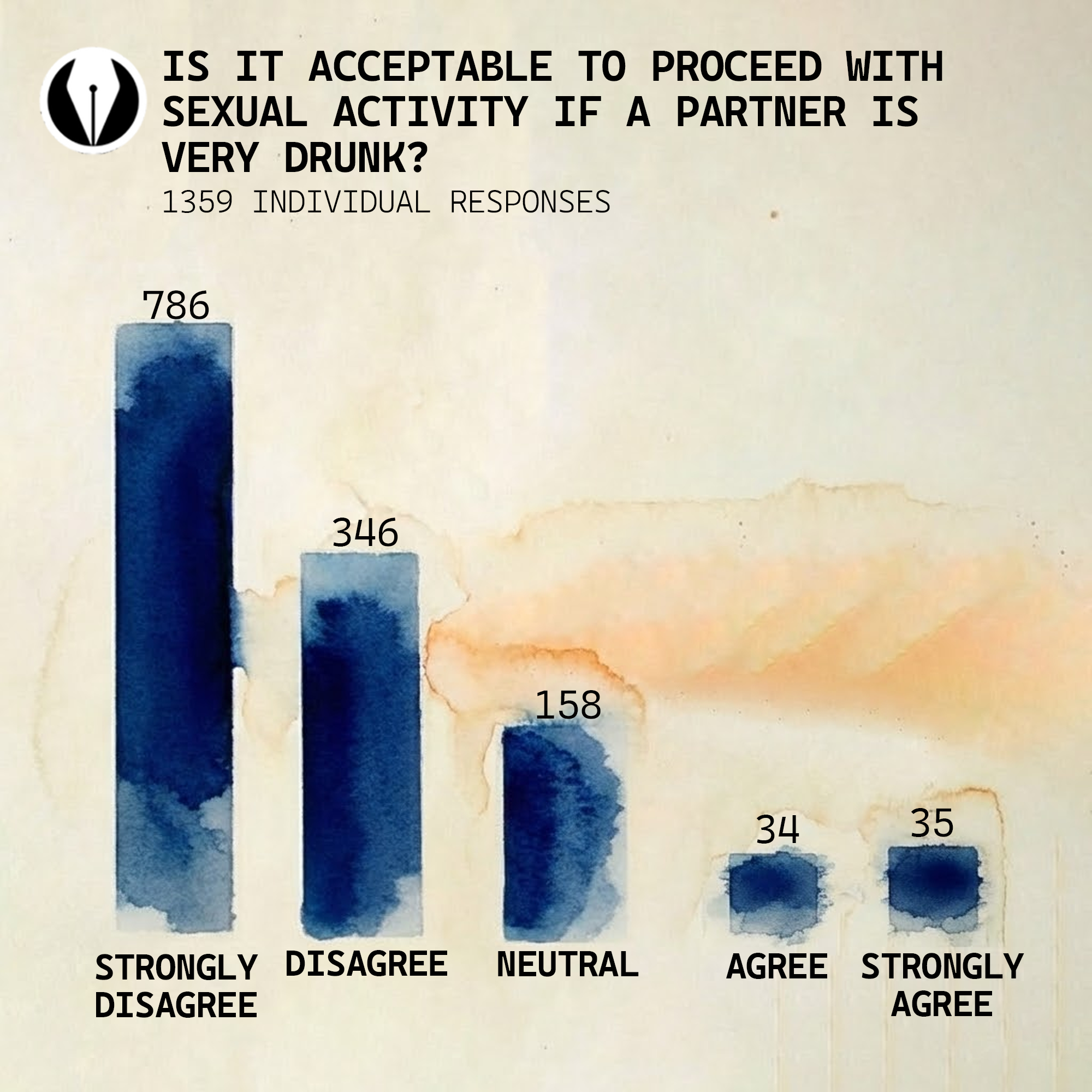
Drunk consent is not valid consent. In our survey, 84% of respondents agreed that it is unacceptable to proceed with sexual activity if a partner is very drunk. Alcohol impairs judgment, awareness, and the ability to communicate boundaries, making any consent given under such conditions neither informed nor reliable. Even if consent was given earlier, intoxication can reduce a person’s capacity to continue consenting. Any hesitation, confusion, or change in behaviour under intoxication is a clear signal to stop.
LEGAL CONTEXT (INDIA)
Indian law recognises that a person who is intoxicated or otherwise incapable of understanding the nature and consequences of an act cannot give valid consent (IPC Section 90). Sexual activity carried out when a person lacks this capacity may constitute rape under Section 375 IPC, punishable under Section 376 IPC, with penalties extending up to life imprisonment.
Boundaries, Persuasion, and Relationships: When “No” Must Mean Stop
Consent does not weaken with familiarity, nor does refusal invite negotiation. The survey shows a strong rejection of persuasion after a boundary is set: 66.5% of respondents disagreed or strongly disagreed with the idea that it is acceptable to persuade a partner after they have said “no.” This reflects a clear understanding that consent must be enthusiastic and freely given, and that a refusal must be respected immediately.
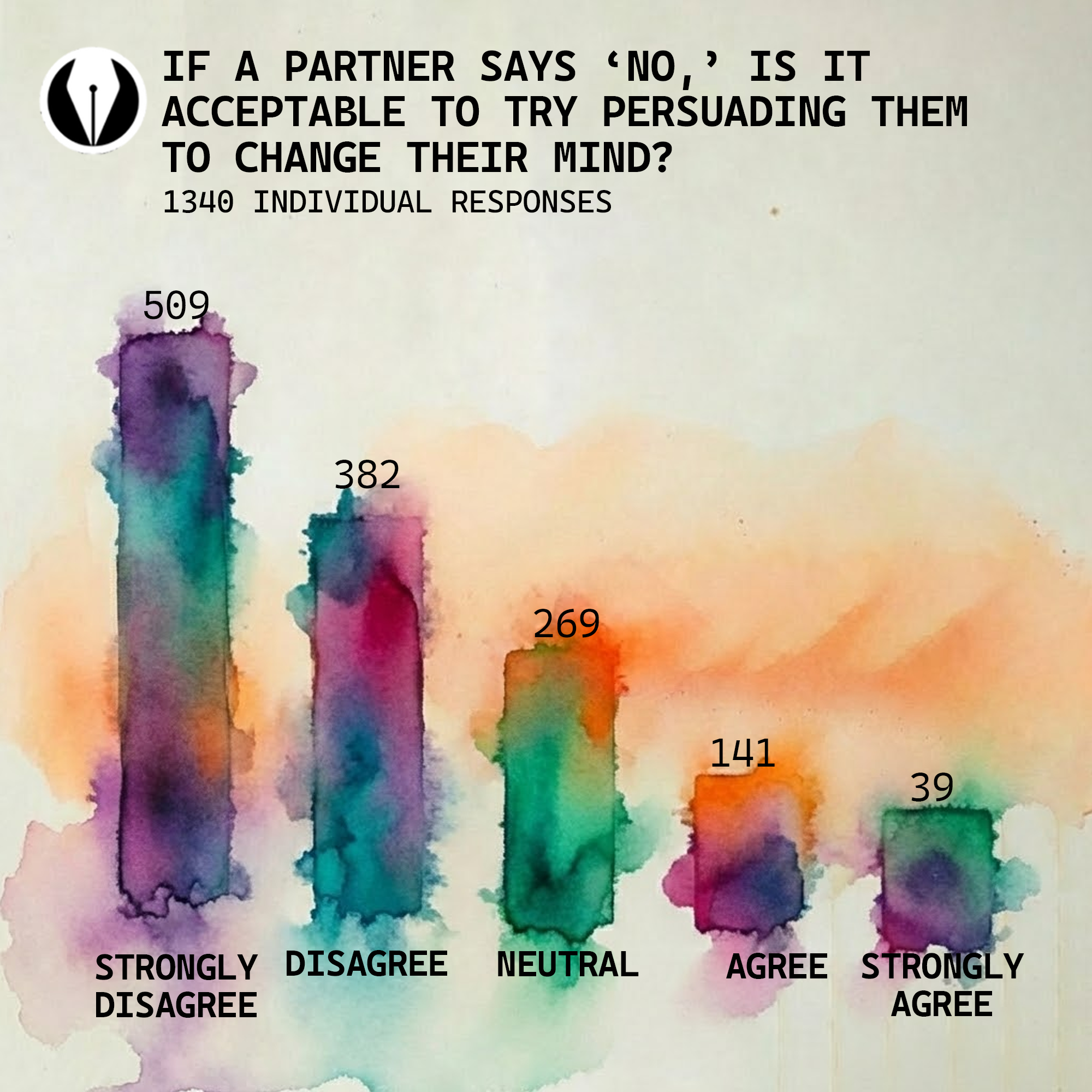
However, 12.4% agreed or strongly agreed, and 19.8% remained neutral, suggesting that a minority still view persuasion as acceptable or are uncertain about how firm a “no” must be. Similarly, when asked whether explicit consent becomes less necessary in long-term or intimate relationships, 57.5% disagreed, reinforcing that consent remains essential regardless of relationship status. Yet the presence of agreement and neutrality indicates that assumptions persist particularly in familiar settings.
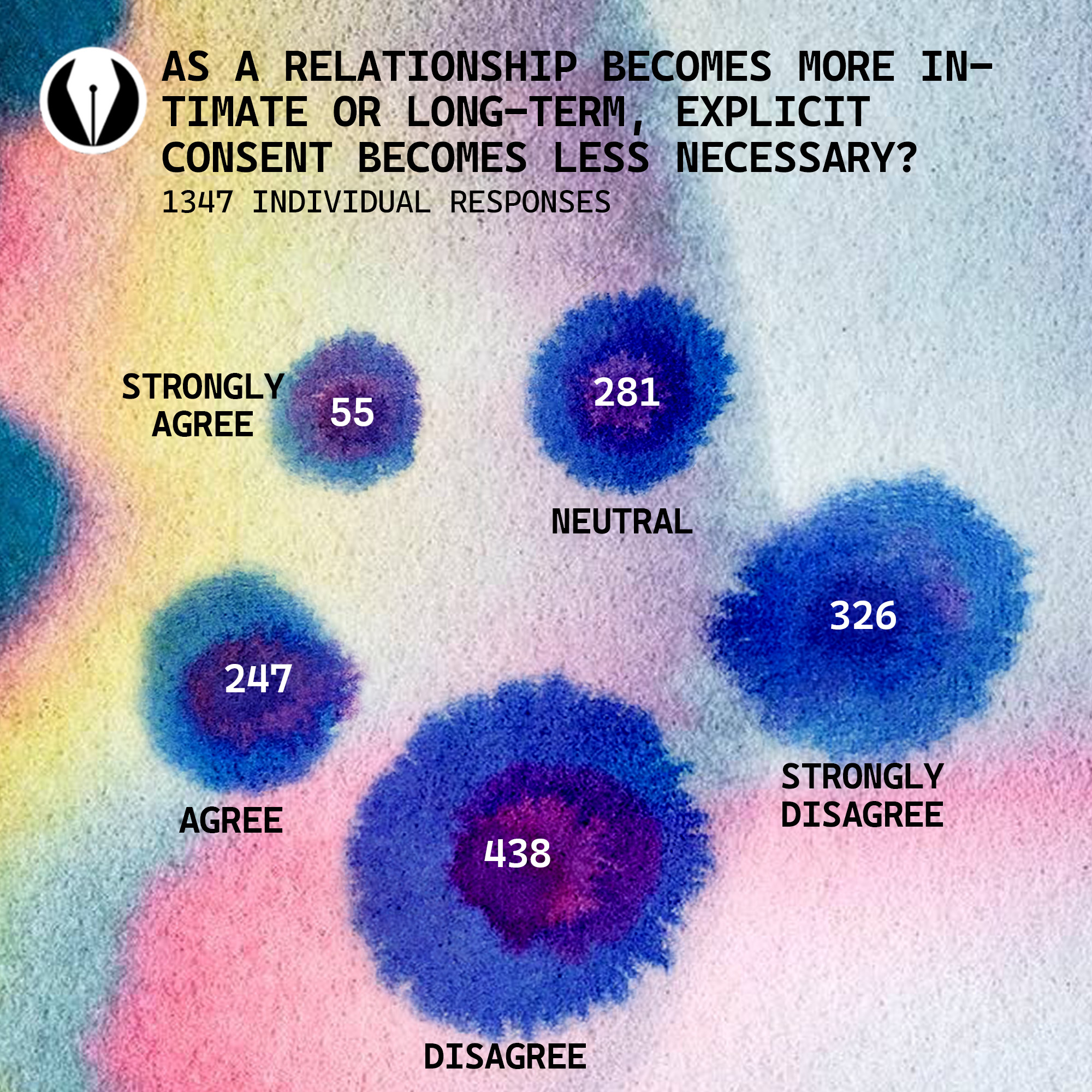
Persuasion after refusal, or assuming consent based on past intimacy, shifts interactions from mutual agreement to pressure. Preferences and boundaries can change at any time. When a boundary is expressed verbally or otherwise the only ethical response is to stop.
LEGAL CONTEXT (INDIA)
Consent obtained through pressure, fear, persistence, or emotional manipulation is not considered free consent under Section 90 IPC. Courts have repeatedly clarified that dating history, relationship status, or prior sexual relations do not imply consent under Section 375 IPC. Any sexual activity without present, voluntary consent may attract criminal liability under Section 376 IPC, with serious penal consequences.
With All This in Mind, How Do We Actually Apply It?
Consent starts before anything else, and no, that step isn’t optional. Anyone can ask for consent, and anyone can say no. Gender, age, familiarity, or vibes do not grant special permissions.
Two things matter when asking for consent. First, be clear and specific, say what you mean instead of hoping it magically lands. Second, make it easy to answer honestly. Checking in shouldn’t feel like you’re ruining the mood; it should feel like you’re making sure everyone’s actually enjoying it.
If asking feels awkward, imagine how much worse it would feel to realise later that you never asked at all.
A degree of openness in phrasing can help. For example, “What if we did this?” is often better than “We should do this, right?” Since consent is an ongoing conversation, it helps to check in with questions like “Is this okay?” rather than assuming comfort. Similarly, “What are you in the mood for?” or “How would you feel about that?” allows far more freedom than “Let’s do that?” Open-ended questions make it easier both to express interest and to decline.
It is also important to remember that consent to one activity does not imply consent to another. Asking “Do you want to continue with this, or would you prefer something else?” is always better than making assumptions or moving ahead without checking in.
We could list countless ways to ask for consent, but at its core, learning how to ask for consent is like learning a new language, only much easier. First, we recognise the need to learn it. Then, we read and understand it. Finally, we practise it. And like any language, it becomes more natural the more we use it.
Understanding Digital Consent:
In today’s world, where relationships, conversations, and intimacy often unfold through screens, digital consent is just as important as physical consent. Just as you wouldn’t want anyone to slide into your DMs uninvited, you also wouldn’t want someone accessing, saving, or sharing your private photos or chats without clear permission.
Digital consent refers to a person’s clear, voluntary, and informed to share, capture, store, or distribute any form of personal or intimate content online. Just like in physical interactions, consent in digital spaces must be explicit, freely given, and ongoing, it cannot be assumed from past behaviour and can be withdrawn at any time. Importantly, receiving a photo or video does not give you the right to forward or repost it without renewed consent.
Violating digital consent is not just a breach of privacy, but a breach of trust. It can cause emotional distress, reputational harm, and long-term psychological impact. As technology becomes deeply embedded in our relationships, respecting digital boundaries is essential for safety, dignity, and trust online.
LEGAL CONTEXT (INDIA)
Violating someone’s consent in digital spaces carries serious ethical and legal consequences in India. Under IPC Section 354C (Voyeurism), watching, recording or sharing a woman’s private images without her consent is a crime punishable with one to three years of imprisonment in case of a first offence, and up to seven years of imprisonment in case of a repeat offence. Intentionally capturing, publishing, or transmitting an image of a private area of any person without their consent is a crime under the Information Technology Act, Section 66E. Committing this crime can result in imprisonment up to three years, a fine of rupees 2 lakh, or both. Furthermore, publishing or transmitting obscene material in electronic form is punishable with imprisonment up to five years under the IT Act, Section 67.
If Your Consent Is Violated: Where to Seek Help at IIT Kanpur
If you experience a situation where your consent was violated—or if something simply felt uncomfortable or wrong—you do not need to be certain, label the experience, or have proof to seek help. Reaching out is about support and safety, not obligation.
At IIT Kanpur, students can approach the following official bodies:
- Centre for Mental Health and Wellbeing (formerly Institute Counselling Service):
Offers counselling and emotional support. You can approach the Centre even if you are unsure whether your experience qualifies as harassment. Speaking to a counsellor does not automatically initiate a formal complaint. - Internal Complaints Committee (ICC):
The ICC is the official body mandated under UGC regulations to address cases of sexual harassment. You may approach the ICC if you wish to file a formal complaint and seek institutional action. The process is structured, confidential, and time-bound. - Gender Cell:
Provides peer support and guidance, and can help you understand your options and navigate institutional mechanisms before deciding your next steps.
Seeking help does not require you to file a complaint, and choosing not to pursue formal action is entirely valid. These mechanisms exist to respect your autonomy, well-being, and right to support.
Summing Up,
Consent is not a one-time question or a technical formality—it is an ongoing practice rooted in communication, respect, and care. Our campus data shows that while many understand consent in principle, real-life situations shaped by pressure, alcohol, or familiarity still blur boundaries.
Building a culture of consent means asking instead of assuming, stopping instead of persuading, and respecting “no” in every form. It means creating environments where changing one’s mind is safe, expected, and respected.
Consent is not just about avoiding harm, it is about ensuring that every interaction is mutual, comfortable, and chosen. That responsibility belongs to all of us, in every moment.
Written by : Namrata Chauhan, Archit Rahalkar, Anandan Iyer, Akash Baudh, Suhani Joshi, Lavanya Srivastav, Sumit Yadav, Palak Bandhu, Saurya Singh, Aniket Dixit
Edited By : Amogh R N
Designed by : Amogh R N