

Disclaimer: Vox Populi, IIT Kanpur, is the exclusive owner of the information on this website. No part of this content may be duplicated, paraphrased, or interpreted in any other way without written consent from Vox Populi. If you want to reproduce any of the content on this page, please contact our chief editors directly or reach out to us by email at voxpopuli@iitk.ac.in.
Maslow places sex at the very base of his hierarchy of needs, right there with food, water, and shelter. Yet, unlike those other needs, it rarely gets discussed without some measure of discomfort. Some people are perfectly at ease and speak about sex education with clarity and confidence. Others engage with it only in smaller, more comfortable circles often with the kind of giggles that make it hard to finish a sentence, and seldom with the seriousness the subject deserves.
The National Family Health Survey (2019–20) conducted by the Ministry of Health and Family Welfare (MoHFW) found that only 38.1% of women and 35.7% of men aged 15–49 in India had ever received any form of sex education, and a 2023 Allo Health poll revealed that 72.4% of Indians never received it in school or college.
Against this backdrop, Vox recognises the problem and this article turns to our campus survey to understand the gaps in sex education and where IIT Kanpur students stand today.
Brief on Survey:
Our campus-wide anonymous survey drew 1,404 responses. Most were undergraduates (75%), with postgraduates making up the rest. A large majority identified as male (76%), about one in five as female (22%), and a small share chose other identities. The survey set out to map where students stand on issues like contraceptives, STIs/STDs, consent, pornography and sexual identity aiming to understand the levels of awareness and perspectives across the student body.
In this article, we present our findings with an objective lens, focusing on awareness levels, perceptions, and experiences rather than rushing to definitive conclusions. The aim is to highlight key trends and gaps that can inform meaningful conversations and solutions.
Sex Education at IIT Kanpur: Where We Stand
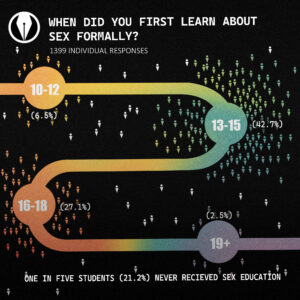
Students’ responses about their first formal lessons on sex and reproduction revealed a striking gap in academic sex education: about one in five students (21.2%) reported never receiving any formal sex education at all. Among those who did, only 6.5% received it between ages 10–12. The largest share, 42.7%, learned between 13–15, followed by 27.1% between 16–18, and another 2.5% at 19 or older.
According to WHO the appropriate age is as early as 5, with foundational body knowledge and consent, and building through primary and early secondary school is crucial for healthy understanding and safe decision-making.
On one point, however, students were nearly unanimous: 80.2% believe sex education should be part of the college curriculum. Only 12.6% were unsure, while a small 7.2% opposed the idea. Yet, many Indian states have resisted or outright excluded sex education from formal curricula.

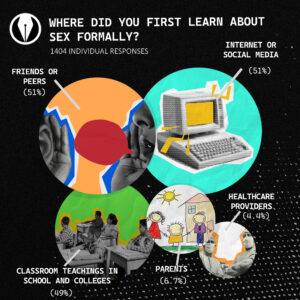
When asked where they first gained knowledge about sexual and reproductive health, about 51.7% cited the internet or social media, and 51.2% mentioned friends or peers. Classroom teaching in schools or colleges accounted for 49.3%, a promising but still insufficient reach. Parents (6.7%) and healthcare providers (4.4%) were almost absent, a reminder of how deeply taboo sex education remains in India.
A Comparative Institutional Perspective
A comparison with other IITs shows sharp differences in institutional approaches. At IIT Kanpur, the Centre of Mental Health and Wellbeing(CMHW) (or then Institute Counselling Service (ICS)) conducts sessions during the freshers’ orientation that address sexual identity, consent, and contraceptives. These sessions provide students with foundational knowledge about healthy relationships and safe sexual behavior, while also creating a space for open discussion and helping intergender interactions become easier. Many students report that the sessions make it easier to approach sensitive topics and seek guidance when needed.
In contrast, IIT Bombay, IIT Delhi, IIT Roorkee, IIT Kharagpur, IIT Guwahati and IIT Madras do not offer comparable orientation modules, nor are large-scale sessions on sex education conducted. Without structured conversations at the start of college life, students often rely on a patchwork of peers, social media, and non-institutional sources, increasing the risk of misinformation, reinforcing taboos, and leaving students less prepared to make informed decisions regarding sexual and reproductive health.
Internationally, universities like Stanford and MIT offer comprehensive sex education through structured programs, coursework, medical support, and student-led initiatives. Stanford’s SHARE Office provides freshman-focused sessions, peer resources, and queer support, while MIT combines sexual health education, STI testing, contraception, and sex-positive student organizations. These examples show the impact of proactive, campus-level initiatives in promoting sexual health and awareness.
Breaking the Silence: Vox Leads the Conversation
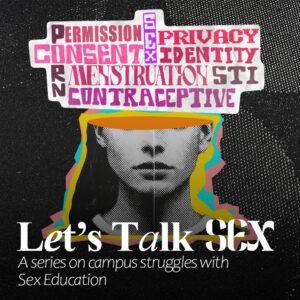
The lack of structured sex education in India, even across premier institutes like the IITs, is evident. While students widely recognize its importance, formal programs remain scarce, leaving many to rely on peers and online sources for critical information. To address this gap, Vox is launching a new series titled Let’s Talk Sex, which will explore key topics including Consent, Contraceptives and STIs, Sexual Identity, Pornography, Menstruation, and Sexual Harassment. Through this series, we aim to create an informed, open, and responsible dialogue on sexual and reproductive health within our campus community.
Written by : Archit Rahalkar, Anandan Iyer, Akash Baudh, Suhani Joshi, Lavanya Srivastav, Sumit Yadav, Palak Bandhu, Saurya Singh, Aniket Dixit
Edited By : Amogh R N
Designed by : Amogh R N