


Disclaimer: Vox Populi, IIT Kanpur, is the exclusive owner of the information on this website. No part of this content may be duplicated, paraphrased, or interpreted in any other way without written consent from Vox Populi. If you want to reproduce any of the content on this page, please contact our chief editors directly or reach out to us by email at voxpopuli@iitk.ac.in.
This editorial reflects the views and judgments of the Vox Populi editorial board. These views formed in response to recent events and sustained engagement with student experiences on campus. It is part of an ongoing effort to document concerns, examine institutional practices, and create space for informed dialogue on issues affecting the student community. Vox Populi remains committed to continued reporting, follow-up, and coverage of these matters as they develop.
This editorial is written in good faith and with respect for the complexity of institutional governance. It does not seek to assign individual blame or speculate on the circumstances surrounding any specific death. Instead, it examines recurring patterns, documented experiences, and publicly observable institutional responses to student distress. The intent of this piece is not to undermine the institution but to strengthen it by insisting that care, accountability, and student wellbeing be treated as central responsibilities rather than peripheral concerns.
Each suicide within the campus community is met with a devastating but familiar mix of rage and helplessness. Rage, because a life was lost within a system that claims excellence and care for its students. Helplessness, because the response that follows rarely matches the gravity of the event. These reactions point to a deeper and more unsettling question: are we, as a community and an institution, failing somewhere?
The goal of this editorial is not to catalogue the immediate pressures that push students to the brink but to investigate an environment that makes such pressure routines.
We require a fundamental shift in how mental health is understood within our institution’s framework, which includes academics, administration, and student support systems. At present, mental health is largely viewed as a personal matter which is something to be managed individually through resilience, counselling, or better coping strategies.
When this empowerment is framed purely as a personal choice, the structural pressures shaping those choices disappear from view. The University Grants Commission (UGC) guidelines on uniform policy for mental health and well being in HEIs further mentions that “mental health is determined by a complex interplay of biological, individual, social and structural strengths, stresses and vulnerabilities… a complete state of mental health emphasises not just the mere absence of mental illness but an effort towards flourishing. It is a condition denoting good mental and physical health, the state of being free from illness and distress and, importantly, of functioning well in one’s personal, academic/ occupational and social life, with purpose, meaning and engagement ”. The UGC recognizes that mental health does not exist in a vacuum, and is not a function of purely the individual. The National Education Policy echoes this view, mandating that higher educational institutions create environments that actively promote student flourishing and not merely provide counselling services as an afterthought. In a closed residential campus where academics, research, social networks, and administrative authority are tightly interlinked, repeated suicides cannot be dismissed as isolated misfortunes. They point toward institutional stressors and reveal an environment where vulnerability accumulates faster than support.
IIT Kanpur has consistently been placed among the top five technological institutions in the country. If excellence is understood only through outputs and rankings, it risks overlooking the cost at which these outcomes are produced. If mental health were truly central to institutional values, attention and action would precede tragedy. Instead, attention follows loss.
The Limits of Student Representation
On paper, students have representation. We have nominees on policy-making bodies, executive votes, and committees where our participation is formally acknowledged. But does that representation actually influence outcomes?
Many demands raised in recent open houses-regarding supervisor accountability and grievance redressal have been placed before institutional committees time and time again. They are proposed, debated, and documented, yet for reasons rarely communicated transparently they remain stalled or indefinitely “under consideration.”
This creates a pattern that is tragic: issues that should be addressed through routine governance receive attention only in the aftermath of a suicide. It is not that students speak only after loss; rather, the institution listens only then. In moments of crisis, open houses are called, committees are announced, assurances are offered, and urgency is displayed. Yet once the immediate pressure recedes, the momentum for structural reform gradually dissipates, leaving many of the original concerns unresolved.
We have witnessed this cycle before. In 2024, students organised a Dharna to demand concrete reforms in student welfare mechanisms and grievance redressal structures. At the time, the administration responded, dialogues were initiated, and commitments were made toward institutional improvements. However, two years later, in the wake of another set of tragedies, some of the very same concerns re-emerged in these forums, raised once again under circumstances of grief and distress.
Firstly the recommendations made by the committee were not released publicly citing issues of “confidentiality”. On investigation, we found that some demands that were implemented did not take the form students had hoped for. The Doctoral Monitoring Committee, constituted only in the previous semester, was not designed according to student expectations. Rather than serving as a support mechanism, it has been identified by many as a source of additional stress, a bureaucratic exercise reduced to yet another deadline to be dealt with rather than a meaningful intervention.
Other demands were left to individual departments to implement at their discretion. The recommendation that students be encouraged to thoroughly explore their options before selecting their supervisor is reasonable, and few departments do follow it. However, some departments still give students approximately one week to choose their supervisor. For a relationship that has such profound influence over one’s degree and, by extension, one’s life on this campus, a timeframe this short is inadequate. Guidelines for the maximum number of PhD students per professor were similarly not adopted institute-wide, citing the differing needs of different departments.
A demand raised in 2024 for a formal review of placement opportunities for PG students was never acted upon. No such review was conducted to our knowledge.
Although some demands were accepted, a large chunk of them were not implemented seriously by each department because of them not being mandated from the institute’s end, or due to a lack of intent to be followed through with.
The repetition of these demands is not a failure of student memory; it is evidence that listening has remained episodic rather than embedded in the institution’s everyday functioning. When action is deferred through prolonged deliberation, redirected into new committees, or absorbed into procedural exhaustion, it becomes a subtle exercise of power. For students living within this system, the outcome is indistinguishable from neglect: their voices are acknowledged, but their concerns do not meaningfully shape decisions.
Institutional Presence After Loss
The problem is not only structural. It is also cultural, and it is felt most acutely in the moments that follow tragedy.
Whenever a crisis demands reflection, the initiative to create spaces for dialogue, mourning, and processing has consistently come from students. Candlelight vigils, general body meetings and open forums to share grief or frustration are organised, sustained, and pushed forward by students themselves.
But there is something deeply wrong with a situation where students must build their own spaces. Administrators are also part of this community. They too have relationships with students and feel something when a student passes away. And yet their presence at student-organised mourning spaces is inconsistent and almost nonexistent.
Administrative engagement has remained largely reactive. Even when such events are formally held, the presence of senior administrators is inconsistent. In the recent GBM, students felt compelled to march to the Dean of Students’ Affairs’ residence to seek answers after the Dean did not attend the meeting at the OAT. Procedural explanations were later offered, citing the absence of an official statement and adherence to protocol. However, when procedural formality takes precedence over presence in such moments, it communicates to us students that institutional care is contingent on paperwork rather than anchored in responsibility.
We saw this same dynamic during the 2024 dharna. Students waited from early afternoon for the then Director to arrive. And when he came, nearly three hours after they had first demanded his presence, he stayed only until 6:10 PM before expressing that he had to leave despite students asking him to stay. Students followed him to his office and had to fill the staircase of the Faculty Building with their voices before the institution would continue engaging with them.
We feel that even in open houses where senior administrators are present, the structure of discussion often shifts toward administrative logistics and procedural clarifications. This leaves limited space for students to directly express the pressures they face to those with decision-making power. Moreover, responsibility for improving community support is usually framed as students needing to be more empathetic toward one another, which once again shifts the burden inward instead of addressing the systemic conditions that shape distress.
Communication following tragedies has similarly followed a templated format. The emails are familiar to us by now. What such messages often lack is a sense of acknowledgement, making the experience of grief from students’ point of view, administratively processed.
Community within campus
Institutions often speak of community as a shared sense of belonging, mutual care, and collective identity. But community is not created by declarations or slogans. It is built through reliable and accessible support structures that students can trust in moments of vulnerability.
In periods of distress, many students find themselves uncertain about where to seek help, or hesitant to speak openly due to fears of academic repercussions, supervisory consequences, or stigma. They know the counselling centres exist. They know the grievance mechanisms are technically available. But knowing that a resource exists is not the same as feeling able to use it. These concerns are intensified by power asymmetries, particularly within postgraduate supervision, where dependence on a single faculty guide can make voicing problems feel risky. They worry that what they share in confidence will find its way back to the people who have power over them. These services are frequently perceived as institutionally embedded rather than independently safe spaces.
This hesitation is not unfounded. Past incidents within the institute have involved the circulation of confidential information including de-addiction clinic records and lists of students awarded F grades through official mailing lists. These were not minor mistakes but clear breaches of confidentiality that led to widespread resentment and a significant erosion of trust in the very bodies students are expected to approach in moments of distress.
Further, the Dean of Student Affairs on national television revealed a student’s psychiatric diagnosis. This to us feels to be unnecessary information that was revealed on such a platform. In a society where mental health is seen with a lot of stigma, this would further deter people from sharing their feelings to anyone if their trust in confidentiality seems to be breached.
In a recent interview with India Today, the Director was asked whether the crisis stemmed from curriculum or campus culture. His full response:
“Actually a mixture, I won’t point out a specific issue here, because as I said here, the reasons one sees are varied. For some students, I agree with you that it is mostly post-graduate students, that one is observing, one of the reasons that this number has increased in the post-graduate side, that all the IITs are today admitting a far larger number of post graduate students. The PhD degree by very nature is quite stressful, because it is not a time bound degree. One has to do work of certain quality in order to complete the degree, and it may take 4 years or it may take 7 or 8 years as well. So that causes uncertainty in the minds of students, stress also at times. There are times when the students and supervisor have differences about how to go about things, again some of these students feel at loss, they have stress building in but there is nobody who they can share it with. They have friends but not everybody has close friends, and this kind of thing leads to additional stress. For undergraduate students as you [interviewer] said, is mostly final year but that number one sees is not very high.”
Two aspects of this feel concerning to students,
- First, the explanation that rising postgraduate numbers across IITs account for rising suicides implies a statistical inevitability – more students, more tragedies, but the data points to the contrary.
- Second, the characterisation of undergraduate suicides as “not very high” is difficult to reconcile with the loss of two undergraduate students in the past year.
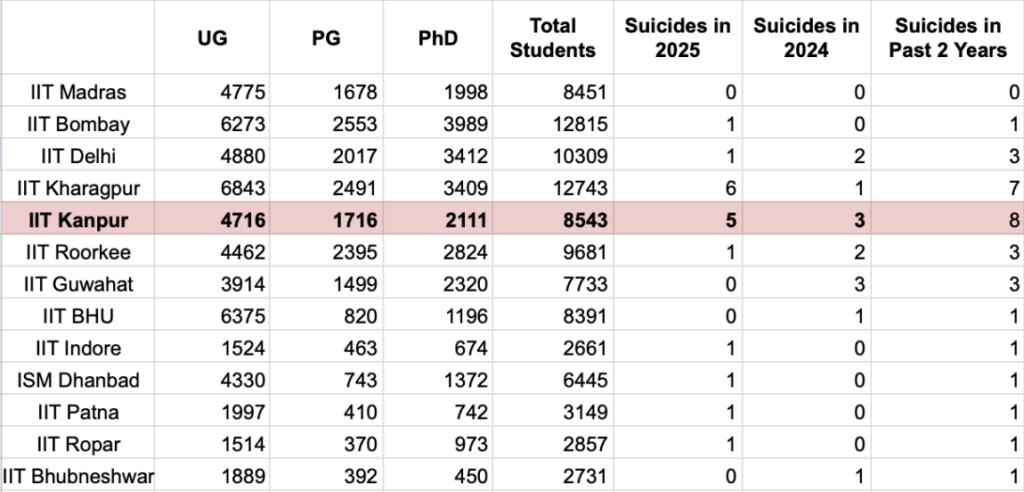
Students’ feel that if the administration’s understanding of the crisis begins from the premise that doctoral stress is natural, that numbers scale with enrolment, and that undergraduate losses are within acceptable bounds.
Within an environment where institutional support feels unreliable, peer empathy naturally becomes the first line of support. Students turn to one another for comfort, reassurance, and understanding. While this peer care reflects a strong sense of genuine solidarity within the student community, it is not a substitute for professional and institutional safeguards. Students are not trained counselors. They do not have the expertise to handle crises, the resources to provide sustained support, or the authority to change the conditions that generate distress. Over time, this substitution places an unsustainable burden on students themselves. Peer support can supplement institutional care. It cannot replace it. True community care requires institutional responsibility, not only student compassion.
Insitutional Procedure
When examining the administration’s role in safeguarding student mental health and wellbeing, it is essential to acknowledge how procedural failures have actively undermined this responsibility. The circulation of confidential documents through official channels has already been discussed, but its implications bear emphasis. When that trust is violated, it is not just the individual student who is harmed but every student who might have sought help and now will not.
Any discussion on institutional procedure would be incomplete without addressing the absence of transparency and accountability. Beyond individual lapses, there exists a systemic disregard for meaningful student participation in discussions concerning their own wellbeing. While the administration frequently claims to consider student input, such inclusion appears selective to us. There is little evidence of on-ground research to assess student needs, especially in non-academic matters.
Reforms are introduced for students, but seldom with them. A recent example is the restructuring of the ICS into the CMHW, a change intended to expand scope and accessibility.
CMHW is now organised into two divisions: a new clinical wing headed by an external psychiatrist, consisting of psychiatrists and counsellors, and an administrative wing that continues to function in much the same manner as the former Institute Counselling Services (ICS). This division was created to address the long-standing concerns of confidentiality breach and to expand the mandate of the counselling services offered by the institute. However, beyond this administrative rebranding, little changed in practice. Students still feel that not much parallel efforts were made to encourage students to seek mental health support more proactively, or to build a sense of safety and trust in these spaces. In the absence of such measures, the new division functions less as a structural reform and more as an extension of the very system it was meant to correct.
In practice, students were largely absent from the discussions that shaped it. Apart from one student nominee, who was not nominated by the Students’ Gymkhana, student perspectives in our view did not inform the transition, and communication was prioritised only after the reform had already been implemented. The result was predictable: confusion, misinformation, and uncertainty persist among the student body regarding what the CMHW actually does, how it differs from its predecessor, and whether the concerns that plagued the ICS have been addressed.
This is not an isolated case. It is a pattern. Reforms are introduced for students but not with them.
This editorial does not claim solutions and structural reform is gradual. Trust, once weakened, requires time and consistency to rebuild. This piece does not argue that institutions are cruel, only that they can be distant, and that distance, sustained over time, can become indistinguishable from absence. When distress is met with procedure and grief with formality, care begins to feel conditional. Students learn to wait, to endure, to explain themselves repeatedly, until speaking no longer feels like relief but exposure. In such a space, suffering does not arrive suddenly. It accumulates, slowly and privately, until it is noticed too late.
“Power rarely says no to [the vulnerable] directly. It delays, redirects, and exhausts them instead.”
The future of this campus depends on whether attention can be given before loss. If trust is to be rebuilt, it will require consistency, patience, and a willingness to sit with discomfort long before it demands response.
An institution is remembered not only for what it teaches or produces, but for how it holds those who struggle within it, quietly and without being asked.