

Disclaimer: Vox Populi, IIT Kanpur, is the exclusive owner of the information on this website. No part of this content may be duplicated, paraphrased, or interpreted in any other way without written consent from Vox Populi. If you want to reproduce any of the content on this page, please contact our chief editors directly or reach out to us by email at voxpopuli@iitk.ac.in
Have you ever wondered about the lives of your professors beyond the lecture halls and labs? Were they just like us as students? What paths might they have taken if not for academia
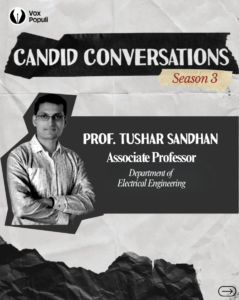
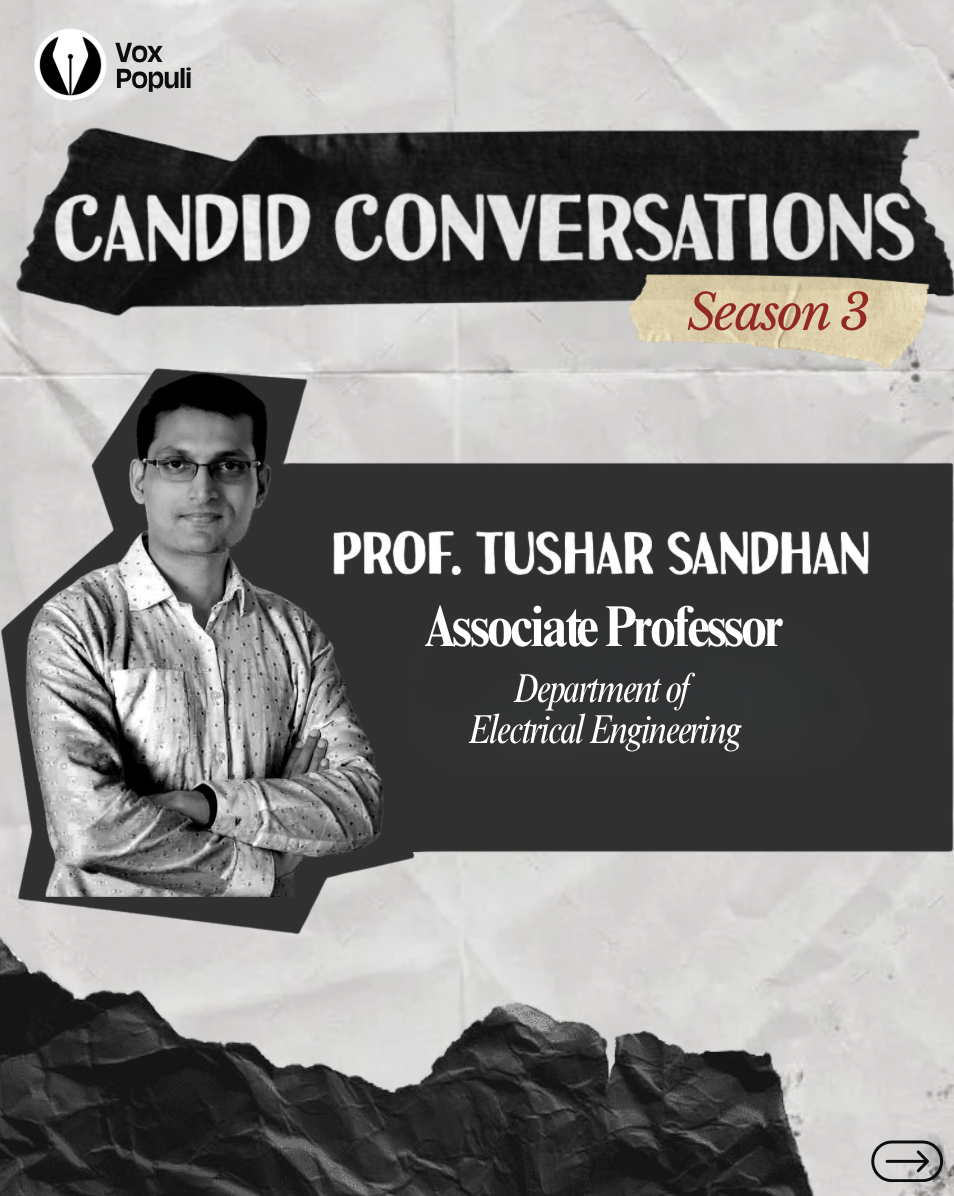
Vox is back with Season 3 of Candid Conversations with Professors @IITK, where our professors share their journeys, interests, and unfiltered insights into life at IITK and beyond.
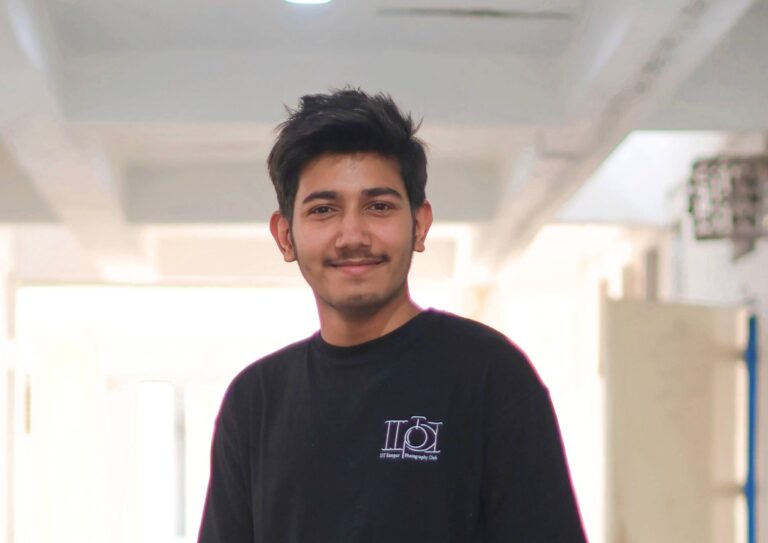
Join us in the 1st part of this season, with Professor Tushar Sandhan from the Department of Electircal Engineering.
From his days as a “back-bencher by height” in Maharashtra to becoming a renowned note-taker at IIT Guwahati,Professor Sandhan’s story is a masterclass in adaptation. He shares his experiences of navigating “culture shock” in South India and later in Seoul, South Korea, where he spent years pursuing higher education and working in corporate R&D at Samsung.
Schooling
Many of us stumble into our careers, while others plan them from a young age. Was there a specific moment, book, or mentor in your early years that first sparked your interest in science and engineering particularly electrical engineering?
I was in the same boat as many others, unsure of what to do. During childhood, like most people, I was more interested in activities outside academics. Some people gravitate towards sports, others towards painting or different activities. I was involved in many such pursuits. I enjoyed playing cricket, like most people in India, as well as painting and NCC.
At the same time, I performed well in non-school examinations. During school, there are several competitive exams—for instance, in Maharashtra, scholarship exams in the fourth and seventh standards, as well as KVPY and NTSE. A teacher once mentioned that while some people excel in academics and others in sports or creative activities, one should choose the area where they perform best. Following this advice, I gradually shifted my focus towards academics.
I had never specifically planned to pursue electrical engineering. However, in the 11th and 12th standards, we had the option to take a vocational subject, and I chose electronics—not electrical engineering, but electronics. That is where my interest in electronics began.
I never attended coaching classes, so I would likely have gone to a state school or the best college I could get through that route. I appeared for the JEE examination, accepted the rank I received, and chose the electronics department at IIT Guwahati. Since I liked electronics, I decided to pursue it wherever I could get the opportunity.
If we were to go back in time and peek into your high school classroom, where would we find you sitting? Front or Back?
I used to sit at the back because of my height. During high school, seating was arranged according to height. Shorter students were made to sit in the front because all the benches were on the same level. Unlike lecture halls, where visibility is clear from anywhere, a taller student sitting in front would block the view of the board for those behind. Teachers arranged students in ascending order of height—the shortest in the front, then the next, and so on—so the last bench was the one left for the tallest students.
After coming to IIT, I made a mistake once. I skipped breakfast and went to a lecture early. The classroom is usually empty at 8 AM, so if you reach by around 7:45, it is completely empty. Typically, you either arrive around 8:15 or 8:20 after breakfast, or you skip breakfast and go early. Since the classroom was empty, I sat in the third or fourth row of the large lecture hall, which is almost like the first row. After sitting there a few times, other students started joining nearby, friendships formed, and I ended up sitting there regularly.
That is why I continued sitting there throughout the first year. Gradually, I realized I did not like sitting in the front. Later, because of my spectacles, I chose the first row but at the corner. So you would usually find me sitting somewhere in the corner.
You also mentioned in a couple of ESC classes that the backbenchers usually do a lot of extraordinary things .
Not for myself. I used to sit at the back, and backbenchers tend to have something extraordinary about them. Front benchers, for instance, are often assumed to have a high CPI. I am not saying they necessarily do—this is just an assumption. They are expected to follow a conventional path. In the end, they are often in a more constrained position: if they do not get a good placement, they are pushed toward higher studies, and even if they do get a good placement, starting a startup becomes difficult because relatives and society question why someone with a good CPI and a secure job would take such a risk.
In contrast, a backbencher has fewer such expectations. Even without a high CPI, they are free to explore other activities—dance clubs, various student organizations, Inter-IIT participation, and more. Their opportunities feel far less restricted. Compared to front benchers, backbenchers often have greater freedom because of psychological and societal factors that impose fewer constraints on them. That is why I believe backbenchers have much more potential, while front benchers are more limited in their options.
There is often a stereotype that professors were always academic achievers who never struggled with grades. Is this true for you, or did you have any subjects in school that you genuinely dreaded?
I struggled with studies, particularly with English. Since I came from a Marathi-medium background, I was comfortable with that. English, or anything new and different, did not come easily to me. Sanskrit, on the other hand, was easier, and I scored very high in it. But English never worked for me.
Higher Education
You completed your B.Tech at IIT Guwahati. What is your fondest memory from your undergraduate days there?
During my undergraduate years, one of my best memories was from the final year, when we went to Tawang in Arunachal Pradesh. That trip, spent with my friends and wingmates, stands out the most. We attended classes regularly, and I was known as a note-taker. I attended every class and took detailed notes, which were circulated across the batch for exam preparation.
In my first year, my approach was quite different. I used to bring books from the library—four or five kilograms at a time—and renew them every fifteen days. I was essentially transporting books without reading them. During my BTech, I did not read any textbook, and I can say that honestly. I relied entirely on my notes. My belief was simple: professors would not ask anything beyond what they taught in class. So I focused on capturing everything in my notes, which students would then photocopy for studying.
Over time, students even preferred the original notes because repeated photocopying reduced quality. Before exams, this became a challenge—how could I study when my notes were with others? Everyone wanted the originals. Through this process, I made many friends, not through extracurricular activities, but through my notes.
Although I generally dislike travelling, my friends convinced me to join them on the trip to Tawang, and it turned out to be the best experience. From this, I always advise students to take time out of the constraints they live with, such as grades. Grades are important, but losing everything else for them is not worth it.
I believe that during your time at IIT, you should aim to achieve at least three things you can be proud of when you graduate. One could be academics, if that is your strength. The second could be sports or cultural involvement. The third could be technical activities beyond coursework—building things, participating in Inter-IIT events, or being involved in cultural festivals. When you graduate, you should be able to say you achieved three meaningful things. That balance helps not only in getting a job, but also in shaping a better life than you initially imagined for yourself.
You further pursued your higher education in Korea.
- What was the biggest culture shock you faced moving from an IIT campus to life in Seoul?
- How are the academic environments different?
Before going there, I had a relatively soft landing. I spent about three months working at a company in southern India, at Cisco, before making my decision. I was confused about whether to pursue higher studies. I had applied to only two places, and fortunately, I got into both. One of them was EPFL, where I had to fund the first semester myself, after which people usually receive a stipend.
While working in southern India, I experienced cultural shock. People could not understand the language when it came to food and daily interactions. There was no Hindi and no English, which made communication difficult. Having just graduated as a BTech student, I found myself unable to communicate properly. Over time, I learned to communicate through gestures, hand movements, and with the help of colleagues. At the same time, people there had little awareness of universities but were generous with advice, which added to the chaos I was experiencing.
Regarding EPFL, I needed an education loan. The SBI manager told my father that since other options were available, it was unnecessary for me to take a loan of around 25 lakh rupees. Gradually, I realized that if I could move from my hometown Nashik to the Northeast, going further east to Korea was not a big leap. I decided I would handle whatever cultural shock came my way. With that mindset, I went there prepared, knowing the shock would come. I experienced it, lived through it, and adapted.
Over time, I learned Korean. I can speak, read, and communicate in Korean. Before coming back, I was presenting in Korean to my manager and teammates at Samsung. The transition from shock to managing daily life eventually became manageable, even though there was nostalgia. I handled it, and I believe IIT students are well trained to manage the outside world.
The academic environment in Korea follows a US-style pattern. Students are highly studious and spend a significant amount of time on academics. I would not say that every student there is as sharp as IIT undergraduates, but they have a strong ability to consistently put in effort and time. The kind of effort IIT students put in before exams, they put in every day. While this comparison may not be very relevant for undergraduates, it is extremely valuable for research, postgraduate programs, and PhDs. Research is more like a marathon—slow, continuous effort over a long period—whereas a BTech is more like a 100-meter sprint completed in a short time.
This sustained effort helps explain how they developed infrastructure rapidly. We gained independence at the same time and once had a higher per capita income, but now the situation is reversed. They have a much higher per capita income because of this culture of sustained effort. That said, life is not about overworking endlessly. The real question is whether we are spending our time on appropriate activities—academics, cultural involvement, and even rest. If time is scattered and not directed toward any specific goal, it is wasted. It should be targeted, at least toward three meaningful pursuits.
Having transitioned from a corporate R&D role at Samsung to a faculty position at IIT Kanpur, what is one specific mindset from the industry that shapes the way you approach research or teaching today?
I focus on practical aspects of what we teach—whether it is worth teaching and whether it will be useful to students when they enter the industry. That mindset helps significantly in teaching, and even in research. While theoretical research is also important, continually asking why we are doing it helps keep everyone motivated, including me, my lab, and my students. I also try to incorporate practical examples into my teaching based on industry experience, so students stay aware of what is happening in the world. This approach helps keep students engaged and motivated.
After living abroad for years, is there a particular Korean dish you miss, or has the return to Indian cuisine been a welcome change?
For example, their pickle—kimchi—is very good. It contains no oil and is well fermented, so it provides probiotics. It is made from cabbage, which means it also provides roughage and fibre. In that sense, it is very healthy. Initially, you may dislike it because of its pungent smell, but when you compare it with our pickles, the difference becomes clear. Our pickles may also have probiotics, but they contain a lot of oil and other ingredients. If you have a sore throat, you cannot eat them, whereas you can still eat kimchi. It can also be mixed to create a variety of other dishes.
Another example is bibimbap. It contains rice along with a variety of vegetables, making it a very healthy and balanced dish.
Teaching and IIT Kanpur
Was there a specific reason you chose to come to IIT Kanpur to teach?
That reason is no longer valid. IIT Kanpur used to be number one in academics across the board. Even now, it stands at number four, and I believe that with the new generation of students, it will soon move back to the first or second position. During my undergraduate years, IIT Kanpur was known for its academic rigour, both in teaching and research.
Even today, IIT Kanpur ranks number one in teaching according to the NIRF rankings. In product development and IP commercialisation, IIT Kanpur is also number one. However, in the overall research category, we have slipped to number four. During my time, IIT Kanpur was ranked number one, and that remained strongly in my mind.
Before applying to IIT Kanpur, I visited the campus. I am not sure whether it was officially allowed, but I sat in a few lecture halls just to observe what was happening. I had visited other IITs as well, and I was already familiar with IIT Guwahati. These experiences helped me finalise my decision.
I was selected in 2019. However, I requested a one-year deferment at the time of the offer because I was working on important AI projects. Then COVID caused an additional year’s delay. As a result, I eventually joined in 2021, two years after receiving the offer.
Reflecting on your own time as an undergraduate, how do you think the current generation of students differs most from your generation?
We did not have as many distractions at that time, which made it easier for us to focus. The generation before us likely found it even easier to manage. Today’s generation, however, deals with far more distractions while still being expected to perform well. This means they carry greater responsibility and must navigate a much more chaotic environment, yet they continue to perform strongly.
Each generation should be superior to the one before it, and the current generation is living up to that expectation in many ways. In that sense, they are superior to our generation across a variety of aspects. However, measuring them by the standards of our generation is flawed. The new generation needs to be evaluated using new measures, and by those measures, they are excelling.
In your time teaching here, has there been a specific interaction with a student that left a lasting impression on you?
Interacting with students is particularly interesting. A teacher prepares a subject and a class, often teaching the same material multiple times. They go into the classroom with a clear plan and teach exactly what they have prepared. However, students often understand the material from a different perspective and ask questions that make the professor think in new ways. There have been moments when a student’s question led me to reconsider a topic from an entirely different angle, and that has been an outstanding and enriching experience.
Another memorable experience is related to examinations. Setting a difficult exam is actually easy—you can pick challenging problems directly from textbooks, often marked as advanced or starred questions, and solutions are readily available. Setting an easy exam is even simpler, using basic examples from lectures. However, designing a thoughtful and well-balanced question paper takes time and effort.
When such a paper is set, you may find ten genuinely thoughtful questions that require deep thinking. For each question, there is usually at least one student in the class who solves it perfectly. This means that as a group, the batch manages to solve the entire question paper, regardless of how difficult or non-trivial the questions are.
I still hold the belief that no matter how challenging a question paper is, there will always be at least one student who can solve every question perfectly. To this day, I have not encountered a single question in any of my exams that was left unanswered by at least one student in the class.
What is one habit or trend among students today that you find difficult to understand or surprising?
Studying just before exams has always been a common practice. It existed during our generation as well, at least for me and a few of my friends, including some who achieved high ranks. That trend is not an issue. What is more surprising today is that when attendance is not mandatory, many students choose not to attend classes at all. This was less common in earlier generations.
Earlier, even when attendance was not compulsory, there was a certain fear among students—perhaps not because of attendance requirements, but because of the professor or uncertainty about what might happen if they skipped class. That fear no longer exists, and that is actually a positive change. Students should not be afraid of their professors. This difference can largely be understood as a generation gap.
We expect students to attend classes, while students expect greater freedom. They also have access to lecture slides, books, and other resources, and in many cases, they can study independently and perform well. However, in some courses, this expectation does not hold, and students end up struggling. They need to be aware of that possibility and be prepared for it—much like I was prepared for cultural shock when I faced it earlier.
AI in Education: With the rapid advancement of Generative AI, how do you see the role of a student and a professor changing in the next five years?
- Has this led to a change in your approach to teaching in any way?
- Do you think GenAI aids or hinders students, because we have seen numerous instances of students asking GPT to explain lectures, generate questions or solutions which can often be wrong.
In AI, a new generation of professors will naturally take over. They will accept AI and try to use it in education, just as every student today belongs to a new generation. Some senior professors who choose not to use AI may experience a significant generation gap with students.
I allow students to use AI in their studies, but not as slaves to it. If you simply click a button, generate an answer using AI, and paste it into your thesis or report, then you are a slave to AI. Instead, AI should be used to improve your answers and enhance the quality of your thinking. You might reflect on an AI-generated response and realize, “This is another valid way of thinking,” and then merge that perspective with your own. From that synthesis, new ideas can emerge. That is the appropriate way to use AI.
However, if you work on assignments at the last moment, you do not have the opportunity to think independently or critically engage with AI. In that situation, the only option is to copy what AI generates and submit it. That is being a slave to AI. Students should aim to use AI as a companion, or better yet, become the master and let AI be the tool.
In teaching, however, the situation is different. Teaching is not about constantly doing something new. It is based on well-established pedagogy. Most core subjects have been developed over several decades, with clearly structured knowledge and chapters. Our responsibility is to assess this material properly and present it in a way that students can understand and assimilate, according to their level.
Generative AI can be partially helpful in teaching—for example, by creating images or diagrams to explain certain concepts. Beyond that, its role is limited. It cannot generate fundamentally new knowledge for teaching core courses. So while AI can provide some assistance, its contribution to teaching remains supplementary rather than central
Candid Questions
ESC201 Memes: After the ESC201 EndSem, we could see a lot of memes being circulated among the students. What was your reaction to the student body’s response to the examination?
- The question paper was pretty different from what we see in other courses. What was the motivation to set such a unique paper?
My initial reaction was, “Was it me?” Some of the pictures I saw portrayed me as Shiva. That made me think, maybe it really is me, and if I ever lose this job, this could be my next role. There is not much dialogue involved anyway. I already speak for an hour during my lectures. I had seen a few episodes during my childhood where Shiva speaks only when everyone is in trouble and comes to him asking for a boon. That is exactly what happens in class as well.
Coming back to your question, as long as students keep things professional, I am completely fine with it. If the jokes or memes are healthy and respectful, that is good. After all, I taught them how to make memes in the last class of ESC, so I cannot really be upset about that.
My motivation comes from seeing whether my students can think through problems, and I know they can. I want to show them that they are capable of solving real problems in their subject and that they can develop practical skills by carefully analysing the question paper. Often, what initially seems difficult becomes much easier once they think it through. That realization motivates them and helps them grow as students.
If the same question paper were given to students from other colleges, other IITs, or even to seniors who have taken the course earlier, they might struggle or feel surprised that a junior batch could solve it so well. That gives students an extra sense of confidence after completing the course. What more can a professor ask for? That is what motivates me to keep doing this.
If you could invite any three people—living, deceased, or fictional—to dinner, who would they be?
One person I would like to meet is the mathematician D. R. Kaprekar. He was an exceptional mathematician, and while I do not claim to be great at mathematics myself, I would like to discuss his views and way of thinking.
From cinema, I would choose the antagonist Joker from The Dark Knight. The performance was extraordinary, and the film became iconic largely because of the antagonist rather than the Dark Knight himself. I would like to meet him and discuss that character and performance.
The third group would be my own students—but not immediately. In the future, I would like to meet students who go on to excel in their chosen careers, whether as civil servants, CEOs, or leaders in other fields. I would like to hear about their career journeys and reflect on whether, as a teacher, I played even a small role in shaping their path.
If you weren’t a professor or a researcher, what profession would you have chosen?
I would have been in the same situation—moving from one place to another within the software industry. As I mentioned earlier, if you are in the category of front benchers with a high CPI but without a variety of experiences, your options become very limited. You are pushed into a rigid career path. I would likely have spent my entire life in the IT industry, moving along that single track and constantly struggling to find something more fulfilling.
You have lived in East Asia; are there other specific regions or countries you are eager to visit in the future?
I kept moving further east—from the Northeast to even farther east—until I felt that if I continued, I would eventually come back around the globe. The world is circular, or spherical, and I believe karma works in a similar way. Even if you do many different things, they eventually come back to you. If you do good things, good things will return to you.
I do not feel the need to travel outside India. I believe everything good is already here, perhaps the best across all regions of the world. If you travel within India—from north to south or east to west—you find everything. I would like to return to the Northeast again. It is incredibly beautiful, calm, and largely unexplored, especially around the Shivalik region.
I generally do not like typical tourist destinations. They are too crowded and overwhelming. I prefer quieter places with simplicity and peace.
If you could meet your 20-year-old self today, what is the most valuable piece of advice you would offer them?
I think I already mentioned this: focus on three things—think of them as three lifelines. A BTech lasts four years. The first year is mainly for coursework. For the remaining three years, you should actively build these three lifelines and use your time wisely.
Many students focus only on academics, but that is often not enough. Apart from earning a degree, you should be able to showcase what you are truly good at. Identify three important areas in which you can develop expertise. Relying only on academics will not help you in the long run.
Beyond your office and lab, is there a specific spot on the IIT Kanpur campus where you go to relax or think?
I would say just relax. I often go to the tea shop with my lab members, students, or anyone who comes by. If you have time, I will take you for tea as well. The tea on campus is not very good—it feels more like hot water than tea—but it is still relaxing to stand there and have a sip.
The library area, however, is very nice. You can take a walk around, sit for a while, and observe people discussing various things—whether academics, life, or something else. There are also open areas near L20, especially around the front. That is a really good spot to sit, talk about academics, and have calm conversations. It is a peaceful and comfortable place.
Are you aware of the current campus lingo used by students? Is there any slang term you’ve heard recently that confused you?
Only a few, perhaps. I am not on Instagram or Facebook. I have moved away from social media platforms. My students are my social media. Whatever is happening, they forward a variety of things to me.
I know a few student lingos—for example, electrical engineering students are called “batti.” If I learn more such terms, I might start using them in class. Students may even create a new lingo for me as a professor.
If you were to write a book about your life so far, what would you title it?
A title? For a book? Why would anyone write a book about me, or why would I write one about myself? Books are usually written about people who have done great things. I consider myself quite small—like an atom, anu.
Anu-sandhan means research, which is the foundation of India. There is the Anusandhan Research Foundation, ANRF. If you take my surname, Sandhan, and attach Anu to it, it becomes Anusandhan. My daughter’s name is also Anu, and she, too, could be called Anusandhan. That name suits her well.
There is nothing grand inside this idea it is just anu, the smallest unit. It begins there and ends there. Perhaps that is it. Maybe what you are creating now is my entire biography.
Interviewers – Aarzoo Yadav, Anandan Iyer, Suhani Joshi
Edited By – Yeva Gupta