

Disclaimer: Vox Populi, IIT Kanpur, is the exclusive owner of the information on this website. No part of this content may be duplicated, paraphrased, or interpreted in any other way without written consent from Vox Populi. If you want to reproduce any of the content on this page, please contact our chief editors directly or reach out to us by email at voxpopuli@iitk.ac.in
Have you ever wondered about the lives of your professors beyond the lecture halls and labs? Were they just like us as students? What paths might they have taken if not for academia?
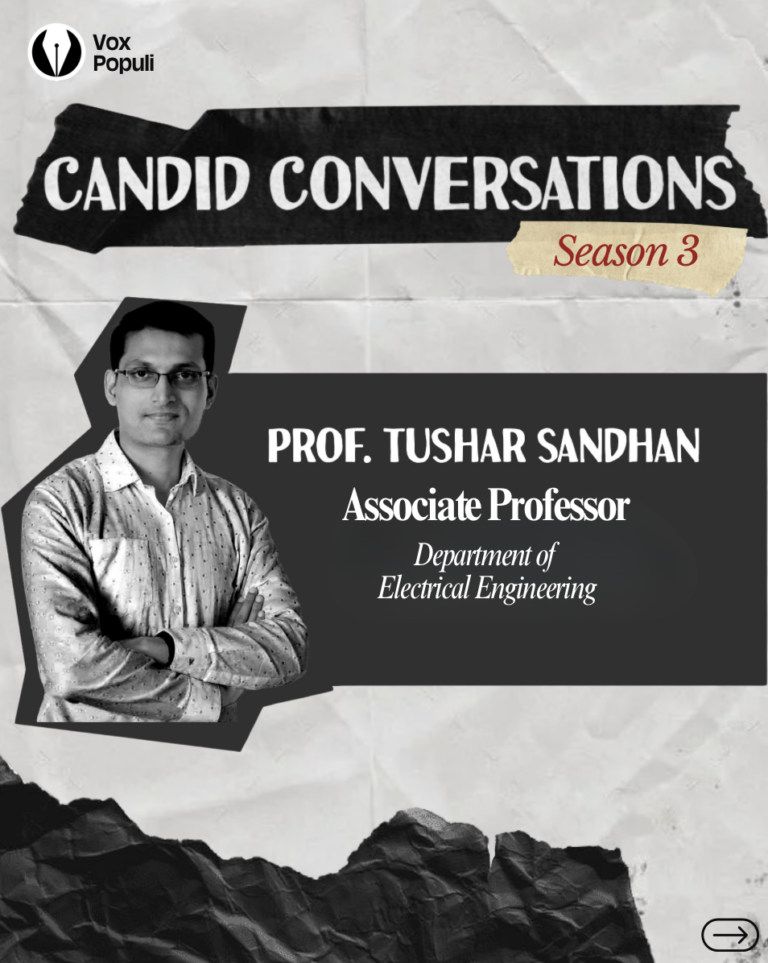
Vox is back with Season 2 of Candid Conversations with Professors @IITK, where our professors share their journeys, interests, and unfiltered insights into life at IITK and beyond.
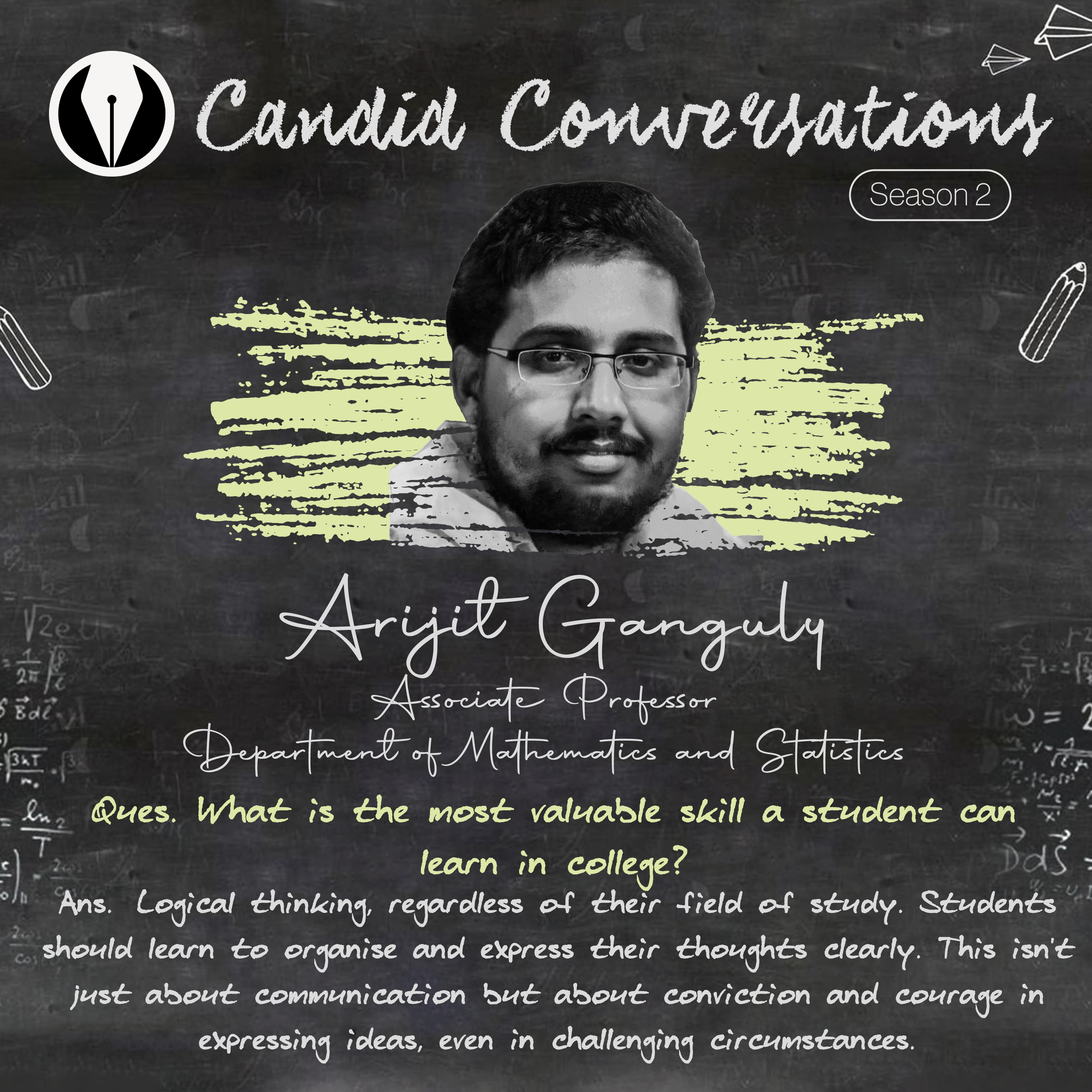
Join us in the 5th part of this season, with Professor Arijit Ganguly from the Department of Mathematics and Statistics, we explore his love for Test cricket matches, Hindustani Classical music, Captain Haddock from Tintin, and the airstrip. He is very passionate about teaching and always has the best interests of his students in mind. His academic journey is nothing short of inspiring. He completed his Postdoctoral Fellowship at Tel Aviv University, earned his PhD from the prestigious Tata Institute of Fundamental Research (TIFR), and began his scholarly pursuits with a BSc from the historic Presidency College in Kolkata. Read on for more!
What would you rather be if you were not a professor?
Frankly, I developed a strong passion for mathematics during my board exams and continued through XI, XII, and graduation. I loved discussing mathematics—and explaining it to friends, juniors, and students. I see it more as a discussion rather than traditional teaching. I enjoyed reading, learning, and discussing mathematics with people; it became a strong inclination. Because of this, I never really thought about pursuing anything else as a career.
That said, I was interested in unconventional things, like writing on social and cultural issues. But, coming from a middle-class family, there was always a sense of insecurity. Unlike someone from a wealthy background, say the child of a political leader who has financial stability and freedom to pursue any profession, I didn’t have that privilege. Being from a common background, I had to excel academically to ensure a stable future.
While I enjoyed writing, my love for mathematics grew stronger. During my adolescence, I also loved reading crime and detective stories—I was even fascinated by the idea of becoming a detective. But it was never something I seriously considered as a career.
How do you see today’s 20-year-olds?
To be honest, when I compare myself with today’s 20-year-olds, I find them much more intelligent and aware of the world around them. This is especially true at IIT Kanpur, a premier institute with students who show immense promise.
Today’s generation is definitely more intelligent, but at the same time, certain things they do are astonishing to us—maybe because of the generation gap or because we didn’t have that level of courage back then. I don’t mean to sound judgmental; it’s just an observation. Overall, I am quite optimistic about this younger generation.
What’s your favourite place on campus?
I have many. During summers, the heat here is tremendous and almost unbearable—a hostile climate. It’s challenging for people from Bengal or other less extreme regions than northern India. And then there’s the extreme cold in winter. I remember my first day here in 2019, on December 31, when the temperature dropped to 0°C. I was attending a DPGC meeting while staying in VH, and I had to cycle to the office. The weather was so harsh that I couldn’t cycle and had to walk that day.
In the summers, I used to love the airstrip. Although students are no longer allowed there, I fondly remember visiting it with PhD students. Another favourite spot is the area near Shivli Gate. However, due to a recent leopard sighting in that area, it’s not advisable to go there anymore!
What is your favourite food?
I’m from Bengal, so naturally, fish is one of my favourites. However, I’m not very rigid about food—I eat everything, both vegetarian and non-vegetarian, as long as it suits me and doesn’t cause any problems. Some of the hostels serve amazing food. My cook, on the other hand, isn’t that great. But of course, having home-cooked food is important, so I try to maintain a good balance between tasty food and home-cooked meals.
What are your hobbies, or how do you spend your free time?
I enjoy listening to music, especially Hindustani classical. Although I don’t know how to play any instrument, I have a strong inclination towards classical Indian dance and music. I also love reading literature. Unfortunately, I get very little time for these activities due to work pressure, even though I’d love to pursue them further.
Are you aware of any campus lingo?
I’ve heard a few terms. For instance, “maggu” refers to someone who crams the syllabus or “rattoo.” Then there’s “chaapu,” someone clever and intelligent who excels in all areas. “Bakait” refers to someone who loves to talk and indulge in “bakaiti” (playful banter or chatter). Hall 2 students seem proud of calling themselves bakaits—they’ve even written it on their ramp. I’ve judged two video-making competitions where the submissions used this term. Interestingly, when my cook takes leave or vacations, I often visit Hall 2 for meals, and I’ve seen the word “bakait” written quite a lot in many places.
What inspired you to get into academia?
It wasn’t due to any incentive. Even now, I have the same mindset. When you develop a passion at a young age, you hardly think about what you’ll gain from it. During my Class 12 years, I simply wanted to learn more mathematics—not for any material reward.
I came from a suburban background, and things were very different back then. In those days, people in the suburbs rarely studied in CBSE or ICSE boards. My school batch wasn’t exceptional, with most friends pursuing engineering and following the conventional path—completing BTech/BE and then landing a job. However, some of them returned to academia years later.
I knew that by the time I finished my academic journey, many of my friends would already be well-settled with stable jobs and incomes. Those incentives didn’t exist in academia, but I didn’t care. I didn’t even appear for JEE—I deliberately chose not to because my passion was purely for studying mathematics.
During your tenure, what changes have you observed at IIT Kanpur?
One major change has been the impact of the pandemic. I didn’t spend much time at IIT Kanpur pre-pandemic, as I joined in February 2019, and by March 2020, the lockdown began. The pandemic brought a lot of mourning—many lost loved ones, and it was a tough time for everyone.
However, students also took undue advantage of the situation. Without efficient modes of proctoring, some resorted to dishonest practices. We tried to convey to students that integrity matters, even when no one is watching. For example, if you come across an unattended shop, it doesn’t mean you should shoplift just because no one is monitoring you.
Academically, the post-pandemic batches have faced significant challenges. Many students completed their high school or undergraduate studies during the pandemic, which disrupted their foundational knowledge. For instance, I taught MTH 111 to the Y22 batch, and despite lenient grading and simplified exams, the overall performance was below par.
Another concerning trend is the normalisation of class bunking, exacerbated by the pandemic. This has caused a broader loss in academic discipline. India’s diversity makes it harder to instill a consistent code of ethics, but the pandemic’s impact on academic standards is undeniable.
What places do you want to travel to?
There are many places in India and abroad I’d like to visit. Recently, I went to Omkareshwar on the banks of the Narmada. Although it’s a holy site, I visited it for its scenic beauty rather than religious reasons. I’ve also been to Agra to see the Taj Mahal—it’s simply breathtaking—and to Khajuraho, which reflects India’s rich art and history.
Abroad– I’ve visited Nazareth in Israel. While it has religious significance, what struck me was the preservation of Renaissance-era art. The paintings, over 500 years old, were mesmerising and made me want to spend hours just admiring them.
I’m not particularly drawn to adventure tourism, but I’d love to explore places in the Himalayas, such as Kathgodam and Ranikhet. As a child, I visited the Char Dham, and regardless of their religious connotation, the grandeur of the Himalayas is unparalleled.
What challenges have you faced in your role as a professor?
Whenever I teach, I do so wholeheartedly without diluting the content, as I want to maintain a high standard for the students. Some may call me strict, but it’s my responsibility to uphold the legacy of this premier institution.
If we compromise on academic rigour, we risk losing the institution’s reputation, which takes generations to rebuild. For instance, giving grades generously without seriousness diminishes the value of those grades and harms the institution’s standing.
One significant challenge is normalising dishonest practices like cheating and impersonation, which were unimaginable during my student days. Students often focus on cramming and answering exams based on options rather than understanding concepts, which is a worrying trend.
The transition to IIT Kanpur can also be challenging for students. Being a star in school is different from joining a galaxy of stars here. Managing this transition while addressing these broader issues is a significant challenge.
What are your thoughts on admitting students to IIT Kanpur based on Olympiad scores, apart from IIT JEE?
Olympiad questions are often trick-based rather than foundation-based. While tricks have their place, disciplines cannot be reduced to intellectual gymnastics. Students excelling in Olympiads may struggle with foundational courses like MTH 101 because concepts require a different approach than tricks.
That said, the system should also recognise students with exceptional talent in specific subjects, even if they lack overall brilliance due to systemic educational shortcomings. This lateral entry system has pros and cons but is ultimately a positive step.
What are the rewards you’ve experienced in your profession?
For me, rewards lie in seeing students learn. I don’t see knowledge as something I own; it’s something I’ve gathered, refined with my thoughts, and passed on to students. Being part of a student’s learning journey, even briefly, is the greatest reward.
Course evaluations don’t feel like reliable rewards. Many students don’t attend classes regularly but still evaluate courses, sometimes based on leniency rather than depth. Rewards should reflect meaningful engagement, not popularity metrics.
What are some myths about professors that are untrue?
One common myth is that professors are inherently strict. I believe professors should be approachable, but with large class sizes, discipline becomes necessary to ensure fairness for diligent students.
Another myth revolves around attendance policies. While I support the principle of choice, data shows a strong positive correlation between low attendance and poor performance. This isn’t about enforcing authority but ensuring students don’t miss important announcements or don’t rely on their superpower to cram things one night before exams without attending classes.
What is the most valuable skill a student can learn in college?
Logical thinking, regardless of their field of study. Students should learn to organise and express their thoughts clearly. This isn’t just about communication but about conviction and courage in expressing ideas, even in challenging circumstances.
Who is your favourite character from a movie or anime?
My favourite character is Captain Haddock from Tintin. During my childhood, I frequented a district library and came across many fascinating books. Captain Haddock has remained my favourite since then, though I’m not entirely sure why.
How were you as a student in college?
Among my batch, including seniors and juniors, I stood out—not because of my intelligence but because of my keenness to learn and explore more. I was fortunate to have parents who supported my academic pursuits, which I consider a privilege.
However, I’ve faced challenges too. During my PhD, my father retired in 2015, and delayed post-retirement payments added pressure on me to take charge. Despite these difficulties, I stayed focused and eventually joined IIT Kanpur in 2019.
One of your favourite interactions with a student?
Oh, there are so many! I was the DUGC (Department Undergraduate Committee) chair for two years, which is like being an academic guardian for students. It’s a role where you provide academic advice, but you can’t do that well without really knowing the students—their strengths, weaknesses, and even sometimes talking to their parents.
I’ve had countless conversations, and while you can’t make everyone happy, I’ve always tried to guide students to the best of my ability, given the time and circumstances. There were times I had to take strict stances based on the situation, but whatever I’ve done has always been with the best intentions and understanding at that moment.
What are some things students do that confuse you?
Ah, bunking classes—that one always gets me. It’s become such a normalised thing. I’ve asked students why, and I get all kinds of excuses. One common one is: “Your class is in the morning; we can’t wake up early.” (Seriously?)
There was another instance where a course was divided into multiple batches. My batch attended my classes regularly but skipped others. When I asked why, they said, “We get the slides anyway, so what’s the point?” I tried reasoning with them: “Class isn’t just about slides; it’s about discussion and interaction.”
Then there’s the classic excuse: “We missed a few classes, and now we don’t understand anything, so we stopped coming.” I mean, really? That’s like saying, “I fell behind in a marathon, so I stopped running entirely.” It’s not rational!
The schedule is so jam-packed that rescheduling classes isn’t feasible. And then you have those freezing January mornings when professors show up on time for morning classes, only to find half the class missing. It’s frustrating but also a little funny.
Do you have any personal philosophy that drives you?
For me, honesty, hard work, and passion for your work have no substitutes. Short-term hard work might get you short-term results, but it can’t guarantee consistency. Consistent effort over the long run is what matters.
I like to give an analogy of cricket—test matches, not T20. Test matches require patience. There’s the first few hours of the day. Then, as the ball loses its polish, it gets harder to play. At that point, it’s not about hitting boundaries; it’s about saving your wickets. Life’s like that—it’s a long game. Consistency is key.
Would you like to give some life advice to students?
Do whatever you like—but first, figure out what you actually like. Many students join courses without knowing if they truly enjoy them. They choose based on rank, peer pressure, or other constraints. I’m not saying these factors shouldn’t matter—they’re part of reality—but blindly chasing them doesn’t help anyone.
Everyone wants placements; everyone’s chasing coding jobs. But going to such extremes isn’t good for anyone. Be honest with yourself. If you know what you like, pursue it sincerely.
I’ve been abroad for my postdoc and spent time in Israel. There, I noticed something fascinating. Although we had thoughtful debates on political ideologies that differed from one another, it is noteworthy that the Jewish community excelled in all fields of science and engineering. It’s not about religion; a value system plays in the background. It’s their clarity of purpose. They know what they like, and they pursue it wholeheartedly.
Contrast that with others: we spend years convincing ourselves that we like something, only to realise later that we’ve successfully fooled ourselves. Don’t do that. Be clear about what you like, follow your heart, and stick to it. Don’t try to convince yourself otherwise.
Interview and Transcription by: Ojas Bajpai, Zypher Ravi
Edited by: Sruthi Subramanian, Vedanshi Aggarwal
Design by: Abhinav Kumar, Arnav Gupta, Pankhuri Sachan