![[Not So] Little Women](https://voxiitk.com/wp-content/uploads/2026/09/WhatsApp-Image-2026-09-28-at-19.21.06-240x300.jpeg)


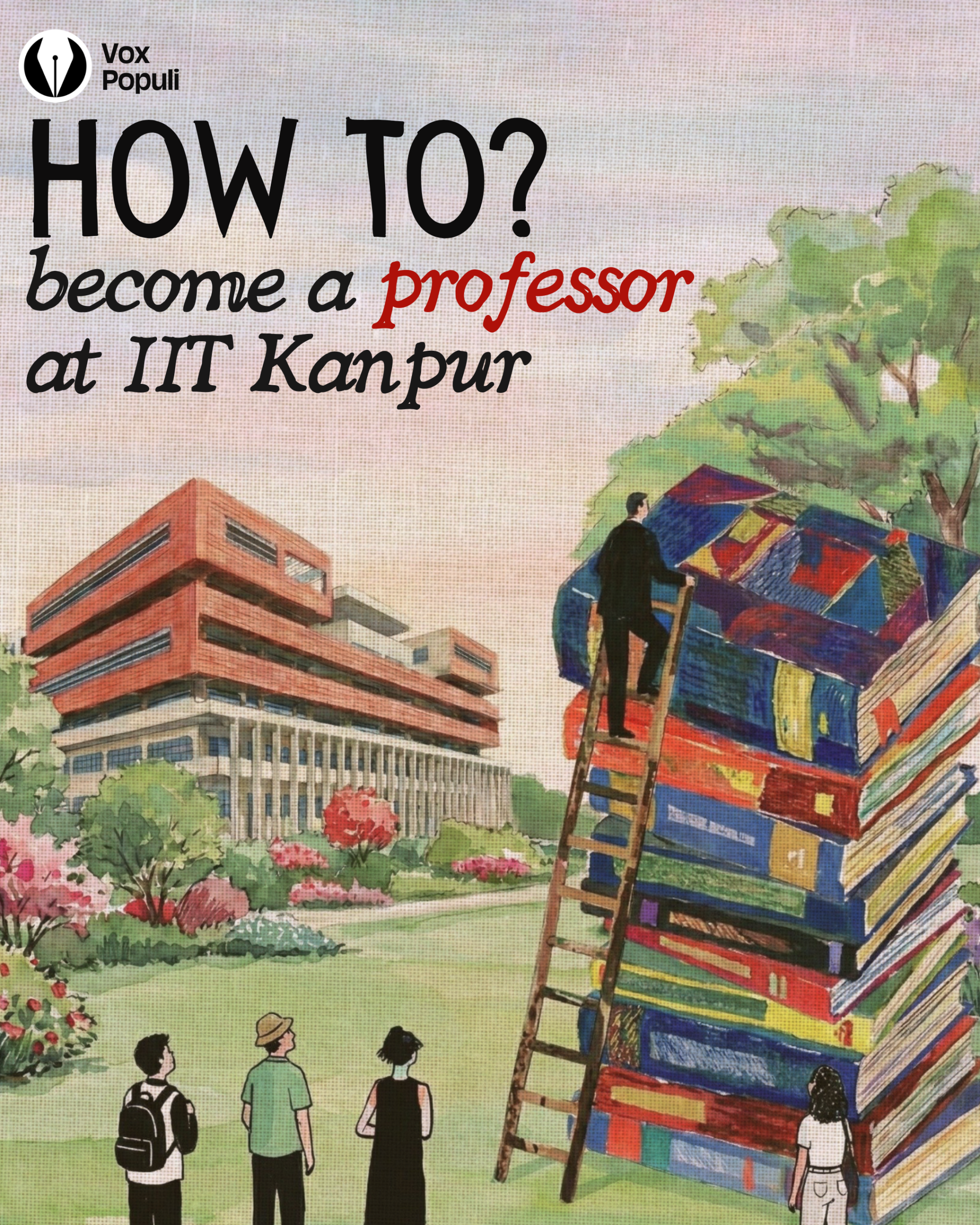
The title of ‘Professor at IIT Kanpur’ has long been a symbol of intellect, perseverance, and excellence. Many of us have wondered what it truly takes to reach that point. A closer look reveals that a significant number of these professors count IIT Kanpur as their alma mater, having once served as students, researchers, or teaching assistants within the same campus. While such returning scholars bring with them valuable institutional insight and continuity, their presence also raises questions about how open the system is to outside perspectives and new academic influences. To understand this dynamic, we at Vox decided to look closely at the recruitment processes through which the institute identifies and appoints its faculty.
How to become a professor?
The journey to becoming a faculty member at IIT Kanpur is a rigorous and merit-driven process. It begins with the academic profile. A PhD in a relevant field is the foundational requirement, but the institute seeks much more than formal qualifications. Candidates are expected to demonstrate high-quality research, a record of impactful publications, and the ability to pursue independent and innovative work. Postdoctoral experience, teaching exposure, and recognition through awards or funded projects further strengthen an application.
Applications are submitted through IIT Kanpur’s rolling portal, which allows candidates to apply throughout the year. This system provides flexibility and ensures that recruitment is responsive to departmental needs. Applicants can also express their interest in multiple departments if their research spans more than one area of focus.
Once submitted, applications are carefully reviewed at the departmental level. Committees comprising the Head of Department (HoD), senior faculty, and representatives from the Dean of Faculty Affairs (DoFA) examine each profile, weighing the relevance of expertise to departmental priorities, quality and impact of research publications and Post-PhD research contributions.
Shortlisted candidates are invited for the first round of interactions, which typically includes a Job Talk – a one-hour presentation of their research, followed by a Q&A session. This stage also evaluates communication skills, depth of knowledge, and ability to engage both specialists and non-specialists.
The feedback from the Job Talk and departmental discussions is then considered by the Department Faculty Affairs Committee (DFAC), which forwards recommendations to the Institute Faculty Affairs Committee (IFAC). It reviews candidates across departments to maintain consistent standards and ensure a balanced distribution of expertise throughout the institute. Even a strong candidate may not advance if their specialisation closely overlaps with that of existing faculty.
Finally, candidates recommended by IFAC meet the Selection Committee which is chaired by the Director and includes senior faculty and external experts. For senior appointments, nominees from the Academic Senate or the Board of Governors may also participate. This stage evaluates research vision, long-term academic plans, and fits with the institute’s broader goals.
While the institute’s stance isn’t written into policy, a widely observed rule of thumb evolved over the years, as mentioned by most professors from many departments, is that Ph.D. graduates of IITK must spend at least five years outside the institute before being considered for a faculty role. The idea is to ensure they gain broader exposure and new perspectives before returning.
While the overall recruitment framework remains uniform across the institute, individual departments often introduce subtle variations in their evaluation process and eligibility criteria.
Prof. Vimal Kumar from the Economic Sciences Department (ECO) mentioned that, unlike core disciplines, publications in Economics are less frequent due to the nature of the field and the limited number of journals considered reputed. Therefore, publication count is not the primary hiring criterion: a single publication in a top-tier journal is considered sufficient for entry-level positions.
Prof. Sayak R. C. from the Department of Computer Science and Engineering (CSE) explained that high-quality research is the central focus of faculty recruitment in the department. The selection committees, he said, place greater emphasis on the quality and impact of publications rather than their sheer number, which comes into play only as a tiebreaker when candidates are otherwise evenly matched.
When it comes to hiring alumni, Prof. Sayak noted that only those who have demonstrated exceptional academic or research achievements are considered. “There are three such faculty members in our department, all of whom are extremely accomplished and widely recognized in their fields,” he said.
Unlike some other departments, CSE conducts only a job talk during the selection process, where candidates present their research before faculty members. Departments like Mathematics and Statistics (MTH), he mentioned, often include a Teaching Talk as well, to assess how effectively a candidate can communicate and engage with an audience.
Research productivity continues to hold the highest weightage in CSE’s evaluation process. New faculty are given a cushion in terms of teaching and can take a break from teaching in the first semester they join, and then from the second semester, design their own course at PG/PhD level/DE, then only shift to core courses. “This approach allows new hires to gain confidence and teaching experience gradually,” Prof. Sayak added.
Prof. Amitabha Bandopadhyay, from the Biological Sciences and Bioengineering (BSBE) department, explained that applications are primarily shortlisted in their department based on a candidate’s overall academic trajectory rather than marks alone. Greater weight is given to the quality of the PhD research, the significance of published papers, and postdoctoral research productivity. In some cases, applications are also shared with external experts working in similar domains to ensure a fair and informed evaluation.
A faculty member is recruited for the potential of what they will bring to the academics of the Institute. The credentials are evidence of technical capabilities, but the future plan is what is evaluated most critically, as that’s the proposed deliverables of the candidate.
He noted that a candidate’s chances improve significantly if their research aligns with the department’s current areas of interest. “Relevance plays a big role,” he said. “If the department is actively exploring a certain field, a strong candidate in that area naturally stands out.”
He also emphasised that a professor’s responsibilities extend well beyond research and teaching. Administrative contributions form an integral part of the role. “Evaluating how a candidate will fit into all three aspects, research, teaching, and administration, is crucial during the hiring process,” he added.
Prof. Mini Chandran from the Humanities and Social Sciences (HSS) department mentioned that consistent academic performance and at least two publications in international journals are essential criteria for shortlisting candidates. The selection process involves several committee meetings before a final decision is made. She further added that teaching engineering undergraduate students is not easy for HSS instructors. They have to remember that the students are not specialising in subjects like Literature or Psychology, so the challenge is to capture and sustain their interest.
Thus, we can observe that each department caters to its needs differently. To gain insights into the fact that many professors are alumni, we analysed faculty across some departments to quantify our observations.
Statistics
Across IIT Kanpur’s departments, the presence of IIT graduates varies widely, but a distinct pattern stands out in the core engineering disciplines. These departments tend to have a strong concentration of faculty who have completed at least part of their education within the IIT system at the Bachelor’s, Master’s, or PhD level.
In the Department of Computer Science and Engineering (CSE), 51% of the faculty are IIT graduates, and about 16% specifically studied at IIT Kanpur. The numbers rise sharply in the Department of Electrical Engineering (EE) and the Department of Civil Engineering (CE), where around 77% and 64% of professors hold degrees from IITs. Of these, 22% in EE and 28% in CE had previously studied at IITK.
Some departments are even more IIT-heavy. In the Department of Chemical Engineering (CHE), four out of five professors, i.e. 80% are IIT graduates, with 27% from IIT Kanpur. The Department of Mechanical Engineering (ME) shows a similar pattern: 56% of its faculty have an IIT background, including 17% from IITK. In the Department of Materials Science and Engineering (MSE), 55% of professors come from IITs and 28% from IITK. The Department of Aerospace Engineering (AE) is comparable, with 66% of faculty as IIT graduates and 33% as IITK alumni.
Outside the core engineering cluster, the picture changes. The Department of Mathematics and Statistics (MTH) has nine professors who studied at IIT Kanpur, but several other departments show much lighter representation. In the Department of Chemistry (CHM), only 1 out of 39 faculty members holds a degree from IITK, and just 11 have any IIT background. Departments such as the Department of Physics (PHY) (27%), the Department of Biological Sciences and Bioengineering (BSBE) (26%), and the Department of Humanities and Social Sciences (HSS) (34%) have modest IIT presence with typically one or two IITK alumni.
In some areas, IIT graduates are present but none are from IIT Kanpur. The Department of Economic Sciences (ECO) and the Department of Earth Sciences (ES) both have six IIT-educated faculty members, but neither department includes an IITK alumnus.
Management and newer interdisciplinary programs show a mix. In the Department of Management Sciences (DoMS), 45% of the 28 professors studied at an IIT, including two from IITK. And in the relatively young Department of Sustainable Energy Engineering (SEE), 12 out of 16 faculty members are IIT graduates, three of whom previously studied at IIT Kanpur.
Academic Inbreeding
In academia, hiring of faculty who earned their degrees from the same institute is referred to as “academic inbreeding”, sometimes called intellectual inbreeding. Critics argue that faculty shaped by the same mentors and methods often end up sharing similar approaches and even the same blind spots. This narrows the range of ideas, theories, and research directions that shape classrooms and labs. In contrast, universities that attract people from different academic ecosystems tend to foster more innovation.
Although IIT Kanpur does not have a formal rule against hiring its own graduates, a strong cultural norm has developed here that discourages academic inbreeding by expecting the PhD graduates at IITK to spend some amount of time outside the institute before being considered for faculty roles. This practice ensures that those who eventually return bring exposure to different research environments, new collaborations, and broader perspectives.
Prof. Veena Bansal (DoMS) highlighted:
“Rule or no rule, it doesn’t really impact IITK. What matters is the fairness and rigor of the hiring process. IITK is built on trust. If a candidate is truly worthy, it doesn’t matter where they graduated from.”
She added that the system has little room for bias:
“You cannot say for any student or faculty that they’re here because of favoritism. Everyone goes through a fair, transparent process.”
Prof. Pranamesh Chakraborty (CE) noted that being an alumnus offered no advantage during his faculty application:
“When I applied, I knew that we were all treated the same and there was no partiality. The other thing is that I knew the institute well when I came back, but as an applicant, all candidates are treated the same way with their applications.”
Other faculty echoed similar views. Prof. Neeraj Misra (MTH) believes this unwritten rule is one of the institute’s quiet strengths:
“The recruitment of IIT Kanpur Ph.D. graduates as faculty members at IIT Kanpur is generally challenging because most departments follow an informal ‘cooling-off’ period of approximately five years. ”
The high bar for internal hires, in fact, is not unique to IITK but common across the older IITs. Prof. Ketan Rajawat (EE) noted that:
“It might be difficult to get selected as a professor in another old IIT right after finishing a PhD from IITK (or any IIT). Typically, most IITs look for five to ten papers in top-tier journals in addition to a near-perfect resume, which is very rare among IIT PhD students. It might be possible to get a faculty position at a new IIT/IIIT/IISER/NIT immediately after a PhD, if one has a few good papers. It is far more common for students to first do a post-doc to enhance their profile and then apply, to ensure better chances.”
Despite this overall discouragement of direct PhD hires, when it happens, it’s almost always because the candidate has demonstrated extraordinary achievement. For instance, in the CSE department, only three current faculty members earned their PhDs at IITK, and all three are widely respected researchers. Their presence reflects that when IIT Kanpur hires from within, it is strictly merit-driven.
Conclusion
Looking at the numbers and listening to professors across departments, one thing becomes clear: IITK’s hiring isn’t driven by where someone studied, but by what they’ve done. Although a fair number of faculty members come from the IIT system, and a smaller group from IITK itself, the road back to this campus is anything but easy. Every department runs candidates through a tough, transparent process that focuses on the strength of their research, their teaching promise, and the direction they want to take their work.
As Prof. Veena Bansal put it simply:
“What matters most is that the hiring process is fair and rigorous.”
And that seems to be the sentiment shared widely. The few IITK graduates who do return have usually spent years outside, built strong research profiles, and come back only after proving themselves in a bigger academic world.
Written and Researched by: Zainab Fatima, Kushagra Srivastava, Maharaajan, Aashika Gupta, Adiba Khan, Vibha Narayan, Diya M, Pailla Lavanya, A Shri Vaishnavi, Sanket Bansal, Archit Rahalkar, Aarzoo Yadav, Akash Baudh, Anandan Iyer, Riddhi Shingte
Design by: Pankhuri Sachan, Pragya Puri, Abhinav Kumar Chaudhary
Edited by: Sruthi Subramanian, Himanshu Mahale

![[Not So] Little Women](https://voxiitk.com/wp-content/uploads/2026/09/WhatsApp-Image-2026-09-28-at-19.21.06-768x960.jpeg)